Cornus controversa
Hemsl. ex Prain
Giant dogwood, Table dogwood, Tabletop dogwood
(c) WATANABE Hitoshi 渡辺仁, some rights reserved (CC BY), uploaded by WATANABE Hitoshi 渡辺仁

(c) Marco Mussita, some rights reserved (CC BY), uploaded by Marco Mussita
(c) Yury O. Kopylov-Guskov, some rights reserved (CC BY-NC), uploaded by Yury O. Kopylov-Guskov
What to Eat
Edible parts: Fruit, Sap
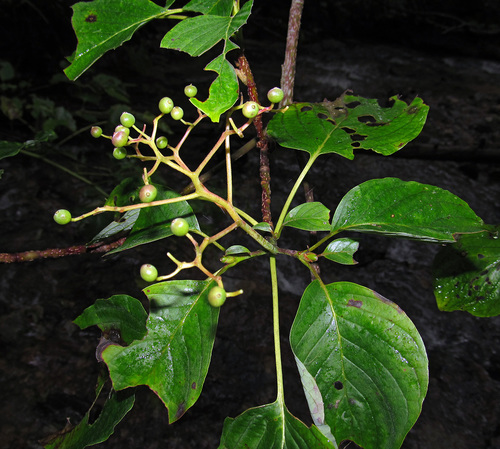
The fruit, about 6mm in diameter, is edible, though no further details are given. The fruit also yields an oil.
Where to Find It
It is a temperate plant. It is native to East Asia. It does best in light to medium, well-drained soils. It needs an open sunny position. It is resistant to frost but sensitive to drought. It suits hardiness zones 5-8. Burnie Rhodo garden. Arboretum Tasmania.
Asia, Australia, Bhutan, Canada, China*, Himalayas, India, Japan*, Korea, Myanmar, Nepal, North America, SE Asia, Taiwan, Tasmania,
How to Identify
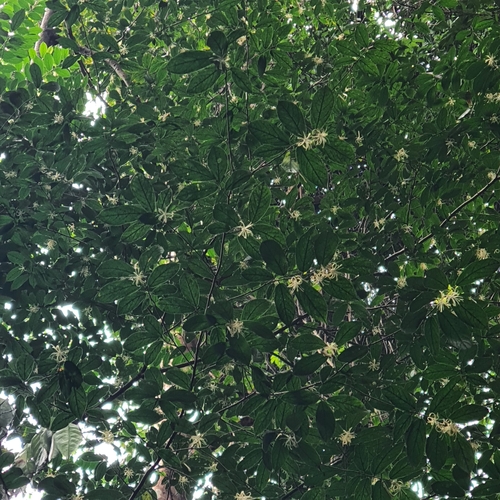
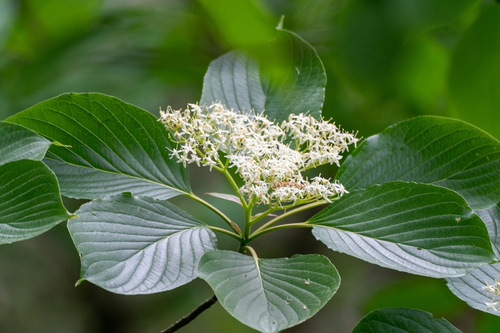
A tree. It grows to 12 m tall. It has a straight trunk with branches in tiers. It loses its leaves during the year. The leaves are dark green. They turn purple in autumn. The leaves are glossy and strongly veined. They are arranged alternately on the red twigs. The flowers occur in flat clusters. They are white and about 10 cm across. The fruit are bluish-black. They are shiny.
How to Grow
An easily grown plant, it succeeds in any soil of good or moderate fertility, ranging from acid to shallow chalk. Grows well in heavy clay soils. Succeeds in full sun or light shade. A very ornamental plant, it is hardy to about -20°c. This species is unusual in having alternate leaves whilst almost all other members of this genus have opposite leaves. Closely related to C. alternifolia. Plants in this genus are notably resistant to honey fungus.
Propagation: Seed is best sown as soon as it is ripe, either in a cold frame or an outdoor seedbed if there is sufficient seed. The seed must be separated from the fruit flesh, which contains germination inhibitors. Stored seed should be cold stratified for 3–4 months and sown as early in the year as possible. Scarification may help, as may a period of warm stratification before the cold stratification. Germination — particularly of stored seed — can be very slow, taking 18 months or more. Prick out cold-frame seedlings into individual pots once large enough to handle and grow on through their first winter in a greenhouse, planting out in spring after the last expected frosts. Take half-ripe side-shoot cuttings in July or August in a frame, or cuttings of mature wood from the current year's growth taken with a heel if possible in autumn in a cold frame — a high percentage will take. New growth can also be layered in June or July, taking about 9 months.
Medicinal Uses
The leaves are used in folk remedies to relieve pain and reduce swelling.
Other Uses
An oil extracted from the fruit is used in the lubricating and soap industries.
Wikipedia
Source ↗Cornus controversa (wedding cake tree), syn. Swida controversa, is a species of flowering plant in the dogwood family Cornaceae. It is native to China, Korea, the Himalayas and Japan. It is a deciduous tree growing to 50 ft (15 m), with multiple tiered branches. Flat panicles of white flowers (cymes to 3–7 in (8–18 cm) wide) appear in summer, followed by globose black fruit (drupes to 1⁄2 in (13 mm)). Ovate dark green leaves (3–6 in (8–15 cm) long) are glaucous underneath and turn red-purple in autumn. It is cultivated in gardens and parks in temperate regions. It is also sometimes referred to as Bothrocaryum controversum (Hemsl.) Pojark when seeds are offered for online sale. The variety C. controversa 'Variegata' has leaves with cream margins, which turn yellow in autumn, and grows to a lesser size than its parent – typically 25 ft (8 m). It has gained the Royal Horticultural Society's Award of Garden Merit.
Notes
There are about 45 Cornus species. The fruit is used for oil for folk medicine.
Names & Synonyms
Cheungcheungnamu, Deng tai shu
References (14)
- Bodkin, F., 1991, Encyclopedia Botanica. Cornstalk publishing, p 282
- Bot. Mag. 125: ad. t. 8261. 1909 Jun (W. B. Hemsley, Bull. Misc. Inform. Kew 1909:331. 1909 Oct)
- Brickell, C. (Ed.), 1999, The Royal Horticultural Society A-Z Encyclopedia of Garden Plants. Convent Garden Books. p 298
- Coombes, A.J., 2000, Trees. Dorling Kindersley Handbooks. p 134
- Cundall, P., (ed.), 2004, Gardening Australia: flora: the gardener's bible. ABC Books. p 415
- Etherington, K., & Imwold, D., (Eds), 2001, Botanica's Trees & Shrubs. The illustrated A-Z of over 8500 trees and shrubs. Random House, Australia. p 227
- GUPTA,
- Joyce, D., 1998, The Garden Plant Selector. Ryland, Peters and Small. p 109
- Kim, H. & Song, M., 2013, Ethnobotanical analysis for traditional knowledge of wild edible plants in North Jeolla Province (Korea). Genetic. Resour. Crop Evol. (2013) 60:1571-1585
- Xiang Qiuyun; David E. Boufford, CORNACEAE [Draft], Flora of China
- Plants for a Future database, The Field, Penpol, Lostwithiel, Cornwall, PL22 0NG, UK. http://www.scs.leeds.ac.uk/pfaf/
- Ryan, S., 2008, Dicksonia. Rare Plants Manual. Hyland House. p 16
- Seeram, N. P., et al, 2002, Characterization, Quantification and Bioactivities of Anthocynans in Cornus Species. Journal of Agricultural and Food Chemistry. 50:2519-2523
- Young, J., (Ed.), 2001, Botanica's Pocket Trees and Shrubs. Random House. p 271