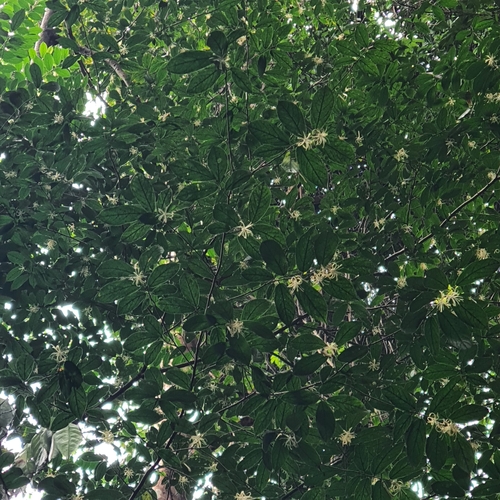
Cornus hongkongensis
Hemsl.
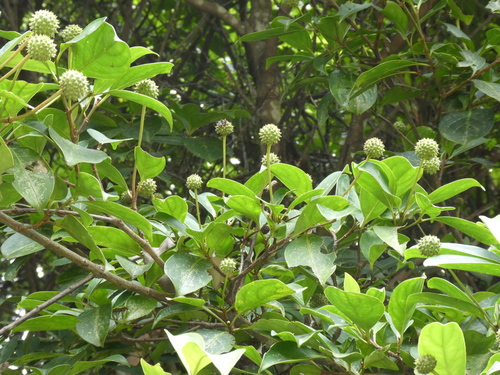
(c) Aaron Liston, some rights reserved (CC BY), uploaded by Aaron Liston

(c) MP Zhou, some rights reserved (CC BY-NC), uploaded by MP Zhou
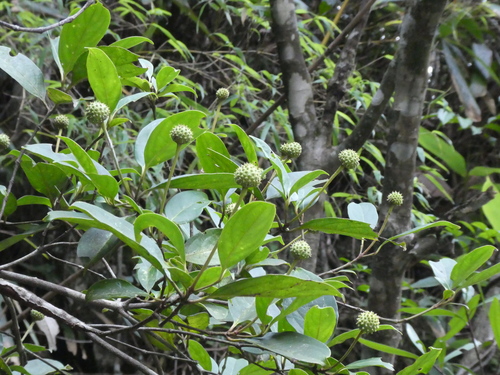
(c) Aaron Liston, some rights reserved (CC BY), uploaded by Aaron Liston
What to Eat
Edible parts: Fruit
The fruit can be eaten raw and used for making wine. In some forms it is sweet and tasty. The subspecies C. hongkongensis ferruginea has been particularly noted for its quality.
Where to Find It
It is a temperate plant. It grows in evergreen broad-leaved forests between 600-1800 m altitude in China. In Sichuan and Yunnan.
Asia, China, Indochina, Laos, SE Asia, Vietnam,
How to Identify
An evergreen shrub or tree. It grows 5-15 m high. The young branches have short brown hairs. The leaves are opposite and thickly leathery. They are narrowly oval and 6-12 cm long by 3-6 cm wide. They taper to the tip. The flowers are yellow and in crowded heads. There are 4 white bracts around the flowers. The fruit is round and yellow or red. They are on stalks 4-10 cm long.
How to Grow
We have very little information on this species and do not know if it will be hardy in Britain, though it is likely to succeed out of doors at least in the milder areas of the country. A very variable species, it is sometimes divided up into a number of closely related but distinct species. The following notes are based on the general needs of the genus. An easily grown plant, it succeeds in any soil of good or moderate fertility, ranging from acid to shallow chalk. Grows well in heavy clay soils. Succeeds in full sun or light shade. Plants in this genus are notably resistant to honey fungus.
Propagation: Seed is best sown as soon as it is ripe, either in a cold frame or an outdoor seedbed if sufficient seed is available. The seed must be separated from the fruit flesh, which contains germination inhibitors. Stored seed should be cold stratified for 3–4 months and sown as early in the year as possible. Scarification may also help, as may a period of warm stratification before the cold stratification. Germination, especially of stored seed, can be very slow, taking 18 months or more. Prick out cold-frame seedlings into individual pots once large enough to handle, grow on through their first winter under glass, and plant out in spring after the last expected frosts. Cuttings of half-ripe side shoots can be taken in July/August in a frame. Cuttings of mature wood of the current year's growth, taken with a heel if possible, can be taken in autumn in a cold frame, with a high success rate. Layering of new growth in June/July takes around 9 months to root.
Medicinal Uses
None known.
Other Uses
The hard wood is used as a building material and for making agricultural implements.
Wikipedia
Source ↗Cornus hongkongensis (sometimes called Benthamidia hongkongensis, Dendrobenthamia hongkongensis, or Hong Kong dogwood) is a species of evergreen dogwood in the family Cornaceae. It is native to China, Laos, and Vietnam. It grows to 15 meters in height and blooms in late spring to early summer, exhibiting an abundance of fragrant flowers. Because this species of dogwood also exhibits a range of minor differences in morphology due largely to geographic distribution, it has been divided into a number of subspecies. It has been described as an excellent ornamental tree species.
Notes
There are about 45 Cornus species.
Names & Synonyms
Shan Lung Ngan, Xiang gang si zao hua
References (8)
- Altschul, S.V.R., 1973, Drugs and Foods from Little-known Plants. Notes in Harvard University Herbaria. Harvard Univ. Press. Massachusetts. no. 3168
- F. B. Forbes & W. B. Hemsley, J. Linn. Soc., Bot. 23:345. 1888
- Hu, Shiu-ying, 2005, Food Plants of China. The Chinese University Press. p 607
- Luo, B., et al, 2019, Wild edible plants collected by Hani from terraced rice paddy agroecosystem in Honghe Prefecture, Yunnan, China. Journal of Ethnobiology and Ethnomedicine 15:56 (As Dendrobenthamia hongkongensis)
- Plants for a Future database, The Field, Penpol, Lostwithiel, Cornwall, PL22 0NG, UK. http://www.scs.leeds.ac.uk/pfaf/
- Reis, S. V. and Lipp, F. L., 1982, New Plant Sources for Drugs and Foods from the New York Botanical Garden herbarium. Harvard. p 225
- World Checklist of Useful Plant Species 2020. Royal Botanic Gardens, Kew
- Xiang Qiuyun; David E. Boufford, CORNACEAE [Draft], Flora of China and Flora of China. www.eFloras.org