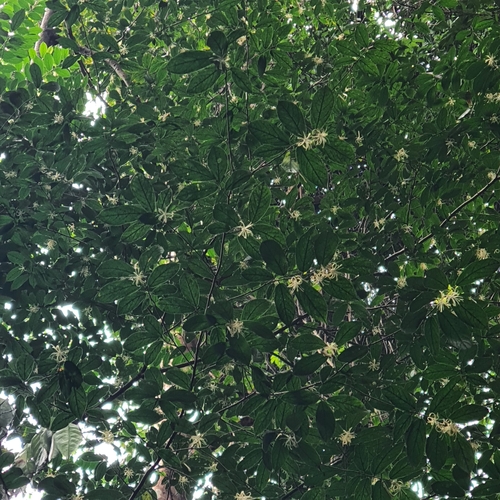
Cornus kousa
Buerger. ex Hance
Szechuan strawberry, Japanese Dogwood

(c) Σ64, some rights reserved (CC BY)
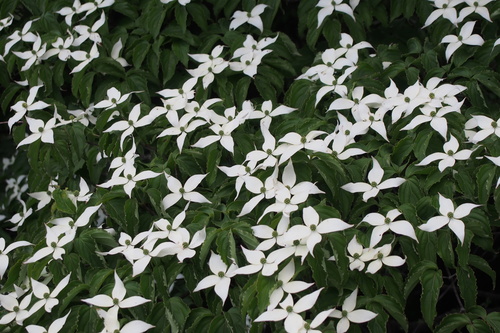
(c) harum.koh, some rights reserved (CC BY-SA), uploaded by harum.koh
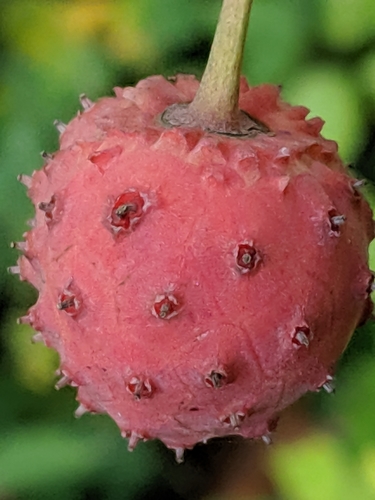
(c) Sue Zucker-Scharff, some rights reserved (CC BY-NC), uploaded by Sue Zucker-Scharff
What to Eat
Edible parts: Fruit, Leaves, Flowers
The fruit can be eaten raw or cooked. It is sweet and juicy, very pleasant in small quantities, though quite seedy. The skin is rather tough and unpleasant, but the pulp is delicious with a custard-like texture, making it an excellent late-summer fruit. The fruit is about 2cm in diameter. Young leaves can be eaten cooked.
Where to Find It
It is a temperate plant. It is native to Japan. It is frost hardy. It grows from 400 to 2200 m in China. It will grow in most soils. It is damaged by drought. It grows on low hills near the coast. It suits hardiness zones 5-8. In Arboretum Tasmania. National Arboretum Canberra.
Asia, Australia, Bhutan, Canada, China, Hawaii, Himalayas, India, Japan*, Korea*, North America, Northeastern India, Sikkim, Taiwan, Tasmania, USA,
How to Identify
A shrub or small tree. It grows 3-6 m tall and spreads 2.7-4.5 m wide. The branches spread out in tiers. The leaves are deep green. They are 5-10 cm long and oval. They have 4-6 pairs of veins. The upper surface is dark green and underneath there are hairs in tufts in the vein axils. The leaves colour in the autumn. The flowers are small and occur in clusters in 5 cm long stalks. They have large white bracts around them. Each bract tapers to a point. The bracts are 5 cm long. These last for 6 weeks. The fruit are strawberry-like. They are dull red. They are edible.
How to Grow
An easily grown plant, it succeeds in any soil of good or moderate fertility, from acid to slightly alkaline but dislikes shallow chalky soils. Grows well in heavy clay soils. Prefers a rich well-drained loamy soil and a position that is at least partially sunny. A very ornamental plant, it is hardy to about -20°c. A number of named forms have been developed for their ornamental value. Plants are slow-growing when young, they speed up somewhat after a few years but then soon slow down again. The sub-species of C. kousa chinensis grows more freely, flowering and fruiting better in Britain though it barely differs in appearance from the species. This species has been known to hybridize with C. capitata. The cultivar 'Norman Hadden' could be such a hybrid. Plants in this genus are notably resistant to honey fungus.
Propagation: Seed is best sown as soon as it is ripe, either in a cold frame or an outdoor seedbed if sufficient seed is available. The seed must be separated from the fruit flesh, which contains germination inhibitors. Stored seed should be cold stratified for 3–4 months and sown as early in the year as possible. Scarification may also help, as may a period of warm stratification before the cold stratification. Germination, especially of stored seed, can be very slow, taking 18 months or more. Prick out cold-frame seedlings into individual pots once large enough to handle, grow on through their first winter under glass, and plant out in spring after the last expected frosts. Cuttings of half-ripe side shoots can be taken in July/August in a frame. Cuttings of mature wood of the current year's growth, taken with a heel if possible, can be taken in autumn in a cold frame, with a high success rate. Layering of new growth in June/July takes around 9 months to root.
Medicinal Uses
None known.
Other Uses
The wood is very hard and heavy, and is used for mallets and similar items.
Wikipedia
Source ↗Cornus kousa is a small deciduous tree 8–12 m (26–39 ft) tall, in the flowering plant family Cornaceae. Common names include kousa, kousa dogwood, Chinese dogwood, Korean dogwood, and Japanese dogwood. Synonyms are Benthamia kousa and Cynoxylon kousa. It is a plant native to East Asia including Korea, China and Japan. Widely cultivated as an ornamental, it is naturalized in the state of New York.
Other Information
It is occasionally cultivated as a fruit crop.
Notes
There are about 45 Cornus species.
Names & Synonyms
Dong yin si zao hua, Japanese strawberry tree, Kousa, Santtalnamu, Shizao, Shizaozi, Yamaboshi, Yelizhi
References (22)
- Bodkin, F., 1991, Encyclopedia Botanica. Cornstalk publishing, p 282
- Brickell, C. (Ed.), 1999, The Royal Horticultural Society A-Z Encyclopedia of Garden Plants. Convent Garden Books. p 299
- Chen, B. & Qiu, Z., Consumer's Attitudes towards Edible Wild Plants, Ishikawa Prefecture, Japan. p 22 www.hindawi.com/journals/ijfr/aip/872413.pdf (As Benthamidia japonica)
- Coombes, A.J., 2000, Trees. Dorling Kindersley Handbooks. p 136
- Cundall, P., (ed.), 2004, Gardening Australia: flora: the gardener's bible. ABC Books. p 416
- Etherington, K., & Imwold, D., (Eds), 2001, Botanica's Trees & Shrubs. The illustrated A-Z of over 8500 trees and shrubs. Random House, Australia. p 228
- Facciola, S., 1998, Cornucopia 2: a Source Book of Edible Plants. Kampong Publications, p 81
- Farrar, J.L., 1995, Trees of the Northern United States and Canada. Iowa State University press/Ames p 186
- Hanelt, P. et al, (Eds.), 2001, Mansfield's encyclopedia of agricultural and horticultural crops. p 1677
- Hu, Shiu-ying, 2005, Food Plants of China. The Chinese University Press. p 608
- J. Linn. Soc., Bot. 13:105. 1873
- John, L., & Stevenson, V., 1979, The Complete Book of Fruit. Angus & Robertson p 118
- Joyce, D., 1998, The Garden Plant Selector. Ryland, Peters and Small. p 133
- Kang, Y., et al, 2012, Wild food plants and wild edible fungi in two valleys on the Qinling Mountains (Shaanxi, central China) Journal of Ethnobiology and Ethnomedicine; 9:26
- Lord, E.E., & Willis, J.H., 1999, Shrubs and Trees for Australian gardens. Lothian. p 218
- Lyle, S., 2006, Discovering fruit and nuts. Land Links. p 156
- Plants for a Future database, The Field, Penpol, Lostwithiel, Cornwall, PL22 0NG, UK. http://www.scs.leeds.ac.uk/pfaf/
- Seeram, N. P., et al, 2002, Characterization, Quantification and Bioactivities of Anthocynans in Cornus Species. Journal of Agricultural and Food Chemistry. 50:2519-2523
- Song, M., et al, 2013, Traditional knowledge of wild edible plants in Jeju Island, Korea. Indian Journal of Traditional Knowledge. 12(2) pp 177-194
- Tanaka,
- Xiang Qiuyun; David E. Boufford, CORNACEAE [Draft], Flora of China
- Young, J., (Ed.), 2001, Botanica's Pocket Trees and Shrubs. Random House. p 272