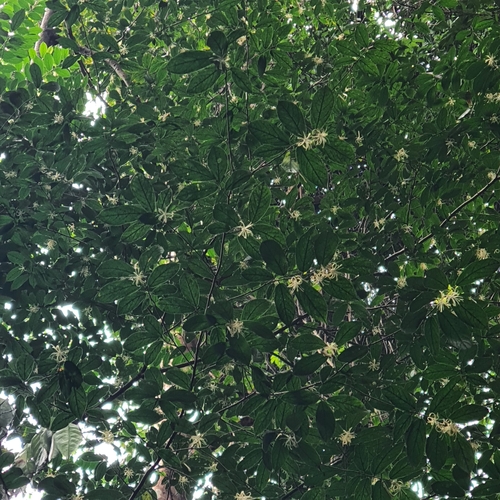
Cornus kousa subsp. chinensis
Osborn.
Japanese dogwood, Four-shining flower, Chinese dogwood

GBIF

GBIF

GBIF
What to Eat
Edible parts: Fruit, Leaves
C. kousa has edible berries. The soft pulp is sweet with a similar flavour to a ripe persimmon but the presence of hard seeds that are well attached to the pulp can be inconvenient when eaten directly. The rind of the berries is usually discarded because it has a bitter taste, although it is edible. The seeds are usually not eaten, but could be ground into jam and sauces. While less popular than the berries, young leaves can also be consumed.
Where to Find It
It is a temperate plant. It grows between 400 and 2200 m altitude in China. It suits hardiness zones 5-8. Arboretum Tasmania. Hobart Botanical Gardens. In Sichuan and Yunnan.
Asia, Australia, Britain, Canada, China, Europe, Japan, North America, Tasmania, USA,
How to Identify
A small deciduous tree. It grows 4 m tall. The branches are in flat layers. They are hairy. The hairs are white. The leaves are narrowly oval and 5-12 cm long by 3-7 cm wide. It has four white bracts around each flower. The flowers are creamy-white. The fruit are red. They are 2.5 cm across. They hang on slender stalks 7-8 cm long.
Wikipedia
Source ↗Cornus kousa is a small deciduous tree 8–12 m (26–39 ft) tall, in the flowering plant family Cornaceae. Common names include kousa, kousa dogwood, Chinese dogwood, Korean dogwood, and Japanese dogwood. Synonyms are Benthamia kousa and Cynoxylon kousa. It is a plant native to East Asia including Korea, China and Japan. Widely cultivated as an ornamental, it is naturalized in the state of New York.
Notes
There are about 45 Cornus species.
Names & Synonyms
Si zao hua
References (9)
- Altschul, S.V.R., 1973, Drugs and Foods from Little-known Plants. Notes in Harvard University Herbaria. Harvard Univ. Press. Massachusetts. no. 3169
- Cundall, P., (ed.), 2004, Gardening Australia: flora: the gardener's bible. ABC Books. p 416
- Flowerdew, B., 2000, Complete Fruit Book. Kyle Cathie Ltd., London. p 176
- Hu, Shiu-ying, 2005, Food Plants of China. The Chinese University Press. p 608
- Plants for a Future database, The Field, Penpol, Lostwithiel, Cornwall, PL22 0NG, UK. http://www.scs.leeds.ac.uk/pfaf/
- Ryan, S., 2008, Dicksonia. Rare Plants Manual. Hyland House. p 17
- Valder, P., 1999, The Garden Plants of China. Florilegium. p 276
- Wang, J., et al, 2020, An ethnobotanical survey of wild edible plants used by the Yi people of Liangshan Prefecture, Sichuan Province, China. Journal of Ethnobiology and Ethnomedicine 16:10 p 7
- Xiang Qiuyun; David E. Boufford, CORNACEAE [Draft], Flora of China, Vol. 14 p 220 and Flora of China. www.eFloras.org