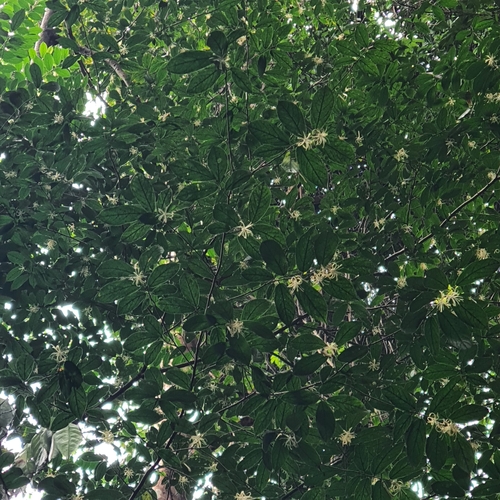
Cornus macrophylla
Wall.
Large-leaf dogwood
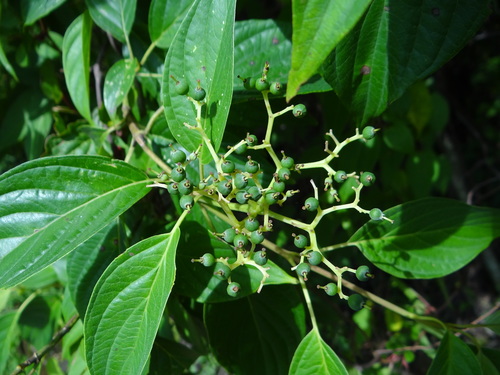
(c) 呂一起(Lu i-chi), some rights reserved (CC BY), uploaded by 呂一起(Lu i-chi)
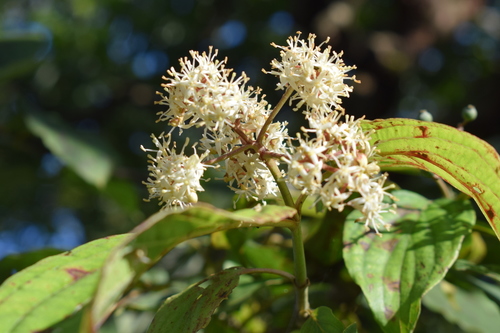
(c) Aniruddha Singhamahapatra, some rights reserved (CC BY-NC), uploaded by Aniruddha Singhamahapatra
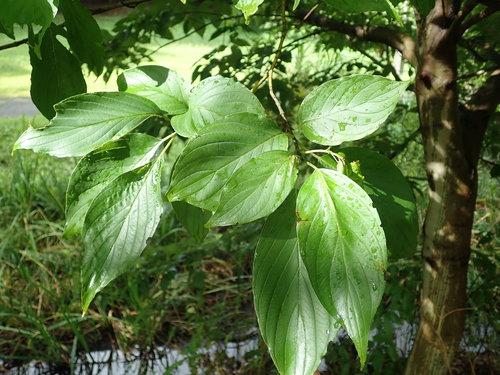
(c) Yoshihiro Tokue, some rights reserved (CC BY), uploaded by Yoshihiro Tokue
What to Eat
Edible parts: Fruit, Leaves, Seeds - oil
The fruit can be eaten raw or cooked. It is about 6mm in diameter.
Where to Find It
It is a temperate plant. It is native to China, Japan and the Himalayas. In the Himalayas it grows between 1,500-2,700 m altitude. It suits hardiness zones 6-9. In Sichuan and Yunnan.
Afghanistan, Asia, Australia, Bhutan, China, Himalayas, India, Indochina, Japan, Korea, Myanmar, Nepal, Northeastern India, Pakistan, SE Asia, Taiwan, Tibet,
How to Identify
A deciduous tree. It grows up to 15-20 m tall. The bark is dark grey and becomes cracked with age. The leaves are oval and 15 cm long by 7.5 cm wide. They taper to a slender tip. The leaves have a wavy edge and do not have teeth. They are dark green and smooth on the upper surface and bluish-green and hairy underneath. The flowers are small and creamy white. They have four petals. They occur in loose flattened heads which are 15 cm across. The fruit are small and rounded and like berries. They are green but turn reddish-purple then blue black as they ripen. They are 6 mm across.
How to Grow
An easily grown plant, it succeeds in any soil of good or moderate fertility, ranging from acid to shallow chalk. Grows well in heavy clay soils. Succeeds in full sun or light shade. A very ornamental tree. There is some confusion between this species and C. controversa. Plants usually fruit heavily in Britain. The flowers have a soft sweet perfume. Plants in this genus are notably resistant to honey fungus.
Propagation: Seed is best sown as soon as it is ripe, either in a cold frame or an outdoor seedbed if sufficient seed is available. The seed must be separated from the fruit flesh, which contains germination inhibitors. Stored seed should be cold stratified for 3–4 months and sown as early in the year as possible. Scarification may also help, as may a period of warm stratification before the cold stratification. Germination, especially of stored seed, can be very slow, taking 18 months or more. Prick out cold-frame seedlings into individual pots once large enough to handle, grow on through their first winter under glass, and plant out in spring after the last expected frosts. Cuttings of half-ripe side shoots can be taken in July/August in a frame. Cuttings of mature wood of the current year's growth, taken with a heel if possible, can be taken in autumn in a cold frame, with a high success rate. Layering of new growth in June/July takes around 9 months to root.
Medicinal Uses
The plant is anodyne, astringent, and tonic. The wood is anodyne and acts as a uterosedative. The stem bark is used in the treatment of dysentery.
Other Uses
The wood is hard and close-grained but warps badly. It makes a good charcoal.
Wikipedia
Source ↗Cornus macrophylla, commonly known as the large-leafed dogwood, is a species of dogwood found in Afghanistan, Bhutan, India, Kashmir, Myanmar, Nepal, Pakistan, Taiwan, and several provinces in China, including Anhui, Fujian, Gansu, Guangdong, Guangxi, Guizhou, Hainan, Hubei, Hunan, Jiangsu, Jiangxi, Ningxia, Shaanxi, Shandong, Sichuan, Xizang, Yunnan, and Zhejiang.
Production
In Yunnan fruit are available in August and September.
Notes
There are about 45 Cornus species.
Names & Synonyms
Boray poitsi, Chapoil baminpa, Dengtaishu, Dieng-phait, Kachar, Kagsha, Kais, Kaksh, Kandar, Kasis, Khagsa, Poitsi, Rma-ke-lo
References (18)
- Ambasta, S.P. (Ed.), 2000, The Useful Plants of India. CSIR India. p 142
- Brickell, C. (Ed.), 1999, The Royal Horticultural Society A-Z Encyclopedia of Garden Plants. Convent Garden Books. p 299
- Coombes, A.J., 2000, Trees. Dorling Kindersley Handbooks. p 136
- Cundall, P., (ed.), 2004, Gardening Australia: flora: the gardener's bible. ABC Books. p 416
- Ding, X., 2021, Collection calendar: the diversity and local knowledge of wild edible plants used by Chenthang Sherpa people to treat seasonal food shortages in Tibet, China. Journal of Ethnobiology and Ethnomedicine 17:40
- Etherington, K., & Imwold, D., (Eds), 2001, Botanica's Trees & Shrubs. The illustrated A-Z of over 8500 trees and shrubs. Random House, Australia. p 228
- Fl. ind. 1:433. 1820
- Flowerdew, B., 2000, Complete Fruit Book. Kyle Cathie Ltd., London. p 176
- Hedrick, U.P., 1919, (Ed.), Sturtevant's edible plants of the world. p 219
- Ju, Y., et al, 2013, Eating from the wild: diversity of wild edible plants used by Tibetans in Shangri-la region, Yunnan, China, Journal of Ethnobiology and Ethno medicine 9:28
- Luo, B., et al, 2019, Wild edible plants collected by Hani from terraced rice paddy agroecosystem in Honghe Prefecture, Yunnan, China. Journal of Ethnobiology and Ethnomedicine 15:56 (As Swida macrophylla)
- Plants for a Future database, The Field, Penpol, Lostwithiel, Cornwall, PL22 0NG, UK. http://www.scs.leeds.ac.uk/pfaf/
- READ,
- Singh, H.B., Arora R.K.,1978, Wild edible Plants of India. Indian Council of Agricultural Research, New Delhi. p 54
- Upreti, K., et al, 2010, Diversity and Distribution of Wild Edible Fruit Plants of Uttarakhand. Bioversity Potentials of the Himalaya. p 166
- Uprety, Y., et al, 2016, Traditional use and management of NTFPs in Kangchenjunga Landscape: implications for conservation and livelihoods. Journal of Ethnobiology and Ethnomedicine (2016) 12:19
- Wild edible plants of Himachal Pradesh
- Xiang Qiuyun; David E. Boufford, CORNACEAE [Draft], Flora of China