Mora excelsa
Benth.
Guiana mora
(c) Bryan Ramdeen, some rights reserved (CC BY-NC)

(c) Bryan Ramdeen, some rights reserved (CC BY-NC)
What to Eat
Edible parts: Seeds
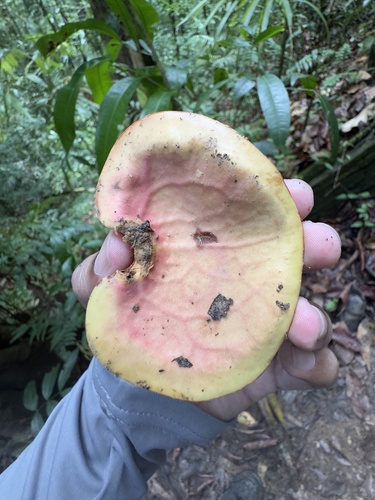
The hard seeds are soaked in water for a week, then scraped and added to cassava bread.
Where to Find It
It is a tropical plant. It grows in moist to wet places.
Brazil, Colombia, Guianas, Guyana, South America, Suriname, Trinidad and Tobago, Venezuela,
How to Identify
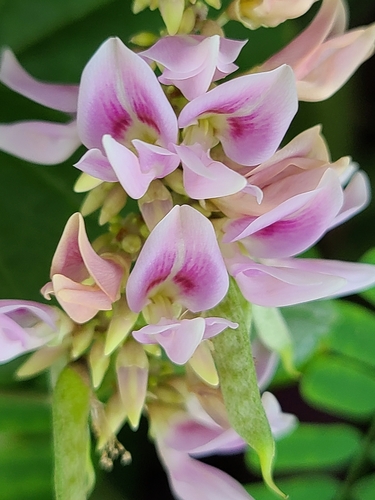
A tree. It grows 50 m tall. The trunk is 2 m across. It can have buttresses 5 m tall and 4 m wide. The leaves are alternate and have 6-8 leaflets. The leaflets are opposite and leathery and 14 cm long by 6 cm wide. The flowering shoots are at the ends of branches and have dense spikes 15 cm long by 1.5 cm wide. The flowers are white and cup shaped. The fruit is a brown flattened woody pod. It is 20 cm long by 7 cm wide and 5 cm thick. It splits open along its length. The edges coil up once open. There are 1-2 seeds that are kidney shaped and 9 cm long by 5 cm wide and 4 cm thick. They have a thin wall.
How to Grow
Prefers heavy clay soils in the wild. There are conflicting reports on whether or not this species has a symbiotic relationship with certain soil bacteria, so it is unclear as to whether it fixes atmospheric nitrogen.
Medicinal Uses
The whole plant is anthelmintic Applied externally, it is used for cleaning and healing sores and cuts. The bark is either boiled or mixed with water and drunk as an antidiarrhoeal. A decoction of the bark is used as an antispasmodic to treat uterine infections, diarrhoea and dysentery, although the pink decoction is said to have a nauseating odour and aftertaste. The inner bark is scraped, soaked in water overnight and drunk as an antidiarrhoeal. An unspecified part of the plant is used for treating skin, worm and urinogenital infections.
Other Uses
The heartwood is yellowish red brown, reddish brown or dark red with paler streaks; it is clearly demarcated from the 5 - 15cm wide band of yellowish to pale brown sapwood. The texture is moderately fine to rather coarse, rather harsh to the feel; the grain is straight to commonly interlocked, very variable; lustre medium to high; there is an astringent taste and a slightly sour odour. The wood is hard to very hard; very heavy; tough; strong; very durable, being resistant to fungi, dry wood borers and termites. A service life of 15 to 20 years in ground contact is reported. It seasons slowly, with a high risk of checking and distortion; once dry it is moderately to poorly stable in service. The wood is moderately difficult to work but yields smooth surfaces in sawing, planing, turning, or boring unless interlocked grain is present when there may be considerable 'pick up' and chipped grain; nailing and screwing are good, but pre-boring is required; gluing is correct for interior use only and requires care because of the dense wood. The wood is highly resistant to fire. The timber has many uses. Because of its fire resistance, it is rated by Lloyds as an A-1 material for stem posts, ribs, knees, and framing in ship building. Because of its instability and lack of cabinet wood beauty, the wood is not well fitted for furniture, interior flooring, turnery, and similar uses. But it is well qualified for bridge timber, house framing, bridge decking and planking, marine construction, and piling in teredo-free areas. The timber is also successfully used for mining timbers, mill beds, heavy-duty industrial flooring, and heavy construction of all types. Pulped by the soda process, the wood yields a good quality pulp suitable for strong paper. A high quality charcoal can be produced from the wood..
Names & Synonyms
Dautara, Maho rouge, Mora, Moraboekea, Morabukea, Mora rouge, Mo'ra, Nato, Nato rojo, Parakuwa, Peto, Pracuuba, Prakue, Witte mora
References (3)
- Grandtner, M. M. & Chevrette, J., 2013, Dictionary of Trees, Volume 2: South America: Nomenclature, Taxonomy and Ecology. Academic Press p 420
- Maas, P.J. M., Non-Timber Forest Products of the North-West District of Guyana Part 2. The 85 most important NTFP species. p 170
- World Checklist of Useful Plant Species 2020. Royal Botanic Gardens, Kew