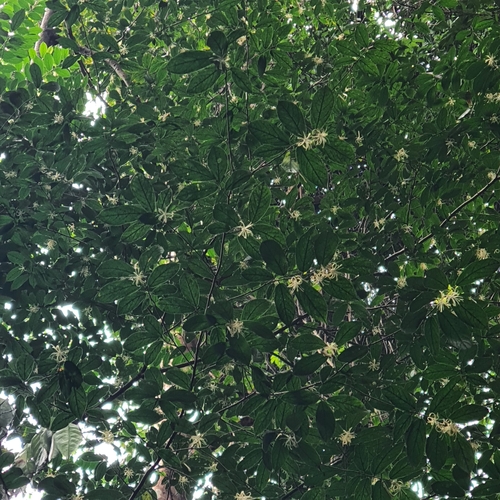
Cornus nuttallii
Audubon
Mountain dogwood, Pacific dogwood, Western Flowering Dogwood, West American dogwood
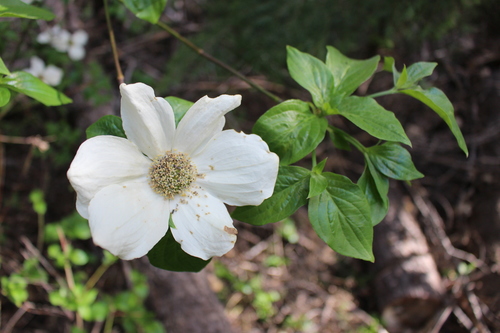
(c) Morgan Stickrod, some rights reserved (CC BY-NC), uploaded by Morgan Stickrod

(c) Larry McCombs, some rights reserved (CC BY-NC-SA)

(c) Adam Schneider, some rights reserved (CC BY-NC), uploaded by Adam Schneider
What to Eat
Edible parts: Fruit
The fruit is possibly edible. It is about 10mm in diameter with a thin, mealy flesh.
Where to Find It
It is native to western North America. Temperate. It suits cool, rainy climates in partly shady places. It is often along riverbanks and near the bottom of valleys. It is resistant to frost but damaged by drought. It suits hardiness zones 7-8. Arboretum Tasmania.
Australia, Canada, North America*, Tasmania, USA,
How to Identify
A slender tree. It grows up to 9-15 m high. The trunk can be 30 cm across. In gardens it is often only a shrub. The bark is light grey and thin. It breaks into small plates with age. The leaves are clustered at the shoot tips. The leaves are opposite and 8-15 cm long. They are widest near the middle and taper to both ends. The tip is short and sharp. The base is broad and wedge shaped. The edges are wavy. The leaves are deep green on top and greyish-green underneath. The leaves turn yellow and red in autumn. The flowers are small and dull purple or green. They occur in compact flower heads which are 10-12 cm across with 4-7 pure white bracts. The small cluster of flowers at their centre is purple. The fruit are bright red and 10-12 mm across. The occur in dense packed round clusters. There are 30-40 in the group. They ripen in autumn.
How to Grow
An easily grown plant, it succeeds in any soil of good or moderate fertility, ranging from acid to shallow chalk. Another report says that it does not thrive in poor chalky soils. Grows well in heavy clay soils. Succeeds in full sun or light shade. Plants are hardy to about -15°c, but they require long hot humid summers in order to promote good growth. A very ornamental tree, but it is usually short-lived in Britain and does not do well in the north of this country. There is some evidence to suggest that trees grow better on poor soils and can be killed by too much kindness. A very good tree has been seen on a poor gravel soil. Closely related to C. florida. This species is the floral emblem of British Columbia. A number of named varieties have been developed for their ornamental value. Plants in this genus are notably resistant to honey fungus.
Propagation: Seed is best sown as soon as it is ripe, either in a cold frame or an outdoor seedbed if sufficient seed is available. The seed must be separated from the fruit flesh, which contains germination inhibitors. Stored seed should be cold stratified for 3–4 months and sown as early in the year as possible. Scarification may also help, as may a period of approximately 3 days of warm stratification at 15°C before the cold stratification. Germination, especially of stored seed, can be very slow, taking 18 months or more. Prick out cold-frame seedlings into individual pots once large enough to handle, grow on through their first winter under glass, and plant out in spring after the last expected frosts. Cuttings of half-ripe side shoots can be taken in July/August in a frame. Cuttings of mature wood of the current year's growth, taken with a heel if possible, can be taken in autumn in a cold frame, with a high success rate. Layering of new growth in June/July takes around 9 months to root.
Medicinal Uses
The bark is antiperiodic, cathartic, febrifuge, laxative, and tonic. An infusion is used as a quinine substitute in the treatment of malaria and has also been used for stomach complaints. Externally, the infusion is applied to treat ulcers.
Other Uses
An intense brown dye is obtained by boiling the bark. The bark is rich in tannin and has been used as a preservative. The long, slender branches have been used to make baby baskets. The wood is exceedingly hard, heavy, strong, and close-grained, and is used for tool handles, cabinet making, and similar purposes.
Wikipedia
Source ↗Cornus nuttallii, the Pacific dogwood, western dogwood, or mountain dogwood, is a species of dogwood native to western North America. The tree's name used by Hul'q'umi'num'-speaking nations is Kwi’txulhp.
Production
It is a short lived tree.
Notes
There are about 45 Cornus species.
Names & Synonyms
References (12)
- Bodkin, F., 1991, Encyclopedia Botanica. Cornstalk publishing, p 282
- Coombes, A.J., 2000, Trees. Dorling Kindersley Handbooks. p 137
- Cundall, P., (ed.), 2004, Gardening Australia: flora: the gardener's bible. ABC Books. p 416
- Etherington, K., & Imwold, D., (Eds), 2001, Botanica's Trees & Shrubs. The illustrated A-Z of over 8500 trees and shrubs. Random House, Australia. p 229
- Farrar, J.L., 1995, Trees of the Northern United States and Canada. Iowa State University press/Ames p 182
- Lord, E.E., & Willis, J.H., 1999, Shrubs and Trees for Australian gardens. Lothian. p 218
- MacKinnon, A., et al, 2009, Edible & Medicinal Plants of Canada. Lone Pine. p 109
- Morley, B. & Everard, B., 1970, Wild Flowers of the World. Ebury press. Plate 155
- Ornith. biogr. 4:482. 1838
- Plants for a Future database, The Field, Penpol, Lostwithiel, Cornwall, PL22 0NG, UK. http://www.scs.leeds.ac.uk/pfaf/
- Ryan, S., 2008, Dicksonia. Rare Plants Manual. Hyland House. p 18
- Young, J., (Ed.), 2001, Botanica's Pocket Trees and Shrubs. Random House. p 273