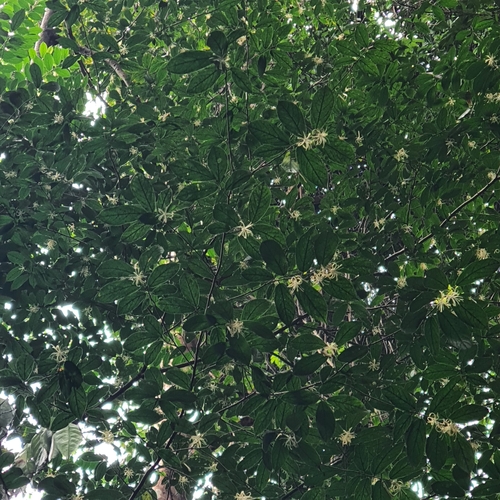
Cornus sericea
L.
Red osier dogwood

No machine-readable author provided. Jkelly assumed (based on copyright claims). (via Wikimedia Commons)

Charles Louis L'Héritier, Dom. de Brutelle (via Wikimedia Commons)

Jennifer Anderson @ USDA-NRCS PLANTS Database (via Wikimedia Commons)

(c) margauxkaz, some rights reserved (CC BY-NC)

(c) margauxkaz, some rights reserved (CC BY-NC)

(c) margauxkaz, some rights reserved (CC BY-NC)
What to Eat
Edible parts: Fruit, Seeds
The fruit can be eaten raw or cooked and is juicy, though some reports describe it as bitter and unpalatable. Native North Americans mixed it with other fruits such as juneberries (Amelanchier spp.) and dried the mixture for winter use. The fruit can cause nausea and is up to 9mm in diameter. The seed is also noted as edible, though no further details are given and the seeds are quite small and woody. An edible oil is obtained from the seed.
Where to Find It
Temperate. It is best in light to medium, moist soils. It needs a protected shaded position. It is resistant to frost but damaged by drought. It suits hardiness zones 2-9.
Australia, Britain, Canada, Europe, North America*, Spain, USA,
How to Identify
A shrub which develops suckers. It loses its leaves. It grows 4 m tall and spreads 2 m wide. The branches are dark purple. The small branches are silky. The leaves are oval to sword shaped. They are smooth above and silky underneath. They turn orange to red in autumn. The flowers are white. The fruit are white with a green tinge.
How to Grow
An easily grown plant, it succeeds in any soil of good or moderate fertility, ranging from acid to shallow chalk. Grows well in heavy clay soils. Prefers a moist soil and a position in sun or partial shade. Succeeds in poorly drained soils. Plants are hardy to about -35°c. A rampant suckering shrub. A number of cultivars have been developed for their ornamental value. This species is closely allied to C. alba. The flowers are very attractive to bees. Plants in this genus are notably resistant to honey fungus.
Propagation: Seed is best sown as soon as it is ripe, either in a cold frame or an outdoor seedbed if sufficient seed is available. The seed must be separated from the fruit flesh, which contains germination inhibitors. Stored seed should be cold stratified for 3–4 months and sown as early in the year as possible. Scarification may also help, as may a period of warm stratification before the cold stratification. Germination, especially of stored seed, can be very slow, taking 18 months or more. Prick out cold-frame seedlings into individual pots once large enough to handle, grow on through their first winter under glass, and plant out in spring after the last expected frosts. Cuttings of half-ripe side shoots can be taken in July/August in a frame. Cuttings of mature wood of the current year's growth, taken with a heel if possible, can be taken in autumn in a cold frame, with a high success rate. Layering of new growth in June/July takes around 9 months to root.
Medicinal Uses
Red osier dogwood was widely used by several native North American Indian tribes, valued particularly for its astringent and tonic bark, applied both internally and externally to treat diarrhoea, fevers, skin problems, and more. It is little used in modern herbalism. The bark and root bark are analgesic, astringent, febrifuge, purgative, mildly stimulant, and tonic; drying the bark removes its tendency to purge. A decoction has been used to treat headaches, diarrhoea, coughs, colds, and fevers. Externally, the decoction has been used as a wash for sore eyes, styes, and other infections, and to treat skin complaints such as poison ivy rash and ulcers. Bark shavings have been applied as a wound dressing to stop bleeding. A poultice of soaked inner bark combined with ashes has been used to alleviate pain. The plant is said to have cured hydrophobia.
Other Uses
A fibre from the bark is used as cordage, and the bark can be twisted into rope. Powdered bark has been used as a toothpowder to preserve the gums and keep teeth white. Oil from the seed burns well and can be used in lighting. A red dye is obtained from the bark mixed with cedar ashes. The pliable branches are used as rims in basket making, and the stem wood is very tough and flexible. Plants can be grown as a tall ground cover for colonising large areas, with the cultivar 'Flaviramea' recommended for this purpose. Red osier is noted as a good Carbon Farming Solution plant; it can be coppiced, used as fodder, and function as a living fence, and is suitable as an industrial biomass crop.
Wikipedia
Source ↗Cornus sericea, the red osier or red-osier dogwood, is a species of flowering plant in the family Cornaceae, native to much of North America. It has sometimes been considered a synonym of the Asian species Cornus alba. Other names include red brush, red willow, redstem dogwood, redtwig dogwood, red-rood, American dogwood, creek dogwood, and western dogwood.
Notes
There are about 45 Cornus species.
Names & Synonyms
References (6)
- Bodkin, F., 1991, Encyclopedia Botanica. Cornstalk publishing, p 283
- Cundall, P., (ed.), 2004, Gardening Australia: flora: the gardener's bible. ABC Books. p 417
- MacKinnon, A., et al, 2009, Edible & Medicinal Plants of Canada. Lone Pine. p 109
- Mant. pl. 2:199. 1771
- Plants for a Future, The Field, Penpol, Lostwithiel, Cornwall, PL22 0NG, UK. http://www.scs.leeds.ac.uk/pfaf/
- Turner, N., 1997, Food Plants of Interior First Peoples. Royal BC Museum Handbook p 106