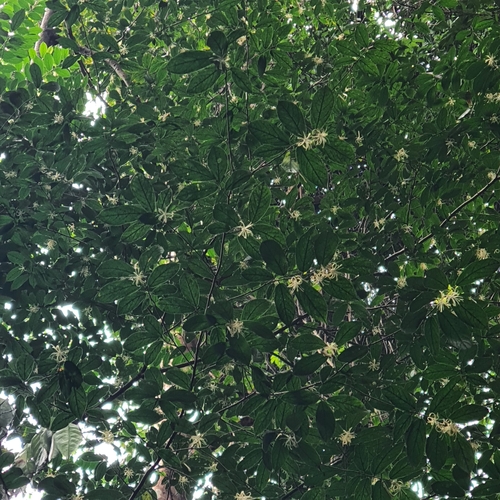
Cornus sessilis
Torr.

(c) 2012 Belinda Lo, some rights reserved (CC BY-NC-SA)

(c) 2012 Belinda Lo, some rights reserved (CC BY-NC-SA)

(c) 2012 Belinda Lo, some rights reserved (CC BY-NC-SA)
What to Eat
Edible parts: Fruit
The fruit can be eaten raw or cooked. Based on the closely related C. officinalis, which likely applies here, the fully ripe fruit is quite pleasant but slightly astringent, measuring about 1.5cm long. It contains approximately 8.6% sugars, 2.9% malic acid, and 0.74% ash.
Where to Find It
Temperate. It suits hardiness zones 7-9.
Australia, North America, USA,
How to Identify
A tall deciduous shrub. It grows 3 m tall. The young shoots are green. The leaves are tapering. The flowers are small and bright yellow. They are in large bracts which fall off. They appear of bare wood. The fruit are purple-black and glossy.
How to Grow
An easily grown plant, it succeeds in any soil of good or moderate fertility, ranging from acid to shallow chalk. Grows well in heavy clay soils. Succeeds in full sun or light shade. This species is very closely related to C. mas and C. officinalis. Plants in this genus are notably resistant to honey fungus.
Propagation: Seed is best sown as soon as it is ripe in a cold frame or an outdoor seedbed if sufficient seed is available. The seed must be separated from the fruit flesh, which contains germination inhibitors. Stored seed should be cold stratified for 3–4 months and sown as early in the year as possible. Scarification may also help, as may a period of warm stratification before cold stratification. Germination, especially of stored seed, can be very slow, taking 18 months or more. Prick out cold-frame seedlings into individual pots once large enough to handle, overwinter in a greenhouse, and plant out in spring after the last expected frosts. Cuttings of half-ripe side shoots can be taken in July/August in a frame. Cuttings of mature wood from the current year's growth, taken with a heel if possible, can be rooted in a cold frame in autumn with a high success rate. Layering of new growth in June/July takes about 9 months.
Medicinal Uses
None known.
Other Uses
None known.
Wikipedia
Source ↗Cornus sessilis is a species of dogwood known by the common names blackfruit cornel, blackfruit dogwood, and miner's dogwood.
Notes
There are about 45 Cornus species.
References (3)
- Etherington, K., & Imwold, D., (Eds), 2001, Botanica's Trees & Shrubs. The illustrated A-Z of over 8500 trees and shrubs. Random House, Australia. p 229
- Lord, E.E., & Willis, J.H., 1999, Shrubs and Trees for Australian gardens. Lothian. p 218
- Plants for a Future database, The Field, Penpol, Lostwithiel, Cornwall, PL22 0NG, UK. http://www.scs.leeds.ac.uk/pfaf/