Senna didymobotrya
(Fresen.) H. S. Irwin &Barneby

(c) Steven Severinghaus, some rights reserved (CC BY-NC-SA)
(c) Communitree, some rights reserved (CC BY-NC)

(c) Communitree, some rights reserved (CC BY-NC)
What to Eat
Edible parts: Leaves, Caution, Medicine
Leaves are used in traditional preparations, though they should only ever be used in very small and processed amounts.
Known Hazards
Where to Find It
It is a tropical plant.
Africa, Angola, Central America, Congo DR, Congo R, Costa Rica, Cuba, East Africa, Ethiopia, India, Kenya, Malawi, Mexico, Mozambique, Panama, South Africa, Southern Africa, Sri Lanka, Sudan, Tanzania, Uganda, Zambia,
How to Identify
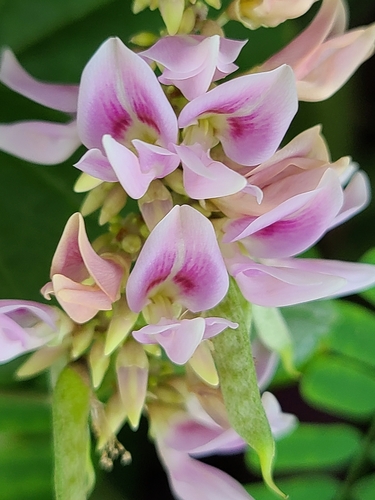
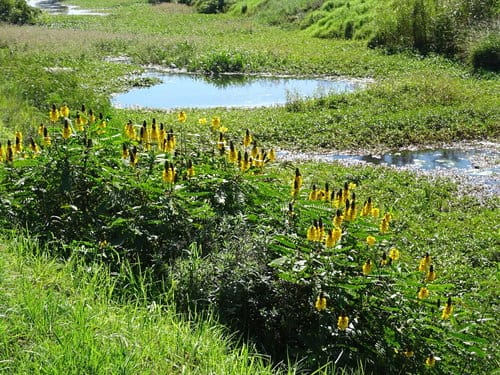
A shrub. It grows up to 3 m tall. There can be several stems. The young leaves and branches are hairy. The leaves can be 35 cm long. They are oval to heart shaped. The flower petals are yellow. The pods are 8-10 cm long by 1.6-1.8 cm wide. There are 9-16 seeds. The seeds are dull brown and 7-8 mm long by 4-5 mm wide.
How to Grow
Succeeds in tropical and sub-tropical regions, where it is found at elevations from sea level to 2,500 metres. The plant has escaped from cultivation in some areas and shows signs of being invasive. The plant flowers profusely twice a year. When planted as a small shade tree in tea plantations, it is spaced at about 5 x 5 metres. The plant yields a fairly large amount of material for green manuring. About 5 tonnes of green material provides 35.5 kg nitrogen. There are conflicting reports on whether or not this tree has a symbiotic relationship with certain soil bacteria, so it is unclear as to whether this tree fixes atmospheric nitrogen.
Propagation: Seed - requires pre-treatment to soften the hard seedcoat and allow the ingress of water. This can be done by soaking the seed in a small amount of nearly boiling water (which cools down quickly and does not cook the seed) and then soaking the seed for 12 - 24 hours in warm water. Alternatively, a small area of the seed coat can be abraded, being careful not to damage the embryo. The seed usually germinates readily - experiments with treated seed gave 75 - 85% germination rate, whilst in the same period only 15 - 20% of untreated seeds germinated. The seeds can germinate both in light and dark conditions and over a wide range of temperatures; however, the optimum germination temperature is 20 - 25°c and the germination rate is very low at 10°c. The seed may be sown in the nursery or directly in the field. Cuttings are said not to be successful.
Medicinal Uses
In Kenya, some cultures, particularly Kalenjins, use the plant to prepare a special type of sour milk (mursik) which is used mainly during festivities. A sizeable tree is cut and its branches pruned. The bark is mostly removed, then dried. Once the bark is dry, and the specially made calabash gourd, or Sotet, has been cleaned and dried, the senna bark is put in a fire, and removed when charred. The process emits fragrant smoke. The charred bark is used to coat the inside of the gourd, which is subsequently used for the storage of fermented or fresh milk. The leaves of this plant can be squeezed, and the extract mixed with water to create a bath that helps cure skin infections.
Other Uses
The ash of burnt twigs is used to coat the inside of gourds that are to be used for storing milk, as it is said to improve digestibility and palatability. The milk can be kept in them for over a year. The hot ashes are used to clean beer vessels. The plant contains tannins. The flowers, bark, leaves and pods can all be used as a dye for fibres and give a wide range of colours (yellow, orange, red). The leaves are used to ripen bananas by wrapping them around the bunch. The wood is used for making handicrafts, and is also used as firewood. The tree has been used to provide shade in tea plantations. It has been introduced as a green manure and cover crop various parts of the tropics. The plants can be lopped several times per year to provide green manure. Lopping is preferably done when the plants are in flower, when the nutrient content in the leaves is high. Growing plants stimulate the germination of any seeds of the parasitic plant witchweed (Striga spp) that might be in the soil. It is not a host species for witchweed, however, so the witchweed soon dies. Thus, when incorporated into the rotation, it can effectively decrease the infestation.
Wikipedia
Source ↗Senna didymobotrya is a species of flowering plant in the legume family known by the common names African senna, popcorn senna, candelabra tree, and peanut butter cassia. It is native to Africa, where it can be found across the continent in several types of habitats. It has been introduced to many other parts of the world for use as an ornamental plant, a cover crop, and a leguminous green manure. In some places it is now naturalized in the wild, for example, in parts of Indonesia, Australia, Mexico, and the United States in California, Florida, and Hawaii.
Names & Synonyms
Magendenakuru
References (3)
- Mutie, F. M., et al, 2023, Important Medicinal and Food Taxa (Orders and Families) in Kenya, Based on Three Quantitative Approaches. Plants 2023, 12, 1145
- Shumsky, S., et al, 2014, Institutional factors affecting wild edible plant (WEP) harvest and consumption in semi-arid Kenya. Land Use Policy 38(2014) 48-69
- World Checklist of Useful Plant Species 2020. Royal Botanic Gardens, Kew