Correa alba
Andrews
Cape Barren tea, White Correa, Native fuschia, Coast correa

(c) dracophylla, some rights reserved (CC BY-NC-SA)
(c) Ken Waterfall, some rights reserved (CC BY-NC)
(c) Ken Waterfall, some rights reserved (CC BY-NC)
What to Eat
Edible parts: Leaves - tea
The leaves can be used as a tea substitute. They are pleasantly aromatic with a sweetish flavour.
Where to Find It
It grows in temperate and subtropical places. It grows on the coast. It is often on headlands and sandy places. It needs well drained soil. It can grow in dry soils and in full sun of light shade. It can stand light frosts. It suits hardiness zones 8-10. Arboretum Tasmania.
Australia*, Tasmania*,
How to Identify
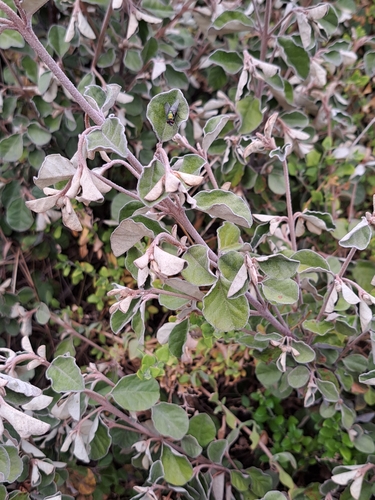
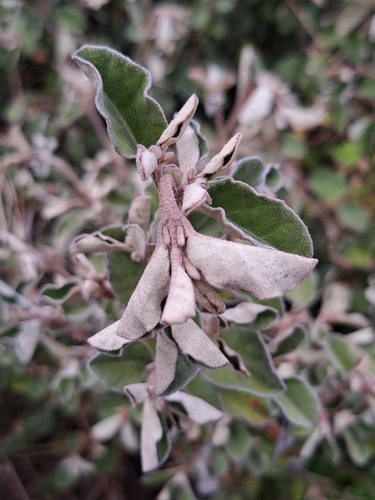
An erect or spreading shrub. It grows 1.5 m high. It can spread 1-2.2 m wide. It has rusty-brown hairy small branches. The leaves are round or oval and hairy underneath. They are 3.5 cm long by 3 cm wide. The leaves are grey-green. The leaves occur in opposite pairs. It has white flowers and a short tube. There are 4 spreading petals. The flowers are about 1.5-2 cm across. Each flower produces about 4 seeds.
How to Grow
Requires a freely draining lime-free peaty soil or a sandy soil rich in organic matter and a sunny position. Another report says that plants do best in a well-drained, rather poor soil with some limestone. Plants are very resistant to salt spray. This species is hardy to at least -7°c in Australian gardens, though this cannot be translated directly to British gardens due to our cooler summers and longer, colder and wetter winters. Plants can tolerate at least short-lived frosts down to about -5°c in Britain and they can be grown on a sunny wall in the milder parts of the country. In S. Cornwall they succeed as free-growing shrubs.
Propagation: Seed is best sown as soon as it is ripe in a greenhouse. Fresh seed usually germinates in 1–3 months at 20°C. Stored seed can be difficult to germinate; leaching with water may help, or a short burst of fire may initiate germination. Prick seedlings out into individual pots once large enough to handle and grow on in the greenhouse for at least their first winter. Plant out into permanent positions in late spring or early summer, after the last expected frosts. Cuttings of half-ripe wood taken in July/August in a shaded frame are generally quite easy to root.
Medicinal Uses
None known.
Other Uses
None known.
Wikipedia
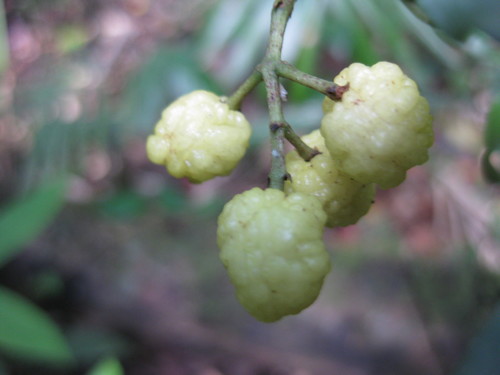
Source ↗Correa alba, commonly known as white correa, is a species of shrub that is endemic to south-eastern Australia. It has egg-shaped to more or less circular leaves, erect white flowers arranged singly or in groups on short side branches, and green fruit.
Notes
There are 11 Correa species. They occur naturally in Australia.
References (24)
- Blomberry, A.M., 1979, Australian Native Plants. Angus and Robertson p 178
- Bodkin, F., 1991, Encyclopedia Botanica. Cornstalk publishing, p 284
- Breidahl H., 1997, Australian Southern Shores. Lothian. p 80
- Brickell, C. (Ed.), 1999, The Royal Horticultural Society A-Z Encyclopedia of Garden Plants. Convent Garden Books. p 301
- Cameron, M., (Ed.) 1981, A Guide to Flowers & Plants of Tasmania. Reed p 100
- Cherikoff V. & Isaacs, J., The Bush Food Handbook. How to gather, grow, process and cook Australian Wild Foods. Ti Tree Press, Australia p 194
- Cribb, A.B. & J.W., 1976, Wild Food in Australia, Fontana. p 174
- Cronin, L., 1989, The Concise Australian Flora. Reed. p 35
- Cundall, P., (ed.), 2004, Gardening Australia: flora: the gardener's bible. ABC Books. p 418
- Curtis, W.M., 1956, The Students Flora of Tasmania Vol 1 p 105
- Elliot, W.R., & Jones, D.L., 1984, Encyclopedia of Australian Plants suitable for cultivation. Vol 3. Lothian. p 91
- Etherington, K., & Imwold, D., (Eds), 2001, Botanica's Trees & Shrubs. The illustrated A-Z of over 8500 trees and shrubs. Random House, Australia. p 230
- Facciola, S., 1998, Cornucopia 2: a Source Book of Edible Plants. Kampong Publications, p 220
- Greig, D., 1996, Flowering Natives for Home Gardens. Angus & Robertson. p 122
- Grieg, D., 2002, A photographic guide to Wildflowers of South-eastern Australia. New Holland. p 124
- Harris, S., Buchanan, A., Connolly, A., 2001, One Hundred Islands: The Flora of the Outer Furneaux. Tas Govt. p 138
- Hastings Advance Community College, 2017, Uses for Native Plants of the Mornington Peninsula. 86pp. p 36
- Hedrick, U.P., 1919, (Ed.), Sturtevant's edible plants of the world. p 220
- Howells, C & Gulline, H., 2003, Coastal Plants of Tasmania. Plant Identikit. Australian Plant Society, Tasmania. p 21
- Lord, E.E., & Willis, J.H., 1999, Shrubs and Trees for Australian gardens. Lothian. p 158
- Low, T., 1992, Bush Tucker. Australia’s Wild Food Harvest. Angus & Robertson. p 33
- Molyneux, B & Forrester, S., 1997, The Austraflora A-Z of Australian Plants. Reed. p 69
- Smith, K & I., 199, Grow your own bushfoods. New Holland. Australia. p 11
- Whiting, J. et al, 2004, Tasmania's Natural Flora. Tasmania's Natural Flora Editorial Committee PO Box 194, Ulverstone, Tasmania, Australia 7315 p 301