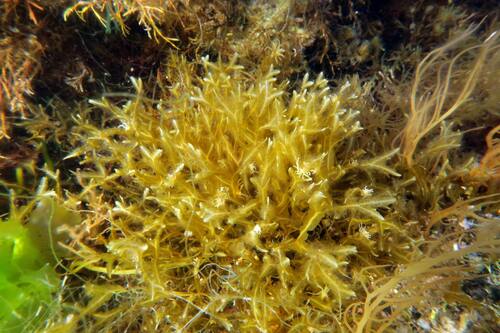
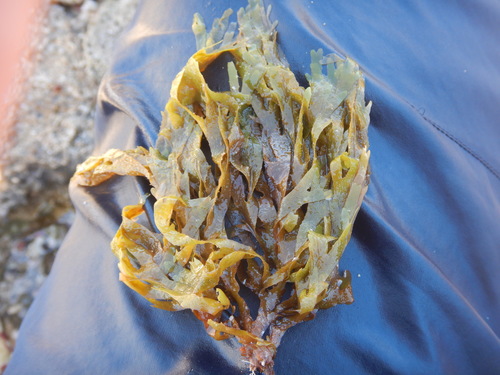
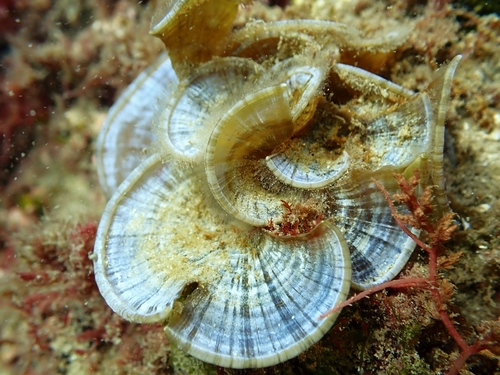
Padina pavonica
(L.) Thivy
Peacock's tail
iNaturalist · cc-by-nc
(c) sofiaconde, some rights reserved (CC BY-NC), uploaded by sofiaconde
(c) sofiaconde, some rights reserved (CC BY-NC), uploaded by sofiaconde

iNaturalist · cc-by-nc
(c) Falk Viczian Solarboot-Projekte gGmbH, some rights reserved (CC BY-NC)
(c) Falk Viczian Solarboot-Projekte gGmbH, some rights reserved (CC BY-NC)

iNaturalist · cc-by-nc
(c) Aniria Lobo, some rights reserved (CC BY-NC)
(c) Aniria Lobo, some rights reserved (CC BY-NC)
What to Eat
Edible parts: Seaweed
Eaten as seaweed.
Where to Find It
A Mediterranean plant.
Atlantic Ocean, Britain, Europe, Indian Ocean, Iran, Ireland, Middle East, Pacific Ocean,
Countries: Andorra, United Arab Emirates, Albania, Austria, Bosnia & Herzegovina, Belgium, Bulgaria, Bahrain, Belarus, Switzerland, Cyprus, Czechia, Germany, Denmark, Estonia, Spain, Finland, France, United Kingdom, Greece, Croatia, Hungary, Ireland, Israel, Iraq, Iran, Iceland, Italy, Jordan, Kuwait, Lebanon, Liechtenstein, Lithuania, Luxembourg, Latvia, Monaco, Moldova, Montenegro, North Macedonia, Malta, Netherlands, Norway, Oman, Poland, Portugal, Qatar, Romania, Serbia, Russia, Saudi Arabia, Sweden, Slovenia, Slovakia, San Marino, Syria, Ukraine, Yemen
How to Identify
A small brown seaweed of the Mediterranean, typically reaching 10 cm across.
Nutrition Score: 3/100
| Part | Moisture | kJ | kcal | Protein | Vit A | Vit C | Iron | Zinc |
|---|---|---|---|---|---|---|---|---|
| Seaweed | — | — | 11.8 | — | — | — | — | — |
Wikipedia
Source ↗Padina pavonica, commonly known as the peacock's tail, is a small brown alga found in the Indian Ocean, the Pacific Ocean, the Atlantic Ocean and the Mediterranean Sea. It inhabits pools in the littoral zone typically with clayey, silty or sandy sediments. Other habitats include rocks and shell fragments in the shallow sublittoral, seagrass meadows, mangrove roots and coral reefs on tidal flats.
Names & Synonyms
Dictyota pavonia (L.) LamourouxFucus pavonicus L.Padina mediterranea Bory de Saint-VincentUlva pavonia (L.) L.
References (1)
- Cherry, P., et al, 2019, Risks and benefits of consuming edible seaweeds. Nutrition ReviewsVR Vol. 77(5):307–329