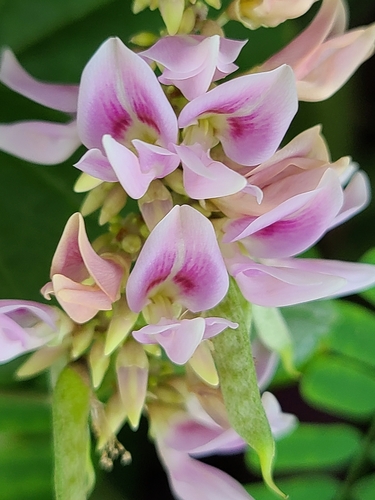
Desmodium styracifolium
(Osbeck) Merr.

Wikimedia Commons - 阿橋 HQ

President and Fellows of Harvard College

President and Fellows of Harvard College
What to Eat
Edible parts: Leaves - tea
None known.
Where to Find It
It is a subtropical plant.
Asia, China,
How to Identify
A small shrub like herb. It grows 30-100 cm tall. Young branches are densely hairy. The leaves can have 1-3 leaflets. The leaf blades are broadly oval to round and 2-4.5 cm long by 2-4.5 cm wide.
How to Grow
Propagation: Best sown as soon as it is ripe in a greenhouse. For stored seed, scarify and pre-soak in warm water for 5 hours before sowing in March in a greenhouse. Germination typically occurs within 1–4 months at 25°C. Prick seedlings into individual pots once large enough, grow on under glass through the first winter, then plant out in late spring or early summer with frost protection considered for the first winter outdoors. Cuttings of half-ripe wood with a heel can be taken in July/August in a frame. Divide as growth begins in spring — replant larger clumps directly, and pot up smaller ones in a cold frame until well rooted before planting out. Root cuttings can be taken in winter.
Medicinal Uses
The whole plant is diuretic and febrifuge. It is used in the treatment of gonorrhoea. A decoction is used to treat gallstones, urinary tract stones, and hepatitis.
Other Uses
Nitrogen Fixer.
Wikipedia
Source ↗Desmodium styracifolium is a nitrogen-fixing perennial growing to 0.8 m tall. Hermaphroditic flowers are insect-pollinated. Grows in light sandy, medium loamy, and heavy clay soils with preference for well-drained conditions. Tolerates mildly acidic, neutral, and basic soils. Requires full sun and moist soil. Hardy to UK zone 10.
Other Information
It is sold in local markets in China.
Names & Synonyms
Jin qian cao
References (1)
- Li, D. et al, 2017, Ethnobotanical survey of herbal tea plants from the traditional markets in Chaoshan, China. Journal of Ethnopharmacology. 205 (2017) 195-206