Cotoneaster microphyllus
Wall. ex Lindl.
Rockspray cotoneaster
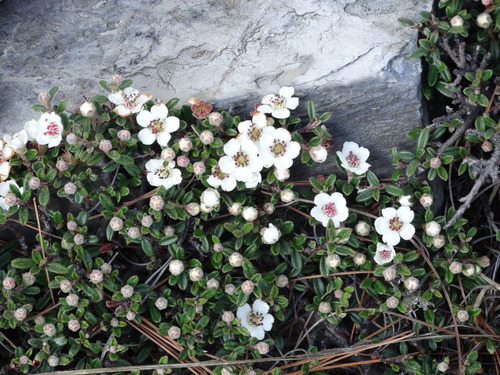
(c) Rebecca Hill, some rights reserved (CC BY-NC), uploaded by Rebecca Hill
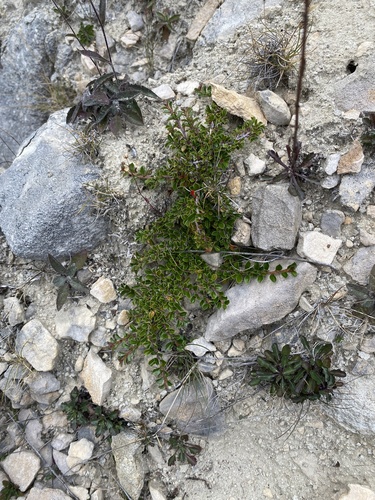
(c) willtodhunter, some rights reserved (CC BY-NC)
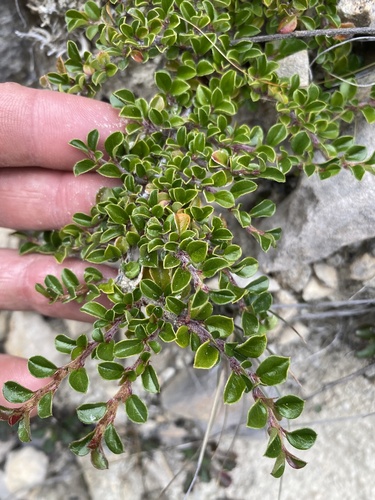
(c) willtodhunter, some rights reserved (CC BY-NC)
What to Eat
Edible parts: Fruit
The fruit is possibly edible raw, sweet when fully ripe with a watery flavour. It is approximately 7mm in diameter.
Where to Find It
It is a temperate plant. They are very frost hardy. It needs an exposed position with full sun. In Nepal they grow between 1300-3500 m altitude. In Uttar Pradesh in India they grow between 2000-4000 m altitude. It is best in a light to medium well-drained soil. It suits hardiness zones 5-10. In Sichuan and Yunnan.
Asia, Australia, Bhutan, China, Himalayas*, India, Myanmar, Nepal, Northeastern India, Pakistan, SE Asia, Sikkim, Tibet,
How to Identify
An evergreen shrub. It has many branches. It is compact with many twigs. It often lies along the ground. It often forms a mound 1 m high. The leaves have short stalks. The leaves are 0.3-1.5 cm long by 0.2-0.5 cm wide. They are oval and leathery. They are glossy dark green above. The flowers occur singly. They are white and in the axils of leaves. The fruit is round and scarlet when ripe.
How to Grow
An easily grown plant, it prefers a good soil but also does well in poor soils. It thrives in lime and is also happy in peaty soils. It succeeds in any soil that is not marshy or waterlogged. Succeeds in dry soils. Grows well in heavy clay soils. Succeeds in full sun or semi-shade but does not fruit so freely in a shady position. Tolerates atmospheric pollution. A very hardy plant, tolerating temperatures down to about -25°c. A very ornamental plant, there are some named forms. Most forms are quite slow-growing. It hybridizes freely with other members of this genus and often self-sows in British gardens. A low-growing plant, the branches often root when they come into contact with the soil. The flowers, when inhaled near to, have an unpleasant smell like decaying fish. They are very attractive to bees whilst the fruit is a good winter food source for many species of birds. Plants are notably susceptible to honey fungus. In garden design, as well as the above-ground architecture of a plant, root structure considerations help in choosing plants that work together for their optimal soil requirements including nutrients and water.
Propagation: Seed. Members of this genus hybridize freely, so seed should be obtained from a known wild source or controlled fertilization if true breeding is required. Sow seed as soon as it is ripe in autumn in a cold frame; it will usually germinate in spring. Stored seed germinates faster with 3 months warm stratification at 15°C followed by 3 months cold stratification at 4°C. Germination usually occurs within 1–18 months at 15°C but can take 2 years. Pot seedlings as soon as they are large enough to handle, and plant out into nursery beds or permanent positions when more than 10cm tall. Cuttings of half-ripe wood with a heel can be taken in July or August in a frame.
Medicinal Uses
The stolons are said to be astringent.
Other Uses
A rose-tan dye is obtained from the fruit. The leaves are used for incense. The plant has an extensive root system and a creeping above-ground habit, making it a good soil binder. The subspecies C. microphyllus cochleatus can be used as a dense, carpeting ground cover in a sunny position. The branches are used for making baskets. The wood is hard, close, and even grained, and is used for fuel.
Wikipedia
Source ↗Cotoneaster microphyllus, the small-leaved cotoneaster or rockspray cotoneaster, is a species of flowering plant in the family Rosaceae. It is native to the Indian Subcontinent, Tibet, Sichuan, and Yunnan in China, and Myanmar, and it has been introduced to various locales in Europe, Australia, and the United States. A rabbit-tolerant shrub reaching 1 m (3 ft) tall but spreading to 2.5 m (8 ft), and hardy in USDA zones 5 through 7, it is recommended for rockeries and hedges. Care should be taken not to plant it where it can become invasive.
Production
In NW Pakistan fruit are available in May.
Other Information
The fruit are especially eaten by children.
Notes
There are more than 200 Cotoneaster species.
Names & Synonyms
Bani, Bhoibuju, Chhar, Gheri, Mamanrha, Manray, Pate, Tharme, Theki jhar, Thuksing, Tsarlam, Tsarleb
References (25)
- Agarwal, R. & Chandra, V., 2019, Diversity of wild edible plants in the Mandal-Chopta forest, Uttarakhand. Journal of Medicinal Plants Studies 2019; 7(1): 89-92
- Ahmad, I., et al, 2011, Ethnobotanical Study of Tehsil Kabal, Swat District, KPK, Pakistan. Hindawi Publishing Corporation Journal of Botany Volume 2011, Article ID 368572, 9 pages
- Ahmad, K. & Pieroni, A., 2016, Folk knowledge of wild food plants among the tribal communities of Thakht-e-Sulaiman Hills, North-West Pakistan. Journal of Ethnobiology and Ethnomedicine, 12:17
- Ambasta, S.P. (Ed.), 2000, The Useful Plants of India. CSIR India. p 144
- Bhattarai, S and Chaudary, R. P., 2009, Wild Edible Plants Used by the People of Manang District, Central Nepal. Ecology of Food and Nutrition, 48:1-20
- Bodkin, F., 1991, Encyclopedia Botanica. Cornstalk publishing, p 290
- Bot. Reg. 13: t. 1114. 1827 "microphylla"
- Brickell, C. (Ed.), 1999, The Royal Horticultural Society A-Z Encyclopedia of Garden Plants. Convent Garden Books. p 309
- Cundall, P., (ed.), 2004, Gardening Australia: flora: the gardener's bible. ABC Books. p 428
- Etherington, K., & Imwold, D., (Eds), 2001, Botanica's Trees & Shrubs. The illustrated A-Z of over 8500 trees and shrubs. Random House, Australia. p 234
- Ethnobotanical Study of Tehsil Kabal, Swat District, KPK, Pakistan, Table 1
- Flora of China. www.eFloras.org Volume 9
- Gautam, R. S., et al, 2020, Wild Edible Fruits of Nepal. Int. J. Appl. Sci. Biotechnol. Vol 8(3): 289-304
- Ghimire, S. K., et al, 2008, Non-Timber Forest Products of Nepal Himalaya. WWF Nepal p 130
- GUPTA
- Haj, F., et al, 2012, Species Diversity and Ethno Botanical Classes of the Flora of Allai Valley District Battagram Pakistan. International Journal of Plant Research 2012, 2(4): 111-123
- Lord, E.E., & Willis, J.H., 1999, Shrubs and Trees for Australian gardens. Lothian. p 220
- Manandhar, N.P., 2002, Plants and People of Nepal. Timber Press. Portland, Oregon. p 173
- Negi, K.S., 1988, Some little known wild edible plants of U.P. Hills. J. Econ. Tax. Bot. Vol. 12 No. 2 pp 345-360
- Plants for a Future database, The Field, Penpol, Lostwithiel, Cornwall, PL22 0NG, UK. http://www.scs.leeds.ac.uk/pfaf/
- Radha, B., et al, 2013, Wild Edible Plant Resources of the Lohba Range of Kedarnath Forest Division (KFD), Garhwal Himalaya, India. Int. Res J. Biological Sci. Vol. 2 (11), 65-73
- Rawat, G.S., & Pangtey, Y.P.S., 1987, A Contribution to the Ethnobotany of Alpine Regions of Kumaon. J. Econ. Tax. Bot. Vol. 11 No. 1 pp 139-147
- Upreti, K., et al, 2010, Diversity and Distribution of Wild Edible Fruit Plants of Uttarakhand. Bioversity Potentials of the Himalaya. p 167
- Young, J., (Ed.), 2001, Botanica's Pocket Trees and Shrubs. Random House. p 288
- Zhang, L., et al, 2016, Ethnobotanical study of traditional edible plants used by the Naxi people during droughts. Journal of Ethnobiology and Ethnomedicine. 12:39
More from Rosaceae


