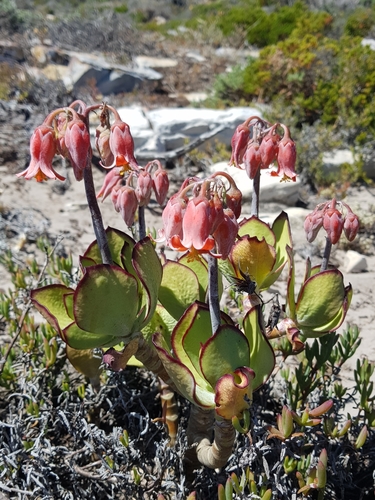
Dudleya pulverulenta
(Nutt.) Britton & Rose
Chalk lettuce, Chalk liveforever

(c) Bob Miller, some rights reserved (CC BY), uploaded by Bob Miller
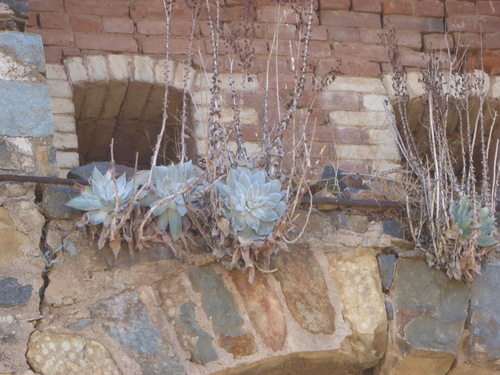
(c) Linda Pardy, some rights reserved (CC BY-NC)
What to Eat
Edible parts: Leaves, Stems
The leaves can be eaten raw.
Where to Find It
It is a Mediterranean climate plant. It grows in open rocky areas. It suits USDA hardiness zone 8.
Mexico, North America, USA,
How to Identify
A succulent plant. It grows a rind of wide, flat, fleshy leaves. They are pale green. These spread 45 cm across. It produces a tall erect stem 60 cm long. The plant has a coating of powdery wax. There are many flowers on a flower stalk. They are reddish.
How to Grow
Propagation: Seed — no further details available.
Medicinal Uses
None known
Other Uses
None known Special Uses
Wikipedia
Source ↗Dudleya pulverulenta is a species of perennial succulent plant known by the common names chalk lettuce, chalk dudleya, and chalk liveforever. It is one of the largest Dudleya, with a silvery, waxy rosette that may greatly contrast with its habitat. It is also regarded as one of the most distinctive members of the Dudleya, with one of the most specialized inflorescences in the genus, adapted to hummingbird pollination through its red pendent flowers, the longest corolla, and the highest nectar output. Dudleya pulverulenta has the largest range of all Dudleya, over 1,000 kilometres (620 mi), being found from southern Monterey County in California to the Sierra de San Borja in southern Baja California. It is closely related to Dudleya arizonica, a smaller desert species that tends to lack the specialized floral traits, and Dudleya anthonyi, which differs in a few morphological traits and is restricted to the San Quintín Volcanic Field.
Names & Synonyms
Teilplant
References (4)
- Beckstrom-Sternberg, Stephen M., and James A. Duke. "The Foodplant Database." http://probe.nalusda.gov:8300/cgi-bin/browse/foodplantdb.(ACEDB version 4.0 - data version July 1994) (As Cotyledon pulverulenta)
- Kermath, B. M., et al, 2014, Food Plants in the Americas: A survey of the domesticated, cultivated and wild plants used for Human food in North, Central and South America and the Caribbean. On line draft. p 321
- Plants For a Future.
- Wikipedia