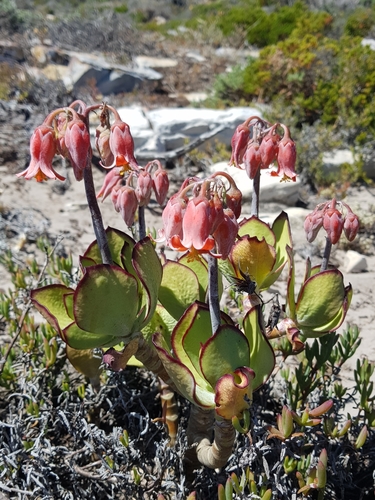
Crassula arborescens
(Mill.) Willd.
Round-leaved crassula

(c) Steven Molteno, some rights reserved (CC BY-NC), uploaded by Steven Molteno
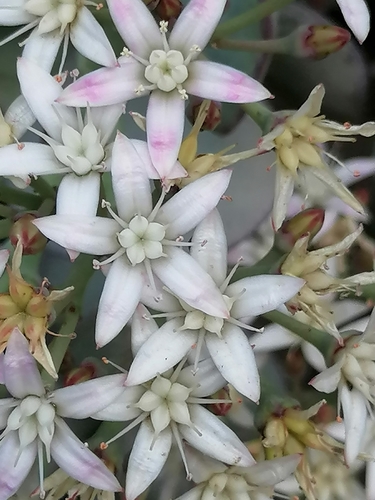
(c) stephen hardcastle, some rights reserved (CC BY-NC), uploaded by stephen hardcastle
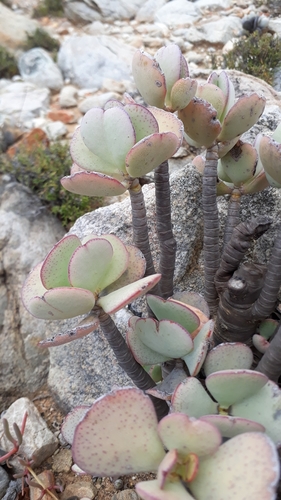
(c) Ian Webb, some rights reserved (CC BY), uploaded by Ian Webb
What to Eat
Edible parts: Roots
The roots are eaten.
Where to Find It
It is a warm temperate to subtropical climate plant. It grows on rocky hillsides. It can grow on fairly poor, well-drained soils. It is salt tolerant. It is best in a partly shaded position. It is resistant to frost and drought. Hobart Botanical Gardens. It suits hardiness zones 9-11.
Africa, Australia, Eswatini, Hawaii, Pacific, Slovenia, South Africa*, Southern Africa, Swaziland, Tasmania, USA,
How to Identify
A succulent tree. It grows to about 3 m tall. he bark is green-grey, succulent and smooth. The leaves are fleshy and bluish-grey. They are oval and tapering towards the base. They have a waxy bloom. They are 3 cm long by 3 cm wide. The flowers are pink and in clusters at the ends of branches. The fruit are small and 6 mm long. They have 3-5 separate oval follicles. The roots are edible.
How to Grow
Plants can be grown from seeds. They can also be grown by stem or leaf cuttings.
Wikipedia
Source ↗Crassula arborescens—the silver jade plant, silver dollar (jade) plant, beestebul, Chinese jade, cookie plant, money plant, or money tree, that is endemic to Western Cape, South Africa, is a species of succulent plant in the family Crassulaceae.
Notes
There are 216 succulent Crassula species. There are also other Crassula species. There are 300 total.
Names & Synonyms
Bull tacky, Drevesasta tolstica, Karka, Kerky, Silver jade
References (13)
- Bodkin, F., 1991, Encyclopedia Botanica. Cornstalk publishing, p 293
- Fox, F. W. & Young, M. E. N., 1982, Food from the Veld. Delta Books. p 163
- Hibbert, M., 2002, The Aussie Plant Finder 2002, Florilegium. p 75
- Llamas, K.A., 2003, Tropical Flowering Plants. Timber Press. p 180
- Long, C., 2005, Swaziland's Flora - siSwati names and Uses http://www.sntc.org.sz/flora/
- Palgrave, K.C., 1996, Trees of Southern Africa. Struik Publishers. p 201
- Palmer, E and Pitman, N., 1972, Trees of Southern Africa. Vol. 1. A.A. Balkema, Cape Town p 655
- Peters, C. R., O'Brien, E. M., and Drummond, R.B., 1992, Edible Wild plants of Sub-saharan Africa. Kew. p 97
- Ruiters-Welcome, A. K., 2019, Food plants of southern Africa. Ph.D. thesis. Univ. of Johannesburg p 47
- Sp. pl. 1(2):1554. 1798
- Staples, G.W. and Herbst, D.R., 2005, A tropical Garden Flora. Bishop Museum Press, Honolulu, Hawaii. p 255 (Drawing)
- Swaziland's Flora Database http://www.sntc.org.sz/flora
- Welcome, A. K. & Van Wyk, B.-E., 2019, An inventory and analysis of the food plants of southern Africa. South African Journal of Botany 122 (2019) 136–179