Crataegus coccinea
L.
Kansas hawthorn, Scarlet hawthorn
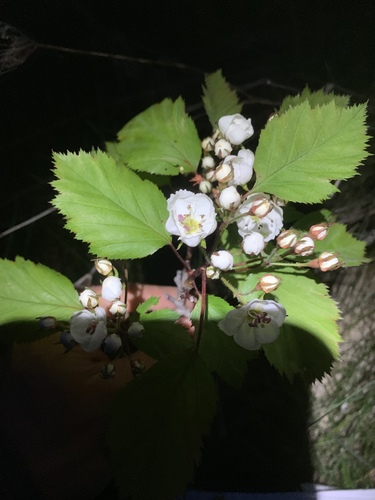
(c) Zack Harris, some rights reserved (CC BY-NC), uploaded by Zack Harris
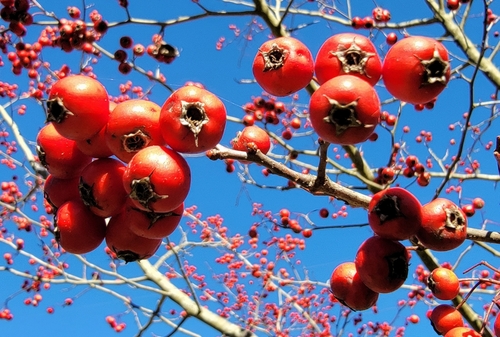
(c) Fred Gibbs, some rights reserved (CC BY-NC), uploaded by Fred Gibbs

(c) Étienne Léveillé-Bourret, some rights reserved (CC BY)
What to Eat
Edible parts: Fruit
The fruit are edible.
Where to Find It
Temperate.
Canada, North America, USA,
How to Identify
A shrub or small tree. It grows to 10 m tall. The leaves are large. They are 6-9 cm long. They are widest below the middle. They are double-toothed or shallowly lobed. The thorns are stout and 6 cm long. They are usually curved. The fruit are round. They are 10-14 mm across. They are bright red.
How to Grow
Plants can be grown from seed. The seed need cold treatment. Plants can also be grafted.
Wikipedia
Source ↗Crataegus coccinea, the scarlet hawthorn, is a species of hawthorn around which there is considerable confusion because the name has been misapplied for a long time. It has been shown to be the same as C. pedicellata, and under the rules of botanical nomenclature, the older name (C. coccinea) should be used.
Notes
There are 200 or more Crataegus species.
References (8)
- Beckstrom-Sternberg, Stephen M., and James A. Duke. "The Foodplant Database." http://probe.nalusda.gov:8300/cgi-bin/browse/foodplantdb.(ACEDB version 4.0 - data version July 1994)
- Farrar, J.L., 1995, Trees of the Northern United States and Canada. Iowa State University press/Ames p 392
- Flowerdew, B., 2000, Complete Fruit Book. Kyle Cathie Ltd., London. p 180
- Hedrick, U.P., 1919, (Ed.), Sturtevant's edible plants of the world. p 224
- Little, E.L., 1980, National Audubon Society Field Guide to North American Trees. Alfred A. Knopf. p 467
- Sp. pl. 1:476. 1753
- Toupal, R. S. & Hollenback, K., 2009, An Ethnobotany of Indiana Dunes National Lakeshore: Plant Uses of the Ojibwa People. Bureau of Applied Research in Anthropology. University of Arizona
- Tozer, F., 2007, The Uses of Wild Plants. Green Man Publishing. p 72
More from Rosaceae


