Prunus eburnea
Aitch.
Wild almond
RosaceaeFruit
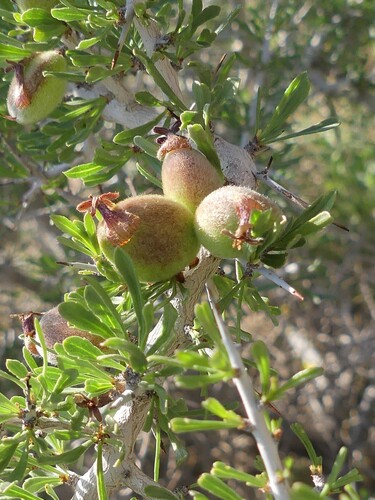
iNaturalist · cc-by-nc
(c) Abolfazl Sharifian, some rights reserved (CC BY-NC)
(c) Abolfazl Sharifian, some rights reserved (CC BY-NC)
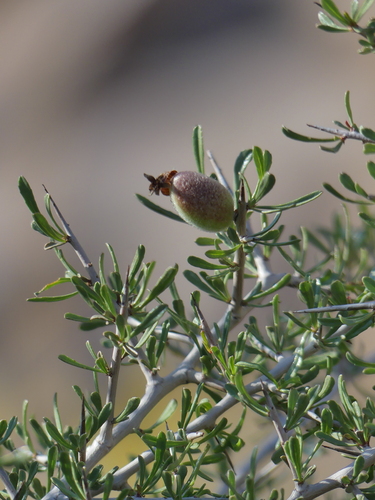
iNaturalist · cc-by-nc
(c) Abolfazl Sharifian, some rights reserved (CC BY-NC)
(c) Abolfazl Sharifian, some rights reserved (CC BY-NC)
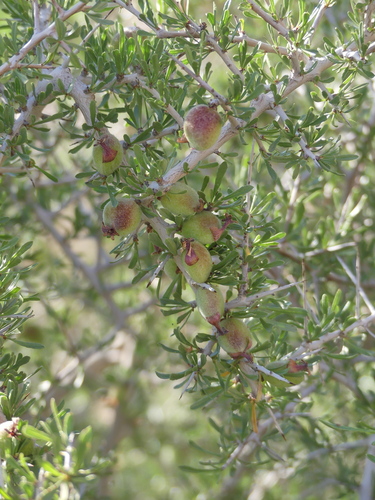
iNaturalist · cc-by-nc
(c) Abolfazl Sharifian, some rights reserved (CC BY-NC)
(c) Abolfazl Sharifian, some rights reserved (CC BY-NC)
What to Eat
Edible parts: Fruit
The fruit is eaten.
Where to Find It
It is a temperate plant.
Asia, Pakistan,
Countries: United Arab Emirates, Afghanistan, Armenia, Azerbaijan, Bangladesh, Bahrain, Brunei, Bhutan, China, Georgia, Indonesia, Israel, India, Iraq, Iran, Jordan, Japan, Kyrgyzstan, Cambodia, North Korea, South Korea, Kuwait, Kazakhstan, Laos, Lebanon, Sri Lanka, Myanmar, Mongolia, Maldives, Malaysia, Nepal, Oman, Philippines, Pakistan, Qatar, Saudi Arabia, Singapore, Syria, Thailand, Tajikistan, Timor-Leste, Turkmenistan, Turkey, Taiwan, Uzbekistan, Vietnam, Yemen
How to Identify
A temperate tree in the Rosaceae family known as wild almond, valued for its fruit.
Wikipedia
Source ↗Prunus eburnea is a species of wild almond native to Iran, Pakistan and Afghanistan . It is a dense shrub 0.2 to 1.2 m tall with gray bark. It is morphologically similar to Prunus lycioides, P. spinosissima, P. erioclada and P. brahuica. It can be distinguished from the similar species by having a pubescent hypanthium. A genetic and morphological analysis shows that it is a good species, with its closest relative being Prunus erioclada. The cross of Prunus scoparia and Prunus eburnea produces Prunus × iranshahrii.
Notes
The name is ambiguous.
Names & Synonyms
Mash monk, Zarga
References (1)
- Khan, D. & Shaukat, S.S., 2006, The Fruits of Pakistan: Diversity, Distribution, Trends of Production and Use. Int. J. Biol. Biotech., 3(3):463-499
More from Rosaceae

Acaena anserinifolia
Bidgee widgee, Buzzy, New Zealand Bur
No photo
Acaenia anserinifolia - (J.R.Forst.&G.Forst.)Druce.
Pirri-Pirri Bur

Adenostoma sparsifolium
Red shanks, Ribbonwood

Agrimonia eupatoria
Agrimony, Salt and Pepper

Agrimonia odorata
Adour agrimony, Liver-wort

Agrimonia pilosa
Indian chestnut, Agrimony