Crotalaria eremaea
F. Muell
Rattlepod, Bluebush Pea
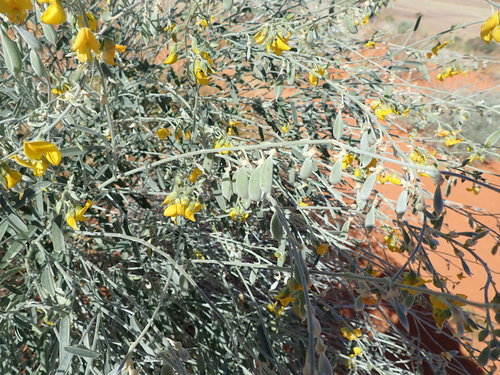
(c) miranda2372, some rights reserved (CC BY-NC)
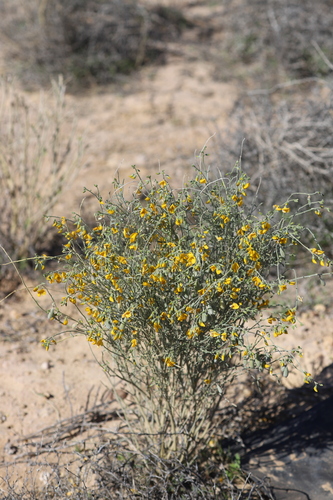
(c) Arthur Chapman, some rights reserved (CC BY-NC-SA)

no rights reserved, uploaded by Peter de Lange
What to Eat
Edible parts: Gum
Gum from the plant is edible.
Where to Find It
It grows on sand hills and flood plains along inland streams in Australia. It suits arid and warm inland areas. It can grow in arid places.
Australia*,
How to Identify
A bushy shrub. It grows 0.2-1 m high and spreads 0.5-1.5 m wide. It spreads by suckers. The stems are branched and hairy. The leaves have 1-3 leaflets. The leaflets are 2-5 cm long by 0.5-2 cm wide. They are oval, blunt and silvery grey. The flowering clusters are 10-15 cm long and loose. The flowers are 1-1.5 cm long and yellow. The fruit is a pod 2-3 cm long. It is inflated and silvery grey.
How to Grow
Plants can be grown from seed, root cuttings or suckers. It can spread by suckers and be cut back to regrow.
Wikipedia
Source ↗Crotalaria eremaea, also known as the bluebush pea or loose-flowered rattlepod, is a species of legume native to Australia and occurring in all mainland states and territories except for Victoria and the Australian Capital Territory.
Notes
There are about 550 Crotalaria species. They are mostly tropical.
References (6)
- Cherikoff V. & Isaacs, J., The Bush Food Handbook. How to gather, grow, process and cook Australian Wild Foods. Ti Tree Press, Australia p 189
- Elliot, W.R., & Jones, D.L., 1984, Encyclopedia of Australian Plants suitable for cultivation. Vol 3. Lothian. p 112
- Enum. pl. coll. Gregory t. 5. 1859
- Latz, P.K., 1996, Bushfires and Bushtucker: Aboriginal plant use in Central Australia. IAD Press Alice Springs p 154
- Lazarides, M. & Hince, B., 1993, Handbook of Economic Plants of Australia, CSIRO. p 68
- Paczkowska, G . & Chapman, A.R., 2000, The Western Australian Flora. A Descriptive Catalogue. Western Australian Herbarium. p 421