Crotalaria juncea
L.
Sunhemp

(c) Christopher David Benda, some rights reserved (CC BY-NC)

(c) Christopher David Benda, some rights reserved (CC BY-NC)

(c) Christopher David Benda, some rights reserved (CC BY-NC)
What to Eat
Edible parts: Leaves, Flowers, Pods, Seeds
The leaves have been recorded as eaten. The flowers are pickled and also cooked with meat and fish.
Known Hazards
Where to Find It
A tropical plant. It prefers light to medium well drained soils. It needs an open sunny position. It is drought resistant but frost tender. In Nepal it grows to about 1300 m altitude. In Sichuan and Yunnan.
Africa, Asia, Australia, Bhutan, Burkina Faso, Cambodia, China, Dominican Republic, East Africa, Eswatini, Guianas, Guyana, Haiti, Hawaii, Himalayas, India, Indochina, Indonesia, Laos, Malawi, Malaysia, Maldives, Mozambique, Myanmar, Nepal, Northeastern India, Pacific, Pakistan, Papua New Guinea, PNG, Russia, SE Asia, South Africa, Southern Africa, South America, Sri Lanka, Suriname, Swaziland, Thailand, USA, Vietnam, West Indies, Zambia, Zimbabwe,
How to Identify
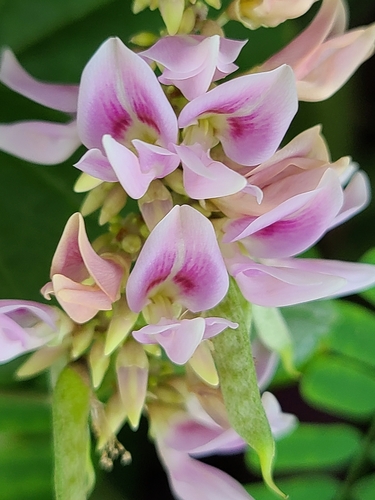
An evergreen shrub. It grows to 2.5 m high and spreads to 2 m across. The stem is erect, with silky hairs on the branches. The plant has a strong taproot. The roots have root nodules which have branches and lobes, and are 25 mm across. The leaves are narrow, simple and spirally arranged. The leaves can be 12 cm long and with short leaf stalks. The flowers are bright yellow and pea shaped. They occur in clusters of up to 20 blooms. The fruit is a short, inflated, light yellow pod. It is about 3 cm long and 1 cm wide. It is covered with soft hairs, has a groove on the upper surface and a beak at the end. The mature seeds are loose in the pod. They are dark grey, broad and flattened and hooked.
Nutrition Score: 40/100
| Part | Moisture | kJ | kcal | Protein | Vit A | Vit C | Iron | Zinc |
|---|---|---|---|---|---|---|---|---|
| Leaves/Pods | 10.2 | — | — | 30.1 | — | 1.39 | 28.9 | — |
How to Grow
Often cultivated in the dry to moist tropics and subtropics, where it can be grown at elevations up to 1,500 metres. It grows best in areas where annual daytime temperatures are within the range 20 - 30c, but can tolerate 4 - 40c. Mature plants can be killed by temperatures of -2c or lower, whilst young growth will be severely damaged at -1c. It prefers a mean annual rainfall in the range 500 - 1,500mm, but tolerates 200 - 4,300mm. Sun hemp is generally sensitive to photoperiod. Long day lengths favour vegetative growth and reduce seed set, although selections exist that are neutral to day length. Widely adaptable to different soil types. For fibre production, a light, loamy well-drained soil is preferred; on low-lying or clay soils plants achieve vigorous growth, but the bast fibre is coarser and yields are lower. Plants are not very tolerant of salty conditions. Prefers a pH in the range 6 - 7, tolerating 5 - 8.4. Established plants are drought resistant. When grown as a fibre crop, the plants are usually harvested at the flowering stage or when the stems turn yellow. When the main priority is seed production, the crop is harvested when the seeds are ripe; the fibre is extracted from the stems afterwards. The production of green plants is normally 40 - 60 tonnes/ha yielding 2.5 - 4.5 tonnes/ha of dry fibre. There are no significant differences in strength and quality of fibre obtained from plants retted at flowering time and those retted when seeds are fully mature. The retting period depends on water temperature, locality, time of year, weather conditions, depth and source of water, thickness of stalks, and quantity of straw in relation to volume of water. Cut straw with a yellowish tinge requires 10 - 21 days to bleach out sufficiently to have fibre of a satisfactory colour. Stems cut while green will bleach out when exposed directly to the sun but have to be turned at least twice. This species has a symbiotic relationship with certain soil bacteria, these bacteria form nodules on the roots and fix atmospheric nitrogen. Some of this nitrogen is utilized by the growing plant but some can also be used by other plants growing nearby. Soybean soils must contain the proper nitrogen-fixing bacteria. When grown on the same land for 2 - 3 successive years, increasing yields are obtained year after year. Seed can be purchased that has been treated with this rhizobium, it is unnecessary on soils with a pH below 5.5 but can be helpful on other soils. When removing plant remains at the end of the growing season, it is best to only remove the aerial parts of the plant, leaving the roots in the ground to decay and release their nitrogen.
Propagation: Sow seed direct in situ. Germination is rapid, with seedlings emerging around 3 days after sowing and quickly forming a dense ground cover that suppresses weeds. Avoid excess moisture during the first 2 weeks after germination. Seeds are ready to harvest when pods begin to turn yellow and seeds can be heard rattling inside them.
Medicinal Uses
The seeds are said to purify the blood and are used to treat impetigo and psoriasis.
Other Uses
Widely grown in the tropics as a green manure, with total green matter yields averaging 18–27 t/ha and forage yields of 5–19 t/ha. It can also reduce root-knot nematode populations and is frequently used as a cover crop in rotation with tobacco, vegetables, dry grains, rice, corn, cotton, sugarcane, pineapples, coffee and orchard crops. A valuable fibre extracted from the bark is used to make twine, cord, canvas, fishing nets, paper and pulp. Sun hemp fibre has greater tensile strength and greater durability under exposure than jute, though it is not as strong as hemp. Its suitability for paper-making rests on three key properties: good yields of bleachable sulphate pulps, pulp strength equal to or exceeding mixed southern hardwood pulp, and a length-to-width ratio of bast fibre greater than that of wood fibres. The stems contain two fibre types — bast and woody core — with bast fibres in the outer bark being much longer, though both are similar in width. Bark makes up 15–20% of total stalk dry weight. The fibre is stronger when wet and is fairly resistant to mildew, moisture and microorganisms in salt water. The plant also holds relatively high fuel value and is a candidate for use as a biofuel. Seed powder chemical composition (g/100g): moisture 10.2, ash 4.0, ether extractives 3.9, nitrogen-free extract 59.6, crude protein (N × 6.25) 30.1, crude fibre 8.7; calcium 20 mg/100g, phosphorus 371.0 mg/100g, iron 28.9 mg/100g, niacin 2.95 mg/100g, ascorbic acid 1.39 mg/100g. Total soluble carbohydrates and reducing substances at 27°c (±3°c): total water-soluble carbohydrates 14.9, total benzoic acid-soluble carbohydrates 18.1, total 5% TCA-soluble carbohydrates 26.7, total reducing substances 0.13; at 100°c: total water-soluble carbohydrates 17.2, total benzoic acid-soluble carbohydrates 23.8, total 5% TCA-soluble carbohydrates 31.5. A novel strongly ninhydrin-positive amino acid has also been identified in the seeds.
Wikipedia
Source ↗Crotalaria juncea, known as brown hemp, Indian hemp, Madras hemp, or Sunn hemp, is a tropical Asian plant of the legume family (Fabaceae). It is generally considered to have originated in India. It is now widely grown in the Indian subcontinent and Brazil for its fiber, which makes it especially useful in the manufacturing of twine, rug yarn and fish nets. This plant is also used as forage for cattle and goats as they have a significant percentage of protein (34.6%). Additionally, according to new research from the Agricultural Research Service (ARS), Sunn hemp is being looked at as a possible bio-fuel. After being put under experimental research the Sunn hemp was found to have produced 82.4 gigajoules of energy per acre, equivalent to 620 gallons of gas. Although it is a useful plant it can be an invasive weed and has been listed as a noxious weed in some jurisdictions.
Other Information
It is cultivated.
Notes
There are about 550 Crotalaria species. They are mostly tropical. The plant is grown for its fibres. Chemical composition (g/100g of seed powder): Moisture = 10.2. Ash = 4.0. Ether extractives = 3.9. Nitrogen-free extract = 59.6. Protein (crude) (N x 6.25) = 30.1. Fibre (crude) = 8.7. Calcium (mg/100 g) = 20. Phosphorus (mg/100 g) = 371.0. Iron (mg/100g) = 28.9. Nacin (mg/100g) = 2.95. Ascorbic acid (mg/100 g) = 1.39. Total soluble carbohydrates and total reducing substances (27 deg. (+/-3 deg. C ): total water soluble carbohydrates = 14.9. Total benzoic acid soluble carbohydrates = 18.1. Total 5% TCA soluble carbohydrates = 26.7. Total reducing substances = 0.13. (100o C): total water soluble carbohydrates = 17.2. Total benzoic acid soluble carbohydrates = 23.8. Total 5% TCA soluble carbohydrates = 31.5. Total reducing substances = - . A new amino acid - strongly nihydrin positive - has also been found in the seeds.
Names & Synonyms
Boru, Bumpo, Ghore sun, Janumu, Kork tong, Oohawaimaton, Pan-paiksan, Pikesan, San, Sana, Sanabu, Sanai, Sanal, Sann hemp, Sannai sunn, Sannappu, Saun, Senabina soppu, Shon, Shonpat, Sunn hemp, Tag, Tum-thang, U Hawai matol, Vihagiguni, Wuckoo nar
References (40)
- Ambasta, S.P. (Ed.), 2000, The Useful Plants of India. CSIR India. p 146
- Bodkin, F., 1991, Encyclopedia Botanica. Cornstalk publishing, p 301
- Burkill, I.H., 1966, A Dictionary of the Economic Products of the Malay Peninsula. Ministry of Agriculture and Cooperatives, Kuala Lumpur, Malaysia. Vol 1 (A-H) p 695
- Cengel, D. J. & Dany, C., (Eds), 2016, Integrating Forest Biodiversity Resource Management and Sustainable Community Livelihood Development in the Preah Vihear Protected Forest. International Tropical Timber Organization p 123
- Cobley, L.S. (rev. Steele, W.M.) 2nd Ed., 1976, An Introduction to the Botany of Tropical Crops. Longmans. p 276
- Devi, O. S., et al, 2021, Wild edible plants associated with the people of Thoubal Khunou village and its migrated villagers. Int. J. Adv. Res. Biol. Sci. 8(9): 72-90
- Dey, A. & Mukhererjee, A., 2015, Living and Survival Amidst Hunger: Wild Edible Botanicals as a Prime Forest Productivity in the Rural Purulia District, West Bengal, India from Colonial to Present. Research Journal of Forestry 9(3): 71-86
- Elliot, W.R., & Jones, D.L., 1984, Encyclopedia of Australian Plants suitable for cultivation. Vol 3. Lothian. p 113
- Fowler, D. G., 2007, Zambian Plants: Their Vernacular Names and Uses. Kew. p 36
- Hussey, B.M.J., Keighery, G.J., Cousens, R.D., Dodd, J., Lloyd, S.G., 1997, Western Weeds. A guide to the weeds of Western Australia. Plant Protection Society of Western Australia. p 149
- Kar, A., et al, 2013, Wild Edible Plant Resources used by the Mizos of Mizoram, India. Kathmandu University Journal of Science, Engineering and Technology. Vol. 9, No. 1, July, 2013, 106-126
- Khodram,S. D., et al, 2019, Local knowledge of edible flowers used in Mizoram. Indian Journal of Traditional Knowledge Vol 18(40 pp 715-723
- Kiran, K. C., et al, 2019, Diversity and Seasonal Availability of Potential Wild Edible Plants from Vidarbha Region of Maharashtra State, India. Int.J.Curr.Microbiol.App.Sci (2019) 8(2): 1434-1446
- Lazarides, M. & Hince, B., 1993, Handbook of Economic Plants of Australia, CSIRO. p 68
- Manandhar, N.P., 2002, Plants and People of Nepal. Timber Press. Portland, Oregon. p 176
- Martin, F.W. & Ruberte, R.M., 1979, Edible Leaves of the Tropics. Antillian College Press, Mayaguez, Puerto Rico. p 198
- Paczkowska, G . & Chapman, A.R., 2000, The Western Australian Flora. A Descriptive Catalogue. Western Australian Herbarium. p 421
- Pham-Hoang Ho, 1999, An Illustrated Flora of Vietnam. Nha Xuat Ban Tre. p 987
- Phon, P., 2000, Plants used in Cambodia. © Pauline Dy Phon, Phnom Penh, Cambodia. p 179
- Plants of Haiti Smithsonian Institute http://botany.si.edu/antilles/West Indies
- Prashanth Kumar, G.M. and Shiddamallayya, N., 2015, Ethnobotanical Study of Less Known Wild Edible Plants of Hakki Pikki Tribes of Angadihalli, Hassan District, Karnataka. Journal or Medicinal Plants Studies 3(5):80-85
- Purseglove, J.W., 1968, Tropical Crops Dicotyledons, Longmans. p 250
- RADHA PANT et al (1969),
- RADHA PANT et al (1974),
- RADHA PANT & FALES,
- RADHA PANT et al (1981-82),
- Ray, A., et al, 2020, How many Wild Edible Plants do we Use. Frontiers in Sustainable Food Systems. 4:56 p 12
- Singh, P.K., Singh, N.I., and Singh, L.J., 1988, Ethnobotanical Studies on Wild Edible Plants in the Markets of Manipur - 2. J. Econ. Tax. Bot. Vol. 12 No. 1 pp 113-119
- Smith, P.M., 1979, Sunn hemp, in Simmonds, N.W., (ed), Crop Plant Evolution. Longmans. London. p 311
- Sp. pl. 2:714. 1753
- Staples, G.W. and Herbst, D.R., 2005, A tropical Garden Flora. Bishop Museum Press, Honolulu, Hawaii. p 330
- Sujanapal, P., & Sankaran, K. V., 2016, Common Plants of Maldives. FAO & Kerala FRI, p 99
- Swaziland's Flora Database http://www.sntc.org.sz/flora
- Terra, G.J.A., 1973, Tropical Vegetables. Communication 54e Royal Tropical Institute, Amsterdam, p 41
- Verdcourt, B., 1979, Manual of New Guinea Legumes. Botany Bulletin No 11, Division of Botany, Lae, Papua New Guinea. p 579
- WATT,
- Wheeler, J.R.(ed.), 1992, Flora of the Kimberley Region. CALM, Western Australian Herbarium, p 384
- Williamson, J., 2005, Useful Plants of Malawi. 3rd. Edition. Mdadzi Book Trust. p 83
- World Checklist of Useful Plant Species 2020. Royal Botanic Gardens, Kew
- Zeven, A. C. & de West, J. M. J., 1982, Dictionary of cultivated plants and their regions of diversity. Wageningen. p 76