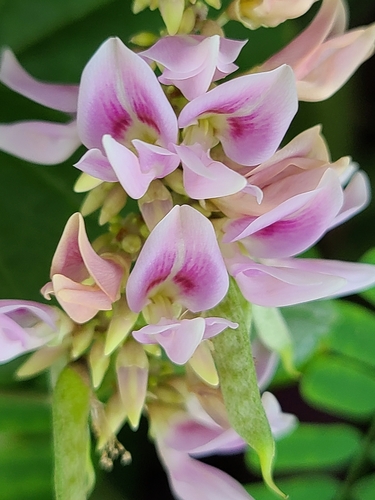
Crotalaria longirostrata
Hook. et Arn.
Long-beak rattlepod

(c) Don Marsille, some rights reserved (CC BY-NC), uploaded by Don Marsille
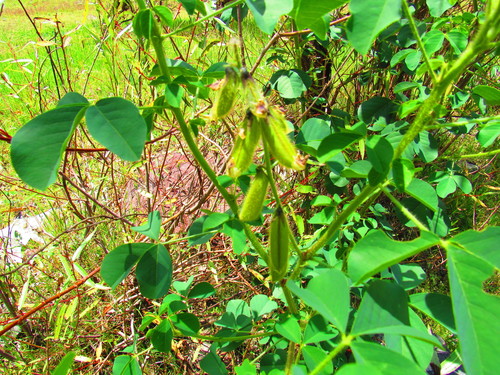
(c) Oscar Alejandro Morales Juárez, some rights reserved (CC BY-SA)
What to Eat
Edible parts: Leaves, Flowers
The leaves are cooked and eaten, can be ground with garlic and added to bread or white sauce for a distinctive flavor, and can be dried and stored. The flowers are also edible.
Known Hazards
Where to Find It
A tropical plant. It will grow to 2,300 m in Guatemala.
Central America*, Costa Rica, El Salvador, Guatemala, Hawaii, Honduras, Mexico, North America, Panama, South America, USA,
How to Identify
A herb or shrub. It is erect and grows 1.5 m high. The leaves are deep green. They are compound and alternate. The flowers are yellow.
Nutrition
| Part | Moisture | kJ | kcal | Protein | Vit A | Vit C | Iron | Zinc |
|---|---|---|---|---|---|---|---|---|
| Leaves | — | — | — | — | 50 | 4.7 | — | — |
How to Grow
Plants in this genus generally prefer a sunny position, succeeding in dry to moist, well-drained soils. The plant has been known to escape from cultivaion - it is recorded as 'Invasive' in Hawaii. This species has a symbiotic relationship with certain soil bacteria, these bacteria form nodules on the roots and fix atmospheric nitrogen. Some of this nitrogen is utilized by the growing plant but some can also be used by other plants growing nearby.
Propagation: Seed - sow in situ. Pre-soaking the seed for 12 hours in warm water can help to reduce germination time.
Medicinal Uses
The leaves are used in folk medicine as a purgative or emetic. It is said that they act as a purgative if the leaves are held downward, whilst they act as an emetic if they are held upward!.
Wikipedia
Source ↗Crotalaria longirostrata, the chipilín, is a perennial legume that is native to Mexico and Central America. Other common names include chepil, chepilin, chipilin and longbeak rattlebox.
Production
It grows very quickly during the rainy season. It will produce edible leaves for 6 months before needing replanting.
Other Information
It is a cultivated food plant.
Notes
There are about 550 Crotalaria species. They are mostly tropical. It strongly fixes nitrogen improving the soil.
References (21)
- Bot. Beechey Voy. 285. 1838
- Casas, A., et al, 1996, Plant Management Among the Nahua and the Mixtec in the Balsas River Basin, Mexico: An Ethnobotanical Approach to the Study of Plant Domestication. Human Ecology, Vol. 24, No. 4 pp. 455-478
- Chizmar Fernandez, C., et al, 2009, Plantas comestibles de Centroamerica. Instituto de Biodiversidad, Costa Rica. p 195
- Facciola, S., 1998, Cornucopia 2: a Source Book of Edible Plants. Kampong Publications, p 103
- FAO, 1993, Valor Nutritivo Y Usis en Alimantacion humana de Algunis Cultivos Autoctonos Subexplotados de Mesoamerica. FAO, Santiago, Chile. p 60
- Hellmuth, N. M., 2013, Maya Ethnobotany. FLAAR Reports.
- Hermandez Bermejo, J.E., and Leon, J. (Eds.), 1994, Neglected Crops. 1492 from a different perspective. FAO Plant Production and Protection Series No 26. FAO, Rome. p18
- ILDIS Legumes of the World http:www:ildis.org/Legume/Web
- INFOODSUpdatedFGU-list.xls
- Kermath, B. M., et al, 2014, Food Plants in the Americas: A survey of the domesticated, cultivated and wild plants used for Human food in North, Central and South America and the Caribbean. On line draft. p 278
- Mapes, C. & Basurto, F., 2016, Biodiversity and Edible Plants of Mexico. Chapter 5 in R. Lira, et al. (eds.), Ethnobotany of Mexico, Ethnobiology, Springer. p 114
- Martin, F.W. & Ruberte, R.M., 1979, Edible Leaves of the Tropics. Antillian College Press, Mayaguez, Puerto Rico. p 198
- Morton, J. F., 1994, Pito (Erythrina berteroana) and Chipilin (Crotalaria longirostrata), (Fabaceae), Two Soporific Vegetables of Central America. Economic Botany, Vo. 48, No. 2, pp. 130-138
- Pascual-Mendoza, S. et al, 2021, Traditional knowledge of edible plants in an indigenous community in the Sierra Norte of Oaxaca, Mexico. Plant Biosystems - An International Journal Dealing with all Aspects of Plant Biology
- Piedra-Malagón, E. M., et al, 2022, Edible native plants of the Gulf of Mexico Province. Biodiversity Data Journal 10: e80565 p 21
- Seidemann J., 2005, World Spice Plants. Economic Usage, Botany, Taxonomy. Springer. p 123
- Terra, G.J.A., 1973, Tropical Vegetables. Communication 54e Royal Tropical Institute, Amsterdam, p 41
- USDA, ARS, National Genetic Resources Program. Germplasm Resources Information Network - (GRIN). [Online Database] National Germplasm Resources Laboratory, Beltsville, Maryland. Available: www.ars-grin.gov/cgi-bin/npgs/html/econ.pl (10 April 2000)
- Vazquez-Garcia. V., 2008, Gender, ethnicity, and economic status in plant management: Uncultivated edible plants among the Nahuas and Popolucas of veracruz, Mexico. Agriculture and Human Values 25: 65-77
- Wiersema, J. H. & Leon, B., 2013, World Economic Plants. A Standard Reference CRC Press. 2nd Ed. p 212
- World Checklist of Useful Plant Species 2020. Royal Botanic Gardens, Kew