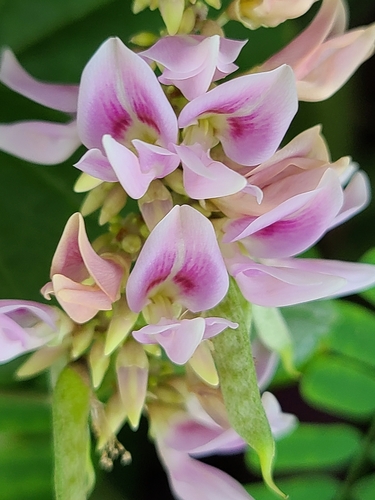
Crotalaria goreensis
Guill. & Perr.
Gambia pea

(c) Russell Cumming, some rights reserved (CC BY-NC), uploaded by Russell Cumming

(c) Deborah E Barber, some rights reserved (CC BY-NC)
What to Eat
Edible parts: Caution
Caution: It probably should not be eaten in large amounts.
Known Hazards
Where to Find It
It is a warm temperate to tropical plant. In Africa it grows between 600-1,200 m above sea level.
Africa, Angola, Australia, Central Africa, Congo DR, Ethiopia, Gambia, Mozambique, Senegal, Sudan, West Africa, Zambia, Zimbabwe,
How to Identify
A herb or small shrub. It has a woody taproot and grows 1.7 -2.6 m tall. The leaves have 3 leaflets. The leaflets are 2.5-8.5 cm long by 0.8-2.5 cm wide. The flowers are yellow and turn reddish. The pod is 1.5-2 cm long by 0.7-0.9 cm wide. The seeds are orange and 2.5-4 mm long.
How to Grow
Plants in this genus generally prefer a sunny position, succeeding in dry to moist, well-drained soils. The plant readily invades disturbed areas and prevents the regeneration of native species. Seed is dispersed in contaminated pasture seed and fodder, as well as by machinery, vehicles and water. The plant is an invasive weed in Australia. This species has a symbiotic relationship with certain soil bacteria; these bacteria form nodules on the roots and fix atmospheric nitrogen. Some of this nitrogen is utilized by the growing plant but some can also be used by other plants growing nearby.
Propagation: Seed - sow in situ. Pre-soaking the seed for 12 hours in warm water can help to reduce germination time.
Other Uses
The plant is used as green manure for tobacco and sugar cane in Australia (Queensland). It has performed well in New Guinea.
Names & Synonyms
References (1)
- World Checklist of Useful Plant Species 2020. Royal Botanic Gardens, Kew