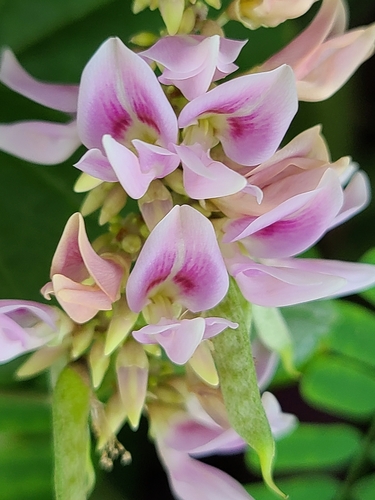
Isomacrolobium explicans
(Baill.) Breteler

MBG

MBG
What to Eat
Edible parts: Seeds
Seeds - cooked. They are sometimes eaten in times of food shortages. They contain 83.6% carbohydrate; 5.1% protein; 7% fat; and 4.1% fibre.
Where to Find It
It is a tropical plant. It grows up to 500 m above sea level.
Africa, Côte d'Ivoire, Guinea, Guinée, Ivory Coast, Liberia, Sierra Leone, West Africa,
How to Identify
A shrub that can be climbing. It can grow 20 m long. The trunk is short and twisted and 60 cm across. It can have low buttresses.
Other Uses
The flexible stem-ends are split and used as withies for tying up rice sheaves and lashing house-posts. The heartwood is dull purplish brown, often streaked; the sapwood pale brown. The grain is fairly straight, texture moderately fine. The wood is heavy, hard, tough and strong. It is easy to cut, finishes smoothly and is durable. The wood is sawn into planks.
Other Information
It is a famine food.
Names & Synonyms
References (2)
- Ferns, Useful Tropical Plants
- World Checklist of Useful Plant Species 2020. Royal Botanic Gardens, Kew