Lessertia canescens
Goldblatt & J. C. Manning

iNaturalist · cc-by-sa
(c) Tony Rebelo, some rights reserved (CC BY-SA), uploaded by Tony Rebelo
(c) Tony Rebelo, some rights reserved (CC BY-SA), uploaded by Tony Rebelo
iNaturalist · cc-by-nc
(c) Nick Helme, some rights reserved (CC BY-NC)
(c) Nick Helme, some rights reserved (CC BY-NC)

iNaturalist · cc-by
(c) Christina, some rights reserved (CC BY)
(c) Christina, some rights reserved (CC BY)
What to Eat
Edible parts: Leaves - tea
The leaves are used to prepare tea drinks.
Where to Find It
It is a subtropical plant. In South Africa, it grows on coastal sands below 100 m above sea level.
Africa, South Africa*, Southern Africa,
Countries: Angola, Burkina Faso, Burundi, Benin, Botswana, Congo (DRC), Central African Republic, Congo (Republic), Cote d'Ivoire, Cameroon, Cape Verde, Djibouti, Algeria, Egypt, Eritrea, Ethiopia, Gabon, Ghana, Gambia, Guinea, Equatorial Guinea, Guinea-Bissau, Kenya, Comoros, Liberia, Lesotho, Libya, Morocco, Madagascar, Mali, Mauritania, Mauritius, Malawi, Mozambique, Namibia, Niger, Nigeria, Rwanda, Seychelles, Sudan, Sierra Leone, Senegal, Somalia, South Sudan, Sao Tome & Principe, Eswatini, Chad, Togo, Tunisia, Tanzania, Uganda, South Africa, Zambia, Zimbabwe
How to Identify
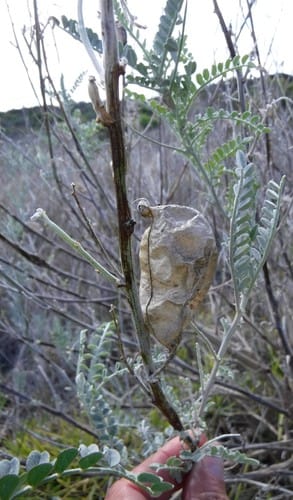
A small shrub. It grows 40 cm tall. The leaves have leaflets and one at the end. The leaflets are broadly heart shaped and have silvery hairs on both ends. The flowers are red. The pods are large and inflated.
References (3)
- Ruiters-Welcome, A. K., 2019, Food plants of southern Africa. Ph.D. thesis. Univ. of Johannesburg p 58
- van Wyk, Ben-Erik, 2019, The diversity and multiple uses of southern African legumes. Australian Systematic Botany, 2019, 32, 519–546
- Welcome, A. K. & Van Wyk, B.-E., 2019, An inventory and analysis of the food plants of southern Africa. South African Journal of Botany 122 (2019) 136–179




