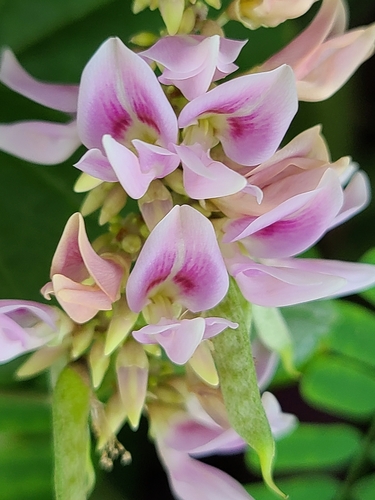
Philenoptera nelsii
(Schinz) Schrire

(c) Riana Fourie, some rights reserved (CC BY-NC), uploaded by Riana Fourie

(c) hkennedy, some rights reserved (CC BY-NC)
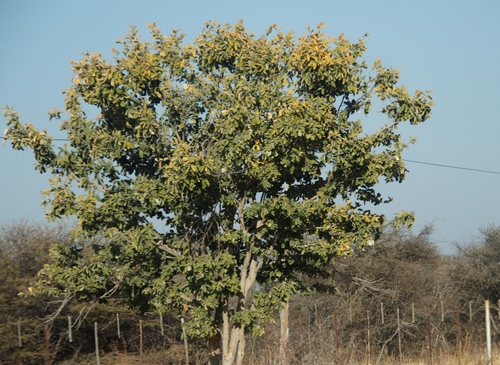
(c) Tony Rebelo, some rights reserved (CC BY-SA), uploaded by Tony Rebelo
What to Eat
Edible parts: Bark - milk curdling
The bark is used to curdle milk.
Where to Find It
It is a subtropical plant.
Africa, Angola, Botswana, Namibia*, South Africa, Southern Africa, Zambia, Zimbabwe,
How to Identify
A shrub or small tree. It grows 12 m tall. It is round at the top. The bark is rough and grey. The small branches are hairy. The leaves have one leaflet. It is leathery and stiff. They are 16 cm long by 9 cm wide. The flowering shoots are 30 cm long. The pod is narrow and 10 cm long by 2 cm wide. There are 1-4 seeds.
How to Grow
This species has a symbiotic relationship with certain soil bacteria; these bacteria form nodules on the roots and fix atmospheric nitrogen. Some of this nitrogen is utilized by the growing plant but some can also be used by other plants growing nearby.
Medicinal Uses
The bark is antitussive and pectoral. A decoction is drunk in the treatment of chest ailments and severe or persistent coughing. The root is antitussive and pectoral. A decoction is drunk in the treatment of chest ailments and severe or persistent coughing. The leaves are chewed to treat a bad cold.
Other Uses
Pencil-sized branches are used as chew sticks for cleaning the teeth and maintaining oral hygeine. The wood is sometimes used to make household utensils such as spoons.
Names & Synonyms
References (4)
- Kew Plants of the World Online
- Ruiters-Welcome, A. K., 2019, Food plants of southern Africa. Ph.D. thesis. Univ. of Johannesburg p 59
- van Wyk, Ben-Erik, 2019, The diversity and multiple uses of southern African legumes. Australian Systematic Botany, 2019, 32, 519–546
- Welcome, A. K. & Van Wyk, B.-E., 2019, An inventory and analysis of the food plants of southern Africa. South African Journal of Botany 122 (2019) 136–179