Sansevieria pearsonii
N. E. Br.
iNaturalist · cc-by-nc
(c) Felix Riegel, some rights reserved (CC BY-NC), uploaded by Felix Riegel
(c) Felix Riegel, some rights reserved (CC BY-NC), uploaded by Felix Riegel

iNaturalist · cc-by-nc
(c) sbahlesonke, some rights reserved (CC BY-NC)
(c) sbahlesonke, some rights reserved (CC BY-NC)

iNaturalist · cc-by-nc
(c) sbahlesonke, some rights reserved (CC BY-NC)
(c) sbahlesonke, some rights reserved (CC BY-NC)
What to Eat
Edible parts: Root, Fruit
The fruit are eaten as a snack. The root is also an edible portion.
Where to Find It
It is a subtropical plant.
Africa, Botswana, Namibia, South Africa, Southern Africa, Zimbabwe,
Countries: Angola, Burkina Faso, Burundi, Benin, Botswana, Congo (DRC), Central African Republic, Congo (Republic), Cote d'Ivoire, Cameroon, Cape Verde, Djibouti, Algeria, Egypt, Eritrea, Ethiopia, Gabon, Ghana, Gambia, Guinea, Equatorial Guinea, Guinea-Bissau, Kenya, Comoros, Liberia, Lesotho, Libya, Morocco, Madagascar, Mali, Mauritania, Mauritius, Malawi, Mozambique, Namibia, Niger, Nigeria, Rwanda, Seychelles, Sudan, Sierra Leone, Senegal, Somalia, South Sudan, Sao Tome & Principe, Eswatini, Chad, Togo, Tunisia, Tanzania, Uganda, South Africa, Zambia, Zimbabwe
How to Identify
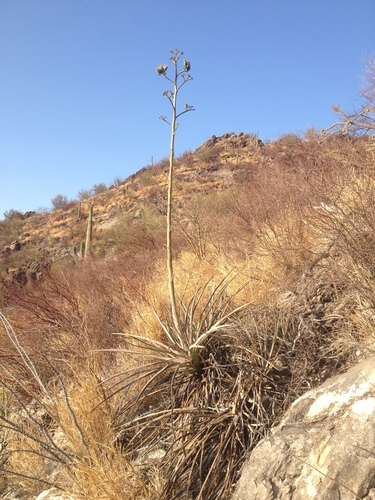
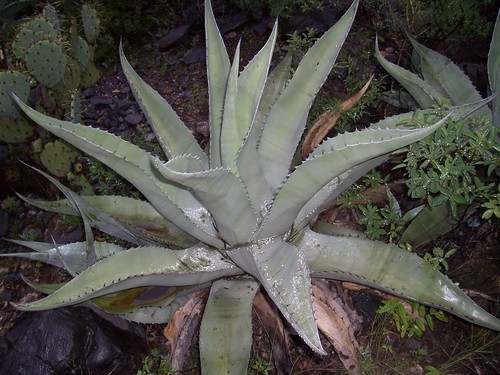
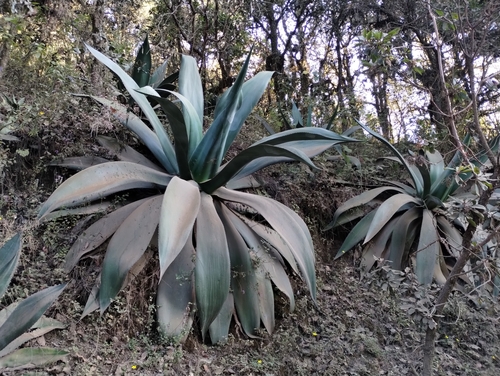
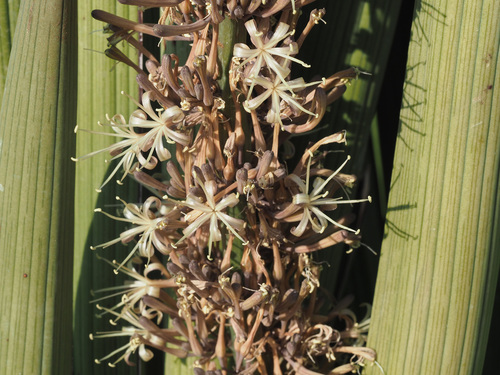
A herb. It grows 1 m tall. It has underground runners. There are 5-7 leaves. They are a dull dark green with red-brown lines. They are very sharp and pointed. The fruit is round and orange.
How to Grow
The plant spreads at the roots and often forms large colonies.
Propagation: Seed - Division.
Other Uses
A strong fibre is obtained from the leaves. It can be plaited into very strong cords. The fibres can be extracted simply by scraping the fleshy plant tissue with the sharp end of a stick, leaving behind the whitish, hair-like fibres.
Notes
Also put in the family Ruscaceae.
Names & Synonyms
Sansevieria deserti N. E. Br.Sanseviera rhodesiana N. E. Br.
References (2)
- Ruiters-Welcome, A. K., 2019, Food plants of southern Africa. Ph.D. thesis. Univ. of Johannesburg p 98
- Welcome, A. K. & Van Wyk, B.-E., 2019, An inventory and analysis of the food plants of southern Africa. South African Journal of Botany 122 (2019) 136–179