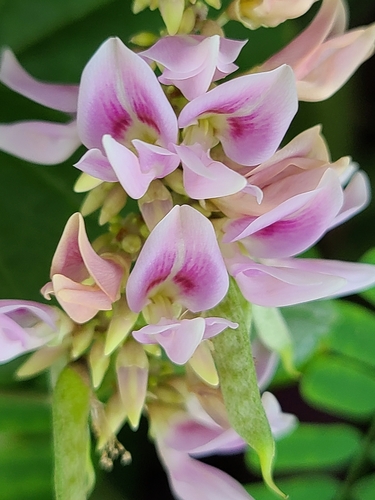
Otoptera burchellii
DC.
Purple savannah pea
FabaceaeRoots

iNaturalist · cc-by-nc
(c) Riana Fourie, some rights reserved (CC BY-NC), uploaded by Riana Fourie
(c) Riana Fourie, some rights reserved (CC BY-NC), uploaded by Riana Fourie

iNaturalist · cc-by-nc
(c) Bart Wursten, some rights reserved (CC BY-NC)
(c) Bart Wursten, some rights reserved (CC BY-NC)
What to Eat
Edible parts: Tap root
The tap root is roasted and eaten.
Where to Find It
It is a subtropical plant.
Africa, Namibia, Southern Africa, Zimbabwe,
Countries: Angola, Burkina Faso, Burundi, Benin, Botswana, Congo (DRC), Central African Republic, Congo (Republic), Cote d'Ivoire, Cameroon, Cape Verde, Djibouti, Algeria, Egypt, Eritrea, Ethiopia, Gabon, Ghana, Gambia, Guinea, Equatorial Guinea, Guinea-Bissau, Kenya, Comoros, Liberia, Lesotho, Libya, Morocco, Madagascar, Mali, Mauritania, Mauritius, Malawi, Mozambique, Namibia, Niger, Nigeria, Rwanda, Seychelles, Sudan, Sierra Leone, Senegal, Somalia, South Sudan, Sao Tome & Principe, Eswatini, Chad, Togo, Tunisia, Tanzania, Uganda, South Africa, Zambia, Zimbabwe
How to Identify
A herb with trailing stems. These can be 2 m long. It can be a climber. The stems are hairy. The leaves have leaflets 1.3-10 cm long by 0.4-3.5 cm wide. The our rounded or wedge shaped at the base and oval and tapering at the tip. The flowers can be pink or blue and have a sweet scent. The fruit are pods 5-12 cm long by 5-8 mm wide. The seeds are dark brown and 9 mm by 5.5 mm,
References (1)
- World Checklist of Useful Plant Species 2020. Royal Botanic Gardens, Kew p 322