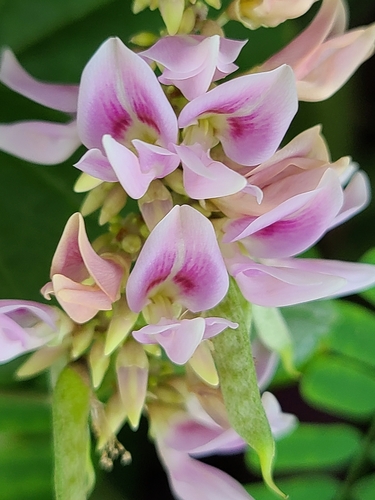
Cullen patens
(Lindl.) J.W. Grimes
Native Verbine
FabaceaeLeaves

iNaturalist · cc-by-nc
(c) Ken Harris EntSocVic, some rights reserved (CC BY-NC), uploaded by Ken Harris EntSocVic
(c) Ken Harris EntSocVic, some rights reserved (CC BY-NC), uploaded by Ken Harris EntSocVic

iNaturalist · cc-by-nc
(c) Ken Harris EntSocVic, some rights reserved (CC BY-NC), uploaded by Ken Harris EntSocVic
(c) Ken Harris EntSocVic, some rights reserved (CC BY-NC), uploaded by Ken Harris EntSocVic
What to Eat
Edible parts: Vegetable
The plant is used as a vegetable.
Where to Find It
It grows in warm temperate regions. It grows on clay loam and sandy soils.
Australia*,
Countries: Australia
How to Identify
A herb. It usually lies along the ground. It spreads 4 m wide. The flowers are purple.
Notes
Also as Papilionaceae.
Names & Synonyms
Psoralea eriantha Benth.Psoralea patens Lindl.
References (5)
- Grimes, J. W. 1997. A revision of Cullen (Leguminosae: Papilionoideae). Austral. Syst. Bot. 10:600.
- Muelleria 9:196. 1996
- Paczkowska, G . & Chapman, A.R., 2000, The Western Australian Flora. A Descriptive Catalogue. Western Australian Herbarium. p 423
- USDA, ARS, National Genetic Resources Program. Germplasm Resources Information Network - (GRIN). [Online Database] National Germplasm Resources Laboratory, Beltsville, Maryland. Available: www.ars-grin.gov/cgi-bin/npgs/html/econ.pl (10 April 2000)
- World Checklist of Useful Plant Species 2020. Royal Botanic Gardens, Kew