Swartzia arborescens
(Aubl.) Pittier
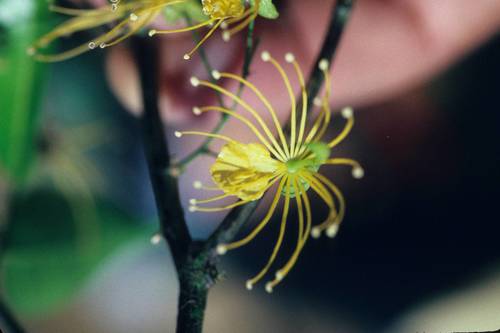
(c) Smithsonian Institution, National Museum of Natural History, Department of Botany, some rights reserved (CC BY-NC-SA)

(c) Guillaume Delaitre, some rights reserved (CC BY)

(c) Guillaume Delaitre, some rights reserved (CC BY)
What to Eat
Edible parts: Fruit
The fruit is eaten.
Known Hazards
Where to Find It
It is a tropical plant.
Amazon, Bolivia, Brazil, Central America, Colombia, Ecuador, Panama, Peru, South America*,
How to Identify
A tree. It grows 10 m tall. The leaves have 1-3 leaflets. The end leaflets is 5-10 cm long. The fruit is a pod 4-5 cm long. The seeds are oval and at an angle.
How to Grow
This species has a symbiotic relationship with certain soil bacteria; these bacteria form nodules on the roots and fix atmospheric nitrogen. Some of this nitrogen is utilized by the growing plant but some can also be used by other plants growing nearby.
Other Uses
The heartwood is dark brown; the sapwood almost white or pale yellow, in some specimens with pale brown or greyish streaks. The texture is fine; grain straight or interlocked, when seasoned it is odourless and tasteless. The wood is moderately heavy to heavy and tenacious; inclined to be fibrous, probably durable. It is not easy to work; takes a smooth finish. We have no more information on the wood of this species. However, a general description of the wood from plants in this genus is as follows:- The heartwood is dark brown, reddish-brown, or nearly black, in solid colour or somewhat variegated; it is sharply demarcated from the nearly white to yellowish sapwood. The texture is very fine to medium; the grain straight to irregular; lustre is usually medium; there is no distinctive odour or taste. The heartwood is very resistant to attack by decay fungi and resistant to dry-wood termites, though it is not resistant to marine borers. The wood is generally reported to be moderately difficult to air dry because of checking and warp. It is difficult to work because of its high density, but it finishes very smoothly and takes a high polish. It is used for purposes such as inlay, parquet flooring, turnery, furniture, cabinetwork, violin bows, specialty items; and has been suggested as a substitute for ebony.
Names & Synonyms
Caya, Moira jiboia preta
References (3)
- Philips, O., 1992, The potential for harvesting fruits in tropical rainforests: new data from Amazonian Peru. Biodiversity and Conservation 2, 18-38
- Roa, J. A. G. & Boada, D. S. G., 2018, Fundación para el Fortalecimiento de la Fruticultura y Plantas Alimenticias no Convencionales en Colombia.
- Torre, de la, L., et al, 2008, Enciclopedia de las Plantas Útiles del Ecuador. Herbario QCA. Pontificia Universidad Católica del Ecuador. p 360




