Wrightia pubescens
R. Br.
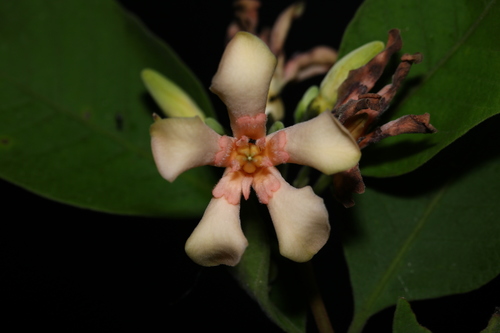
(c) 方伊琳(阿鈣), some rights reserved (CC BY-NC), uploaded by 方伊琳(阿鈣)

(c) Jason Searle, some rights reserved (CC BY-NC)

(c) Jason Searle, some rights reserved (CC BY-NC)
What to Eat
Edible parts: Bark
The bark is commonly used in Indonesia as a coagulant for the manufacture of 'litsusu', a traditional cheese-like product.
Where to Find It
It is a tropical plant. It grows up to 1,000 m above sea level.
Asia, Australia, Cambodia, China, Indonesia, Laos, Malaysia, Myanmar, New Guinea, Philippines, SE Asia, Thailand, Vietnam,
How to Identify
A tree. It grows 35 m tall. The trunk can be 60 cm across. The bark is yellowish-brown. Young branches have yellow hairs. The leaves are 5-10 cm long by 3-6 cm wide. The fruit are follicles 15-30 cm long by 1-2 cm wide. The seeds are narrow and 3.5 cm long.
How to Grow
Found at elevations up to 1,000 metres. Requires a sunny position. Prefers a deep soil. Established plants are drought tolerant.
Medicinal Uses
The latex has been used as a treatment against severe dysentery. Extracts from the roots and bark are used to treat scrofula and rheumatic arthralgia. The roots and bark are used in poultices.
Other Uses
Bark fibres are used for making paper and artificial cotton. The wood is light, soft and fine-textured, hence suitable for carving and turnery. This species is the main source of the wood known as 'lanete'. It is used for purposes such as general construction, pencils, musical instruments, wayang figures and carving. The tree is sometimes used in reforestation projects in the Philippines.
Wikipedia
Source ↗Wrightia pubescens is a species of small tree in the family Apocynaceae. Its distribution includes: Australia (Northern Territory, Queensland), southern China, Taiwan (introduced), Indonesia (Java, Lesser Sunda Isl., Moluccas, Sulawesi, Sumatra), New Guinea, Philippines (Masbate, Panay, Guimaras, Negros, Cebu, Biliran, Leyte, Mindanao) and Indo-China (Cambodia, Malaysia, Thailand, Viet Nam). In Viet Nam, it may be called: lòng mức lông.
Names & Synonyms
References (1)
- World Checklist of Useful Plant Species 2020. Royal Botanic Gardens, Kew


