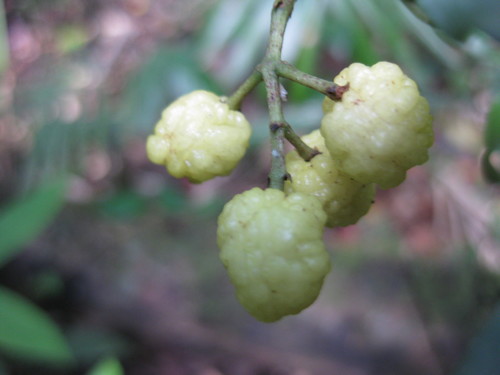
Galipea officinalis
Hancock
Angostura, Cusparia bark

wikimedia · pd
Hamilton, Edward (via Wikimedia Commons)
Hamilton, Edward (via Wikimedia Commons)

wikimedia · cc-by-sa
photo by Michael Saalfeld (via Wikimedia Commons)
photo by Michael Saalfeld (via Wikimedia Commons)
What to Eat
Edible parts: Bark - flavouring
The bark is used as a flavouring extract in bitter tonics, baked goods, ice cream, and gelatins.
Known Hazards
Where to Find It
It is a tropical plant. It grows in humus rich soil in part shade. It needs a temperature above 15-18°C.
America, South America,
How to Identify
A rainforest shrub. It grows 15 m high and spreads 10 m wide. The bark is smooth and grey. The leaves have 3 leaflets. The leaves are 30 cm long. The flowers are tube shaped and white with 5 lobes. The fruit are 5 celled capsules. The seeds are round and black.
Notes
There are 8-10 Galipea species. They grow in tropical America. It is also used to stun fish.
Names & Synonyms
Cusparia febrifugaGalipea cusparia
References (5)
- Brouk, B., 1975, Plants Consumed by Man. Academic Press, London. p 277 (As Cusparia febrifuga)
- Brown, D., 2002, The Royal Horticultural Society encyclopedia of Herbs and their uses. DK Books. p 218
- Facciola, S., 1998, Cornucopia 2: a Source Book of Edible Plants. Kampong Publications, p 221
- Morton,
- Trans. Med. Bot. Soc. London 1:25. 1829