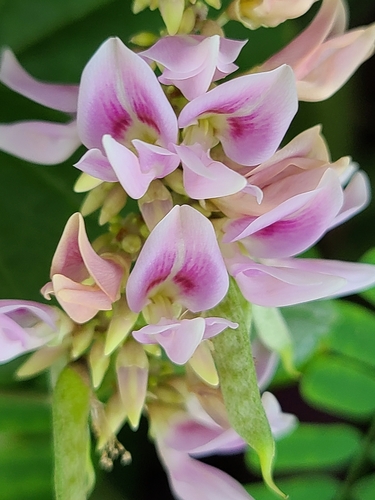
Adinobotrys vastus
(Kosterm.) J. Compton & Schrire
FabaceaeSeeds/Nuts

wikimedia · cc-by-sa
Wikimedia Commons - Bernard DUPONT from FRANCE
Wikimedia Commons - Bernard DUPONT from FRANCE

gbif · cc0
President and Fellows of Harvard College
President and Fellows of Harvard College

gbif · cc0
President and Fellows of Harvard College
President and Fellows of Harvard College
What to Eat
Edible parts: Seeds - oil
The seeds are processed for oil.
Where to Find It
It is a tropical plant. It grows in occasionally flooded sites. In Kalimantan. It grows from sea level to 250 m above sea level.
Asia, Indonesia, Malaysia, SE Asia,
Countries: United Arab Emirates, Afghanistan, Armenia, Azerbaijan, Bangladesh, Bahrain, Brunei, Bhutan, China, Georgia, Indonesia, Israel, India, Iraq, Iran, Jordan, Japan, Kyrgyzstan, Cambodia, North Korea, South Korea, Kuwait, Kazakhstan, Laos, Lebanon, Sri Lanka, Myanmar, Mongolia, Maldives, Malaysia, Nepal, Oman, Philippines, Pakistan, Qatar, Saudi Arabia, Singapore, Syria, Thailand, Tajikistan, Timor-Leste, Turkmenistan, Turkey, Taiwan, Uzbekistan, Vietnam, Yemen
How to Identify
A tree. It grows 35 m tall. It has a short thick trunk and very large buttresses. The flowers are dark purple.
Names & Synonyms
Callerya vasta (Kosterm.) SchotMillettia vasta Kosterm.
References (2)
- Kew Plants of the World On line
- Sosef, M. S. M., Hong, L. T., & Prawirohatmodjo, S., (Eds.), 1998, Timber tree: Lesser-known timbers. Plant Resources of South-East Asia, 5(3), p 128 (As Callerya vasta)