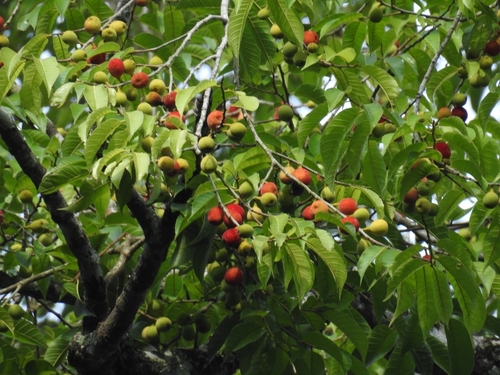
Ficus subcordata
Blume
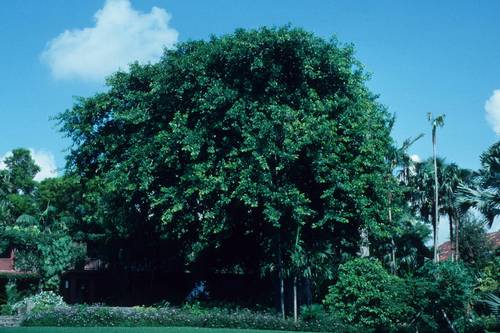
(c) Smithsonian Institution, National Museum of Natural History, Department of Botany, some rights reserved (CC BY-NC-SA)

Wikimedia Commons - Photo by David J. Stang

Wikimedia Commons - Photo by David J. Stang
What to Eat
Edible parts: Fruit
The fruit is edible.
Where to Find It
It is a tropical plant.
Asia, Indonesia, Malaysia, Pacific, Papua New Guinea, PNG, Philippines, SE Asia, Solomon islands, Vanuatu, Vietnam,
How to Identify
A tree. It can grow 30 m tall. It can grow attached to other plants. The leaves are in spirals.
How to Grow
A plant of the moist, lowland tropics, where it is found at elevations up to 800 metres. It grows best in areas where annual daytime temperatures are within the range 22 - 30°c, but can tolerate 15 - 39°c. It prefers a mean annual rainfall in the range 1,200 - 1,800mm, but tolerates 900 - 2,500mm. Prefers a position in full sun. Tolerates a wide range of soil types, growing well on limestone-based soil and on sloping land of 25cm soil depth. Prefers a well-drained soil. Prefers a pH in the range 7 - 7.5, tolerating 6.5 - 8. In shallow soil the lateral roots near the soil surface can spread 4 - 7 metres away from the base of the trunk. Under natural conditions, reproduction starts when the tree is 5 - 6 years old. Firewood production from 3-year-old trees may be 30 - 65 kilos per tree, increasing to 240 - 350 kilos per tree for older trees. The tree can be planted at 5 - 10 metre spacing when used as fence border and at 10 metres x 10 metres within and between rows when used as a windbreak. Many species can be grown with this plant, including grasses such as Cenchrus ciliaris, Panicum maximum, and Urochloa mosambicensis; herbaceous legumes such as Stylosanthes hamata, Stylosanthes scabra, and Centrosema pubescens; shrub legumes such as Leucaena leucocephala and Gliricidia sepium; and fodder trees such as Lannea coromandelica and Hibiscus tiliaceus. Fig trees have a unique form of fertilization, each species relying on a single, highly specialized species of wasp that is itself totaly dependant upon that fig species in order to breed. The trees produce three types of flower; male, a long-styled female and a short-styled female flower, often called the gall flower. All three types of flower are contained within the structure we usually think of as the fruit. The female fig wasp enters a fig and lays its eggs on the short styled female flowers while pollinating the long styled female flowers. Wingless male fig wasps emerge first, inseminate the emerging females and then bore exit tunnels out of the fig for the winged females. Females emerge, collect pollen from the male flowers and fly off in search of figs whose female flowers are receptive. In order to support a population of its pollinator, individuals of a Ficus spp. must flower asynchronously. A population must exceed a critical minimum size to ensure that at any time of the year at least some plants have overlap of emmission and reception of fig wasps. Without this temporal overlap the short-lived pollinator wasps will go locally extinct.
Propagation: Seed - since it is very small, the seed is preferably sown under nursery conditions. Germination usually takes 3 - 4 weeks. After development of the cotyledons and a few secondary leaves, seedlings should be transplanted into pots. Planting into permanent sites is carried out during the rainy season when the plants are 6 - 12 months old. Propagation by cuttings is most commonly practised by farmers. For direct planting, healthy and straight 2-year-old stems of 5 - 10 cm in diameter and 1.5 - 2.5 metres in length are cut from the parent tree. The end to be planted should be even and free from splitting, and any leaves and twigs should be removed. Each cutting should be planted in a prepared hole of 25 cm depth and 15 cm width, then covered with soil in such a way that the planted stem cannot move. Direct planting should be carried out at the onset of the rainy season, since planting during the wet season causes the buried cambium to rot. Twelve weeks after planting 75% of the cuttings can develop buds and about 70% survive after 52 weeks. Twenty-six weeks after planting a cutting, there can be 8 - 13 main branches of 45 - 55 cm length and 10 - 12 leaves per branch. For planting in nurseries, twigs with 50 - 100 cm length are inserted in 10 - 15 cm of soft and moist soil. Such cuttings are not ready for transplanting until the roots are well developed.
Other Uses
The bark is used for making string for farm tools. The timber is not hard enough for building houses, making farm implements or woodcarving. The mature stem is used for farmyard posts. The wood is used as fuel for brick and limestone kilns, and the smaller branches are used for household firewood. The tree is used as shade, for storing crop residues, for reclamation of denuded land, for protecting soil on sloping land and as a windbreak.
Wikipedia
Source ↗Ficus subcordata is a banyan fig species in the family Moraceae. No subspecies are listed in the Catalogue of Life. The species can be found in Indo-china, Malesia and New Guinea. In Vietnam it may be called sung mù u.
Names & Synonyms
References (1)
- Lebot, V. & Sam, C., Green desert or ‘all you can eat’? How diverse and edible was the flora of Vanuatu before human introductions?. Terra australis 52 p 408