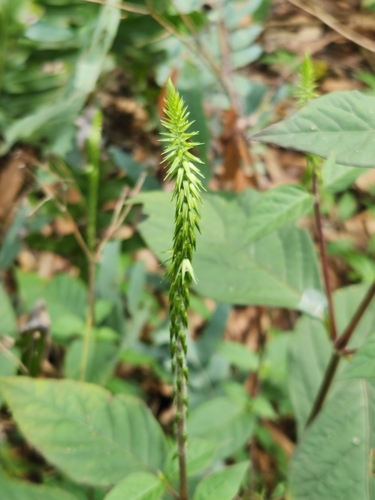
Cyathula prostrata
(L.) Blume
Prostrate pastureweed, Prostrate burr-amaranth

(c) JODY HSIEH, some rights reserved (CC BY-NC), uploaded by JODY HSIEH

(c) Dinesh Valke, some rights reserved (CC BY-SA)

(c) Dinesh Valke, some rights reserved (CC BY-SA)

Sumit Bhowmick

Sumit Bhowmick

Sumit Bhowmick
What to Eat
Edible parts: Leaves, Vegetable
The leaves are eaten as a vegetable.
Where to Find It
A tropical plant. It occurs throughout the tropics. In Papua New Guinea the plant occurs between sea level and 1,200 m. Sometimes it grows up to 2,000 m. It grows in moist shady places. It can grow in arid places.
Africa, American Samoa, Angola, Asia, Australia, Bhutan, Brazil, Burkina Faso, Cambodia, Cameroon, Caribbean, Central Africa, Central African Republic, CAR, Central America, China, Congo DR, Côte d'Ivoire, Dominica, East Africa, Ethiopia, Fiji, Gabon, Gambia, Ghana, Guiana, Guianas, Guinea, Guinée, Guinea-Bissau, Guyana, Himalayas, India, Indochina, Indonesia, Ivory Coast, Laos, Liberia, Malawi, Malaysia, Mali, Marquesas, Mozambique, Myanmar, Nepal, Nigeria, Northeastern India, Pacific, Panama, Papua New Guinea, PNG, Philippines, Rotuma, Samoa, Sao Tome and Principe, SE Asia, Sierra Leone, Sikkim, Solomon Islands, South America, Sudan, Suriname, Tanzania, Thailand, Togo, Tonga, Uganda, Venezuela, Vietnam, West Africa, Zambia, Zimbabwe,
How to Identify
A herb which continues to grow from year to year. It can be upright or hanging over. It often lies along the ground. It grows up to 50-100 cm tall. The stem is slender, stiff and brittle. The stem is tinged red. It has many branches. These are thickened and often form roots at the nodes. The leaves are 1.5-10 cm long by 1-5 cm wide. They are narrowed below the middle. The leaf stalk is 2-12 mm long so the leaves appear to be attached directly to the stalk. The leaves often have red hairs underneath and near the veins. The flowers are mostly in one stalk. These arise from the axils of the upper leaves. These flower arrangements are 5-25 cm long. Along it the flowers are in clusters with 1-3 fertile flowers and some sterile ones. The fruit or seed is oval and about 1.5 mm long and shiny brown. The flower clusters have small hooks and these attach to things moving the seeds around.
Nutrition Score: 31/100
| Part | Moisture | kJ | kcal | Protein | Vit A | Vit C | Iron | Zinc |
|---|---|---|---|---|---|---|---|---|
| Leaves | 85.6 | 143 | 34 | 3.6 | — | 10 | — | — |
How to Grow
Plants are mostly self sown from seed. They can be grown from cuttings.
Propagation: Seed - Stem cuttings.
Medicinal Uses
The plant is used in medicine.
Other Uses
The macerated leaves are used as soap.
Notes
It is used in medicine.
Names & Synonyms
Anghup merah, Bayam pasir, Bayam rusa, Bululu, Chaine d'enfant, Cherukadaladi, Cuocdai, Ekur kuching, Hamac de la biche, Jarang-jarang, Linilini Kyet-mauk-pyan, Menjarang, Nyarang puteh, Nyarang, Penjarang ayam, Penjarang, Rumput dayang, Senjarang, Temeku
References (28)
- Ambasta, S.P. (Ed.), 2000, The Useful Plants of India. CSIR India. p 153
- Bijdr. 549. 1826
- Borrell, O.W., 1989, An Annotated Checklist of the Flora of Kairiru Island, New Guinea. Marcellin College, Victoria Australia. p 48, 173
- Burkill, H. M., 1985, The useful plants of west tropical Africa, Vol. 1. Kew.
- Burkill, I.H., 1966, A Dictionary of the Economic Products of the Malay Peninsula. Ministry of Agriculture and Cooperatives, Kuala Lumpur, Malaysia. Vol 1 (A-H) p 728
- Checklist of NT Vascular Plant Species. January 2003.
- Cooper, W. and Cooper, W., 2004, Fruits of the Australian Tropical Rainforest. Nokomis Editions, Victoria, Australia. p 14
- Flora of Solomon Islands
- Garcia, G. S. C., 2006, The mother-child nexus. Knowledge and valuation of wild food plants in Wayanad, Western Ghats, India. Journal of Ethnobiology and Ethnomedicine, 2:39
- Grubben, G. J. H. and Denton, O. A. (eds), 2004, Plant Resources of Tropical Africa 2. Vegetables. PROTA, Wageningen, Netherlands. p 561
- Henty, E.E., & Pritchard, G.S., 1973, Weeds of New Guinea and their control. Botany Bulletin No 7, Division of Botany, Lae, PNG. p 60
- Jardin, C., 1970, List of Foods Used In Africa, FAO Nutrition Information Document Series No 2.p 73
- Kanis, A in Womersley, J.S., (Ed), 1978, Handbooks of the Flora of Papua New Guinea. Melbourne University Press. Vol 1. p 32
- Martin, F.W. & Ruberte, R.M., 1979, Edible Leaves of the Tropics. Antillian College Press, Mayaguez, Puerto Rico. p 173
- Mot So Rau Dai an Duoc O Vietnam. Wild edible Vegetables. Ha Noi 1994, p 36
- Narayanan Ratheesh, M. K. et al, 2011, Wild edible plants used by the Kattunaikka, Paniya and Kuruma tribes of Wayanad District, Kerala, India. Journal of Medicinal Plants Research Vol. 5(15), pp. 3520-3529
- Parham, B. E. V., 1972, Plants of Samoa. New Zealand Department of Scientific and Industrial Research. Information Series. No. 85 p 49
- Peekel, P.G., 1984, (Translation E.E.Henty), Flora of the Bismarck Archipelago for Naturalists, Division of Botany, Lae, PNG. p 170, 171
- Pham-Hoang Ho, 1999, An Illustrated Flora of Vietnam. Nha Xuat Ban Tre. p 729
- Raponda-Walker, A & Sillans, R., 1961, Les Plantes Utiles du Gabon. Editions Paul Lechevalier, Paris. p 50
- Royal Botanic Gardens, Kew (1999). Survey of Economic Plants for Arid and Semi-Arid Lands (SEPASAL) database. Published on the Internet; http://www.rbgkew.org.uk/ceb/sepasal/internet [Accessed 25th March 2011]
- Savita, et al, 2006, Studies on wild edible plants of ethnic people in east Sikkim. Asian J. of Bio Sci. (2006) Vol. 1 No. 2 : 117-125
- Smith, A.C., 1981, Flora Vitiensis Nova, Lawaii, Kuai, Hawaii, Volume 2 p 289
- Sukarya, D. G., (Ed.) 2013, 3,500 Plant Species of the Botanic Gardens of Indonesia. LIPI p 1100
- Thiselton-Dywer, W.T., (Ed.), 1913, Flora of Tropical Africa. Vol VI-section 1. Reeve, p 43
- World Checklist of Useful Plant Species 2020. Royal Botanic Gardens, Kew
- www.eFloras.org Flora of China
- Yuncker, T.G., 1959, Plants of Tonga, Bernice P. Bishop Museum, Hawaii, Bulletin 220. p 108