Zanthoxylum capense
(Thunb.) Harv.
Small knobwood
(c) Adriaan Grobler, some rights reserved (CC BY-NC), uploaded by Adriaan Grobler
(c) Craig Peter, some rights reserved (CC BY-NC), uploaded by Craig Peter

(c) Richard Gill, some rights reserved (CC BY-NC), uploaded by Richard Gill
What to Eat
Edible parts: Medicine
Where to Find It
It is a tropical plant.
Africa, Mozambique, South Africa, Zimbabwe,
How to Identify
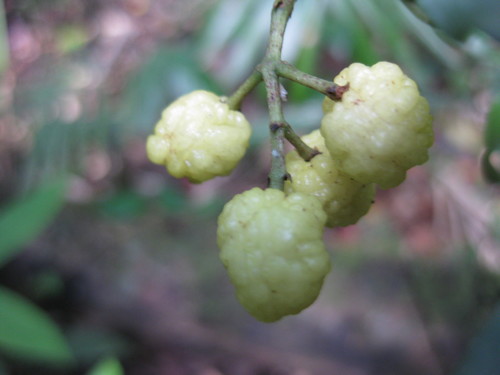
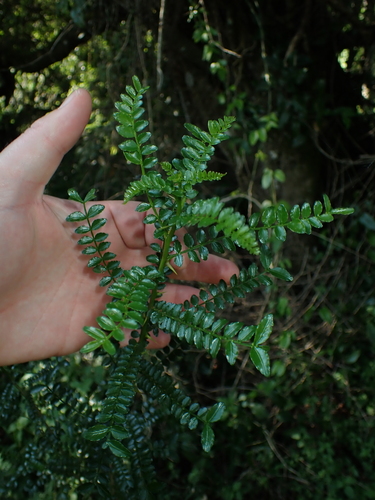
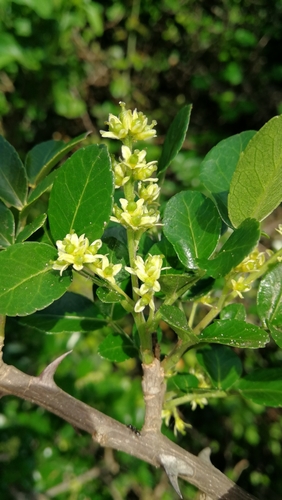
A shrub or small tree. It grows 13 m tall. The trunk and stems usually have spines. The leaves are compound with leaflets along the stalk. The leaflets are opposite and oval. They are 1-4 cm long by 1-2 cm wide. The leaves have a lemon scent when crushed. The flowers are greenish-yellow. The fruit are 4-4/5 mm across. The seeds are black and shiny.
Medicinal Uses
Used medicinally.
Wikipedia
Source ↗Zanthoxylum capense, the small knobwood, is a species of plant in the family Rutaceae. It occurs in the eastern regions of southern Africa, from the vicinity of Knysna, Western Cape to the Zimbabwean granite shield and coastal Mozambique. It tolerates a range of altitudes, from highveld to coastal elevations, but is most prevalent in dry thickets or on rocky slopes and outcrops. Their trunks are bare apart from the numerous conical knobs that each terminate in a spine. They bear clusters of compound leaves on the tips of their branches. The leaves and fruit are noticeably citrus-scented. The fruit are round capsules of about 5 mm in diameter, fully covered with glands. When they ripen they split open to release a single black and oil-rich seed. It is a host plant for the Citrus swallowtail, White-banded swallowtail and Emperor swallowtail butterflies. Similar species are the larger Z. davyi which is more limited to the mist belt regions, and Z. leprieurii that occurs in sand forests of subtropical lowlands.
Names & Synonyms
References (1)
- World Checklist of Useful Plant Species 2020. Royal Botanic Gardens, Kew