Cyclopia intermedia
E. Mey.
Mountain tea, Kouga bush tea, Honey-bush tea
(c) Felix Riegel, some rights reserved (CC BY-NC), uploaded by Felix Riegel
(c) Marienne de Villiers, some rights reserved (CC BY-NC)

(c) Αριστοτέλης Σκιαδαρέσης, some rights reserved (CC BY-NC), uploaded by Αριστοτέλης Σκιαδαρέσης
What to Eat
Edible parts: Leaves - tea, Stems - tea, Flowers - tea
The leaves, flowers, and twigs are cut into small pieces, fermented, and dried to make a fragrant tea.
Where to Find It
It is a subtropical plant.
Africa, South Africa*, Southern Africa,
How to Identify
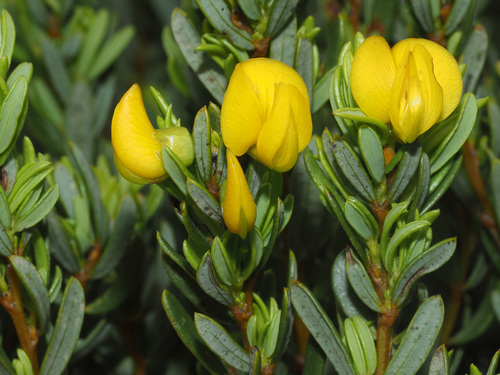
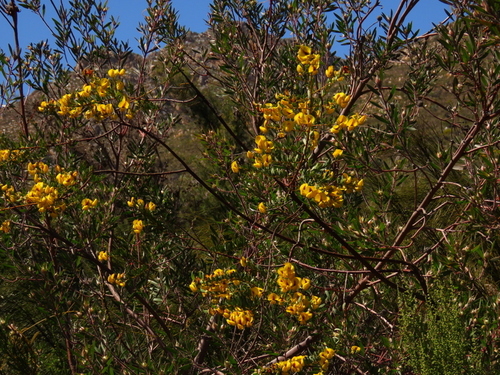
An evergreen shrub. It grows about 1 m high. The twigs are golden brown. The leaves have 3 leaflets. The leaves are narrowly oval. The flowers are in the axils of leaves. They are golden yellow and in clusters along the stem. They have a honey scent. The fruit are pods. They are flat and brown with many seeds.
Wikipedia
Source ↗Cyclopia intermedia is a species of flowering plant in the legume family. So called honeybush tea is made from fermented leaves and stems of this plant.
Other Information
It is cultivated commercially.
Names & Synonyms
References (11)
- E. H. F. Meyer & J. F. Drege, Comm. pl. Afr. austr. 3. 1836
- ILDIS Legumes of the World http:www:ildis.org/Legume/Web
- Kew Plants of the World On line
- Ruiters-Welcome, A. K., 2019, Food plants of southern Africa. Ph.D. thesis. Univ. of Johannesburg p 57
- van Wyk, B., 2005, Food Plants of the World. An illustrated guide. Timber press. p 167
- van Wyk, B., 2000, A Photographic Guide to Wild Flowers of South Africa. Struik Nature. p 41
- van Wyk, Be., & Gericke, N., 2007, People's plants. A Guide to Useful Plants of Southern Africa. Briza. p 102
- van Wyk, Ben-Erik, 2019, The diversity and multiple uses of southern African legumes. Australian Systematic Botany, 2019, 32, 519–546
- Welcome, A. K. & Van Wyk, B.-E., 2019, An inventory and analysis of the food plants of southern Africa. South African Journal of Botany 122 (2019) 136–179
- Wiersema, J. H. & Leon, B., 2013, World Economic Plants. A Standard Reference CRC Press. 2nd Ed. p 223
- World Checklist of Useful Plant Species 2020. Royal Botanic Gardens, Kew