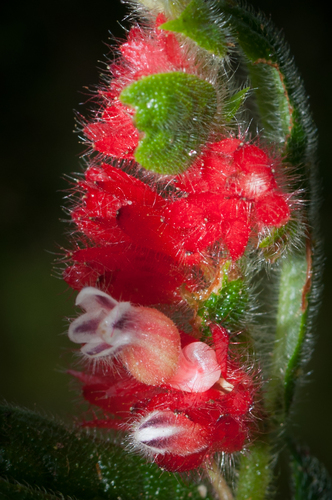
Cyrtandra pendula
Blume
Rock Sorrel
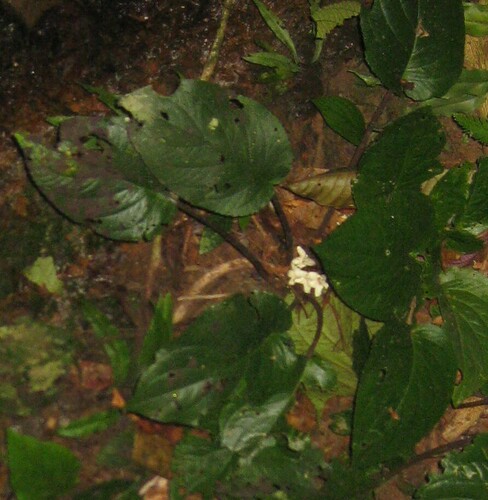
(c) Ganjar Cahyadi, some rights reserved (CC BY-NC), uploaded by Ganjar Cahyadi
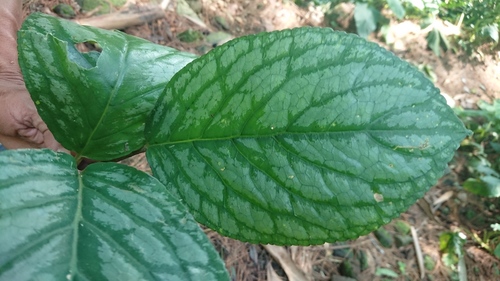
(c) aswad andriyanto, some rights reserved (CC BY-NC)
What to Eat
Edible parts: Leaves as condiment, Spice
The sour leaves are used as a flavouring, condiment, and spice.
Where to Find It
A tropical plant. It grows in forest vegetation.
Asia, Indonesia, Malaysia, SE Asia,
How to Identify
A herb. It can be creeping or curve upwards. It can be 15 cm tall. The stem are brown and with scattered stiff hairs. It is angular. The leaves are opposite. One of the pairs is small. They are crowded at the top of the stem. The leaf stalk is 7-27 cm long. The edges have rounded teeth. They have soft hairs. The leaf blade is oval and 13-20 cm long by 7-12 cm wide. The edges of the leaves have teeth which can be rounded or sharp. The leaves are very hairy on the veins underneath the leaf. The flowering cluster is in the axils of leaves. These can be 18 cm tall. The flower stalk is red-brown and hairy. The fruit is a berry. Three varieties have been distinguished based on the length of the flower stalk.
Medicinal Uses
A decoction of the whole plant is used by women suffering from puerperal fever.
Notes
There are between 350-600 Cyrtandra species.
Names & Synonyms
Asam batu, Meroyan panas
References (5)
- Burkill, I.H., 1966, A Dictionary of the Economic Products of the Malay Peninsula. Ministry of Agriculture and Cooperatives, Kuala Lumpur, Malaysia. Vol 1 (A-H) p 754
- Martin, F.W. & Ruberte, R.M., 1979, Edible Leaves of the Tropics. Antillian College Press, Mayaguez, Puerto Rico. p 98
- PROSEA handbook Volume 13 Spices. p 251
- Seidemann J., 2005, World Spice Plants. Economic Usage, Botany, Taxonomy. Springer. p 132
- World Checklist of Useful Plant Species 2020. Royal Botanic Gardens, Kew