Dacrycarpus dacrydioides
(A.Rich.) de Laub.
New Zealand white pine
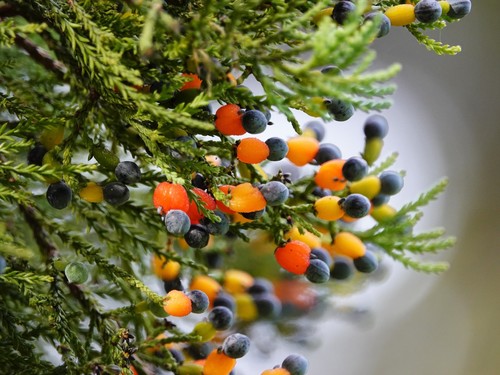
(c) Jacqui Geux, some rights reserved (CC BY), uploaded by Jacqui Geux

(c) matildak, some rights reserved (CC BY-NC)

(c) Jon Sullivan, some rights reserved (CC BY)
What to Eat
Edible parts: Fruit, Gum
The fruit is eaten raw and has a sweet, palatable flavour with a slightly oily taste. The resin obtained from the tree is used as a chewing gum; a report of the fruit being used as a masticatory likely refers to this resin.
Where to Find It
It is a warm temperate plant. They can grow in wet and swampy conditions. It will also grow in drier sites. In New Zealand it grows up to 600 m altitude. Melbourne Botanical Gardens. It suits hardiness zones 9-11. Arboretum Tasmania. Hobart Botanical Gardens.
Australia, Britain, Europe, New Zealand*, Tasmania,
How to Identify
A tree. It can grow to 45 m high. The trunk can be 1.5 m through. It can spread 6-8 m wide. It is upright with a cone shaped crown. The bark is grey and scales off in flakes. Old trees can have buttresses. The leaves are cypress like. They have a bronze colour when mature. Trees are separately male and female. The cones have black nut-like seeds. The cones swell into a fleshy berry.
How to Grow
They can be grown from seed or cuttings.
Propagation: Seed can be very slow to germinate, often taking 18 months or more. Sow in a cold frame as soon as the seed is ripe, or as early in the year as possible with stored seed. Prick seedlings out into individual pots once large enough to handle and grow on under glass for at least the first winter. Plant out into permanent positions in late spring or early summer after the last expected frosts, with protection from cold for the first winter or two outdoors. Take cuttings of short leading shoots in late summer in a frame and plant out in late spring after the last expected frosts. Note that if side shoots are used as cuttings, the resulting plants will be prostrate in habit.
Medicinal Uses
None known.
Other Uses
The tree tolerates trimming reasonably well and could potentially be grown as a hedge in mild areas. The wood is yellowish and easily worked, used for general carpentry and paper pulp.
Wikipedia
Source ↗Dacrycarpus dacrydioides, commonly known as kahikatea (from Māori) and white pine, is a coniferous tree endemic to New Zealand. A podocarp, it is New Zealand's tallest tree, gaining heights of 60 metres (200 feet) over a life span of 600 years. It was first described botanically by the French botanist Achille Richard in 1832 as Podocarpus dacrydioides, and was given its current binomial name Dacrycarpus dacrydioides in 1969 by the American botanist David de Laubenfels. Analysis of DNA has confirmed its evolutionary relationship with other species in the genera Dacrycarpus and Dacrydium. In Māori culture, it is an important source of timber for the building of waka and making of tools, of food in the form of its berries, and of dye. Its use for timber and its damp fertile habitat, ideal for dairy farming, have led to its decimation almost everywhere except South Westland. Kahikatea seeds have fleshy structures called receptacles attached to them, which encourage birds such as kererū and tūī to eat them and disperse the seeds. The water storage ability of these structures may also act to protect seeds from drying out. It supports many smaller plants in its own branches, which are called epiphytes; 100 different species have been recorded on one tree alone.
Production
It is slow growing.
Notes
There are 7-9 Dacrycarpus species. They are in Asia and the Pacific.
Names & Synonyms
Kahikatea, New Zealand Dacryberry, White pine
References (14)
- Abdillahi, H. S., 2009, Ethnobotany, phytochemistry and pharmacology of Podocarpus sensu latissimo (s.l.). South African Journal of Botany 76 (2010) 1–24 (As Podocarpus dacrydioides)
- Crowe, A., 1997, A Field Guide to the Native Edible Plants of New Zealand. Penguin. p 23
- Cundall, P., (ed.), 2004, Gardening Australia: flora: the gardener's bible. ABC Books. p 464
- Etherington, K., & Imwold, D., (Eds), 2001, Botanica's Trees & Shrubs. The illustrated A-Z of over 8500 trees and shrubs. Random House, Australia. p 252
- Facciola, S., 1998, Cornucopia 2: a Source Book of Edible Plants. Kampong Publications, p 184
- Hedrick, U.P., 1919, (Ed.), Sturtevant's edible plants of the world. p 509 (As Podocarpus dacrydioides)
- Hibbert, M., 2002, The Aussie Plant Finder 2002, Florilegium. p 80
- J. Arnold Arbor. 50:337. 1969
- Matthews, J., 1987, New Zealand Native Plants for your Garden. Pacific Publishers, p 97
- Plants for a Future database, The Field, Penpol, Lostwithiel, Cornwall, PL22 0NG, UK. http://www.scs.leeds.ac.uk/pfaf/
- Ryan, S., 2008, Dicksonia. Rare Plants Manual. Hyland House. p 66
- Salmon, J.T., 1989, The Native Trees of New Zealand. Heinmann Reid p 51
- Stewart, K., 1984, Collins handguide to the Native Trees of New Zealand. Collins. p 114
- Young, J., (Ed.), 2001, Botanica's Pocket Trees and Shrubs. Random House. p 309


