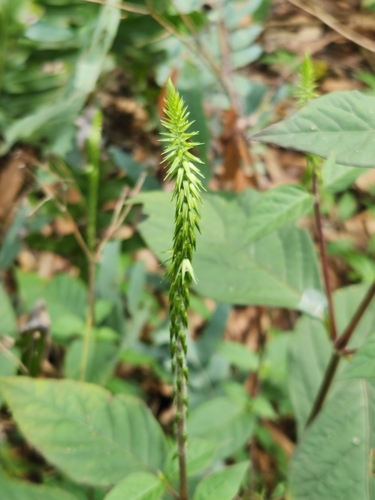
Aerva javanica
(Burm.f.) Juss. ex Schult.
Kapok bush, Pillow weed
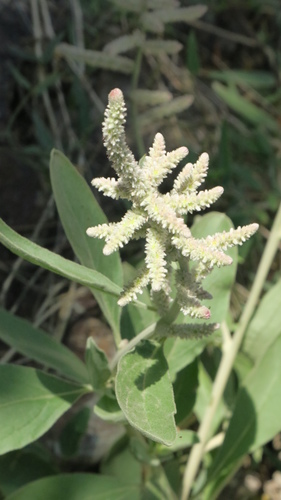
(c) Altaf Habib, some rights reserved (CC BY-NC), uploaded by Altaf Habib
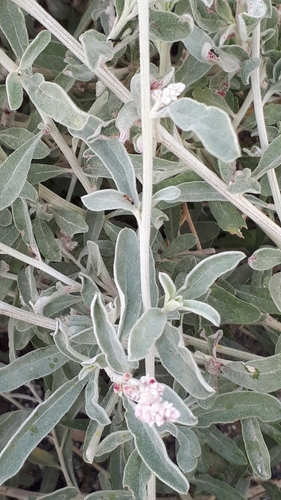
(c) Franco Colnago, some rights reserved (CC BY-NC), uploaded by Franco Colnago
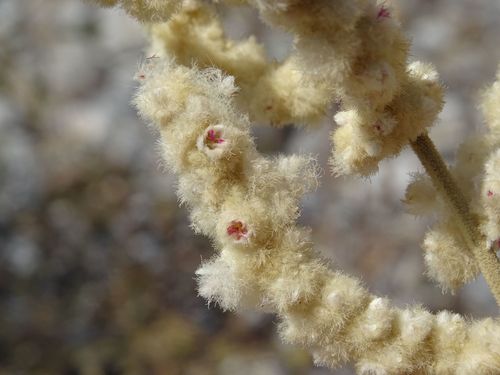
(c) Joey Bom, some rights reserved (CC BY-NC), uploaded by Joey Bom
What to Eat
Edible parts: Shoots, Leaves, Seeds, Flowers, Vegetable
The leafy shoots of young plants are used in curries, or boiled in water for half an hour then cooked with ghee, fried onions and red chillies. The shoots, leaves, seeds, and flowers are all edible portions.
Where to Find It
It is a tropical plant. It often grows on sandy soils. It grows in arid places. It can grow in salty places.
Afghanistan, Africa, Algeria, Asia, Australia, Bahrain, Botswana, Burkina Faso, Cameroon, Central Africa, Chad, East Africa, Egypt, Ethiopia, Ghana, India, Indonesia, Iran, Iraq, Israel, Jordan, Kenya, Libya, Madagascar, Malawi, Mali, Mauritania, Mauritius, Mediterranean, Middle East, Morocco, Mozambique, Myanmar, Niger, Nigeria, North Africa, Pakistan, Palestine, Qatar, Sahel, Saudi Arabia, SE Asia, Senegal, Socotra, Somalia, Southern Africa, Sri Lanka, Sudan, Syria, Tanzania, Uganda, United Arab Emirates, UAE, West Africa, Yemen, Zimbabwe,
How to Identify
A shrubby plant which keeps growing from year to year. It grows 1 m high. The leaves are small and blue-green. They are leathery. The flowers are white. The seeds are very small. They are enclosed in short white fibres.
How to Grow
A plant of drier areas in the tropics and subtropics where it is found at elevations from sea level to 1,900 metres. Requires a sunny position. Succeeds in heavy soils in the wild, though it is more commonly found in light and sandy soils. A dioecious plant, both male and female forms need to be grown if seed is required.
Medicinal Uses
This herb is deep rooted, and is used as soil binder in desert reclamation. It is used for fuel and for fodder for goats. In traditional medicine the seeds are believed to cure headaches. A gargle is made from the plant to try to treat toothache. The plant has naturalised in northern regions of Australia, as an alien introduction, and is cultivated and utilised by the indigenous peoples of some countries. The thick, white inflorescences have traditionally been harvested in Arabia for stuffing cushions and saddle pads. Today, the soft fibres are still used as kapok for pillows. It is called Bilhangga in the languages of the Yindjibarndi and Ngarluma people, the English term is Kapok Bush.
Other Uses
The roots are used as tooth brushes. The woolly spikes are used for stuffing pillows.
Wikipedia
Source ↗Aerva javanica, the kapok bush or desert cotton, is a species of plant in the family Amaranthaceae. It has a native distribution incorporating much of Africa (including Madagascar), and the south-west and south of Asia, and it has become adventitious in northern Australia.
Notes
Chemical composition (after Hooper): Fat = 3.15% (dry). Albumenoids = 20.12% (dry). Carbohydrates = 36.10% (dry). Ash = 22.48% (dry). Fibre: = 18.15% (dry). Nitrogen = 3.22% (dry). Phosphoric acid = .70% (dry). Silicates = 6.33% (dry). There are about 10 Aerva species in warmer climates.
Names & Synonyms
Boen, Boi kalan, Booh, Buida, Bur, Dholimundi, Doddahindi gidda, Fotivolo, Geed-bahal, Haamboobis, Kamheda, Magavira, Makosy, Niki boien, On-hnye, Perumpoolai, Safed bui, Shorakai, Snow bush, Sparokai, Suumagale, Thoo, Volofoty, Volompotsy
References (25)
- Ahmad, K. & Pieroni, A., 2016, Folk knowledge of wild food plants among the tribal communities of Thakht-e-Sulaiman Hills, North-West Pakistan. Journal of Ethnobiology and Ethnomedicine, 12:17
- Ahmad, K., et al, 2018, Ethnobotanical investigation of wild vegetables used among local communities in northwest Pakistan. Acta Soc Bot Pol. 2019;88(1):3616.
- Ambasta S.P. (Ed.), 2000, The Useful Plants of India. CSIR India. p 17
- Bircher, A. G. & Bircher, W. H., 2000, Encyclopedia of Fruit Trees and Edible Flowering Plants in Egypt and the Subtropics. AUC Press. p 11
- Burkill, H. M., 1985, The useful plants of west tropical Africa, Vol. 1. Kew.
- Busson, 1965,
- Dalziel, J. M., 1937, The Useful plants of west tropical Africa. Crown Agents for the Colonies London.
- Flora of Pakistan. p 26
- Global Plants JSTOR
- Grubben, G. J. H. and Denton, O. A. (eds), 2004, Plant Resources of Tropical Africa 2. Vegetables. PROTA, Wageningen, Netherlands. p 559
- HOOPER
- Hussey, B.M.J., Keighery, G.J., Cousens, R.D., Dodd, J., Lloyd, S.G., 1997, Western Weeds. A guide to the weeds of Western Australia. Plant Protection Society of Western Australia. p 78
- Jardin, C., 1970, List of Foods Used In Africa, FAO Nutrition Information Document Series No 2.p 51
- Kenneally, K.E., Edinger, D. C., and Willing T., 1996, Broome and Beyond, Plants and People of the Dampier Peninsula, Kimberley, Western Australia. Department of Conservation and Land Management. p 54
- Lazarides, M. & Hince, B., 1993, Handbook of Economic Plants of Australia, CSIRO. p 9
- Majeed, M., et al, 2021, Gathered Wild Food Plants among Diverse Religious Groups in Jhelum District, Punjab, Pakistan. Foods 2021, 10, 594.
- Martin, F.W. & Ruberte, R.M., 1979, Edible Leaves of the Tropics. Antillian College Press, Mayaguez, Puerto Rico. p 173
- Paczkowska, G. & Chapman, A.R., 2000, The Western Australian Flora. A Descriptive Catalogue. Western Australian Herbarium. p 136
- Peters, C. R., O'Brien, E. M., and Drummond, R.B., 1992, Edible Wild plants of Sub-saharan Africa. Kew. p 47
- Petheram, R.J. and Kok, B., 2003, Plants of the Kimberley Region of Western Australia. UWA Press p 37
- Phillips, D.C., 1988, Wild Flowers of Bahrain. A Field Guide to Herbs, Shrubs, and Trees. Privately published. p 27
- Royal Botanic Gardens, Kew (1999). Survey of Economic Plants for Arid and Semi-Arid Lands (SEPASAL) database. Published on the Internet; http://www.rbgkew.org.uk/ceb/sepasal/internet [Accessed 24th March 2011]
- Syst. veg. 5:565. 1819 (A.L. Juss., Ann. Mus. Natl. Hist. Nat. 2:131. 1803, nom. inval.)
- Wheeler, J.R.(ed.), 1992, Flora of the Kimberley Region. CALM, Western Australian Herbarium, p 107
- World Checklist of Useful Plant Species 2020. Royal Botanic Gardens, Kew