Damasonium alisma
Mill.
Thrumwort, Star fruit

(c) Flavien Saboureau, some rights reserved (CC BY), uploaded by Flavien Saboureau
(c) alonre, some rights reserved (CC BY-NC)
(c) יאיר אור, some rights reserved (CC BY-NC-SA), uploaded by יאיר אור
What to Eat
Edible parts: Root
The root is edible, though no further details on preparation or use have been recorded.
Where to Find It
It grows at the edge of shallow water. It needs to be less than 15 cm deep.
Britain, Europe,
How to Identify
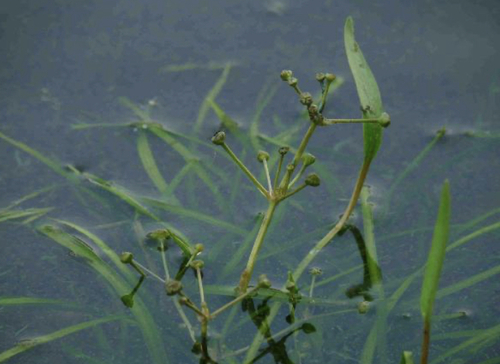
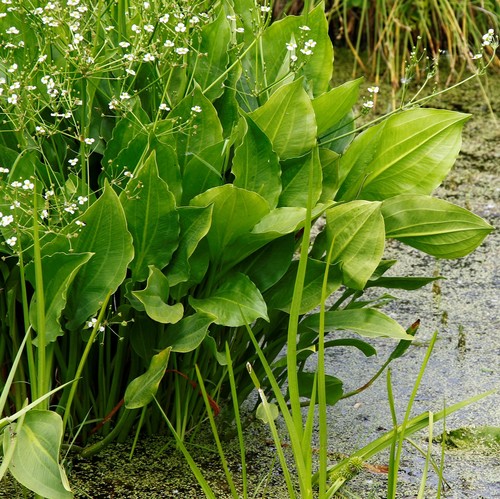
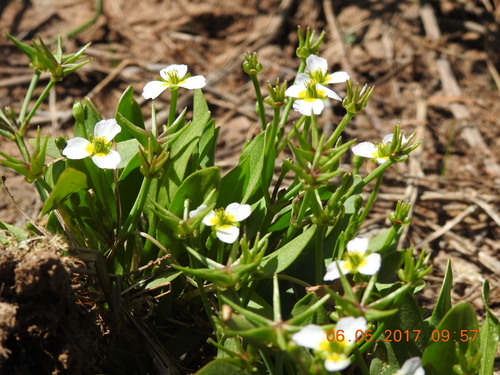
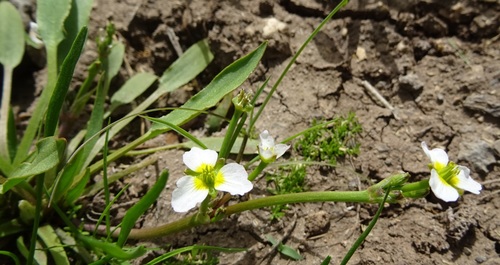
A herb which grows in water. The leaves have long stalks. The leaf blades are oval or sword shaped and 10 cm long. The flowers are in rings. They are white or pink with a yellow spot at the base of each petal. The fruit forms a star shape.
How to Grow
Succeeds in an open sunny position in boggy soils or in still water up to 25cm deep.
Propagation: Seed is best sown as soon as it is ripe in a cold frame, in trays standing in shallow water. Once seedlings are large enough to handle, prick them out into individual pots and grow on in trays of shallow water, planting out in summer. Division in spring is also straightforward — larger clumps can be replanted directly into permanent positions, though smaller clumps are best potted up and grown on in a cold frame until rooting well, then planted out in spring.
Medicinal Uses
None known
Other Uses
None known Special Uses
Wikipedia
Source ↗Damasonium alisma is a species of flowering marsh plant known by the common name of starfruit. Its native range includes parts of Great Britain, France, Portugal, Spain, Italy, Greece, Russia, Ukraine, Moldova, and Kazakhstan. Damasonium alisma is native to the British Isles and was at one time commonly found in south and central England. Numbers have declined as a result of the loss of pond habitats. It was not recorded in the wild in 2006 and is classified as endangered within the United Kingdom. Seeds from the (extinct) Headley Heath population were germinated in undisturbed ponds managed by Surrey Wildlife Trust in 2013, and have grown there each year since (at least up to 2018).
Notes
There are 5 Damasonium species. They are temperate and grow in water.
Names & Synonyms
References (3)
- Gard. dict ed. 8: Damasonium no. 1. 1768
- Plants for a Future database, The Field, Penpol, Lostwithiel, Cornwall, PL22 0NG, UK. http://www.scs.leeds.ac.uk/pfaf/
- Slocum, P.D. & Robinson, P., 1999, Water Gardening. Water Lilies and Lotuses. Timber Press. p 93