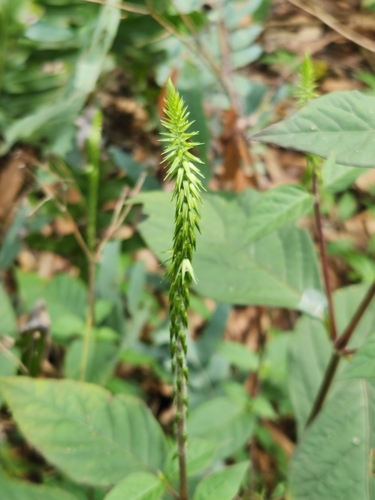
Aerva lanata
(L.) Juss. ex Schult.
Mountain knot grass
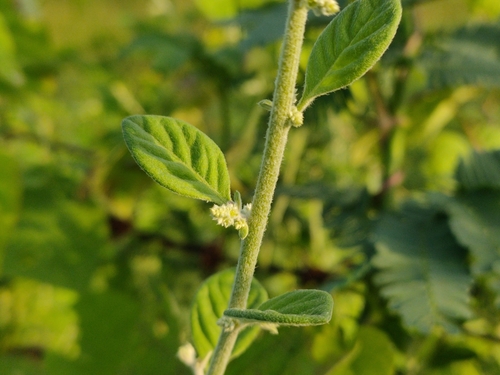
(c) SONU KUMAR, some rights reserved (CC BY-NC)
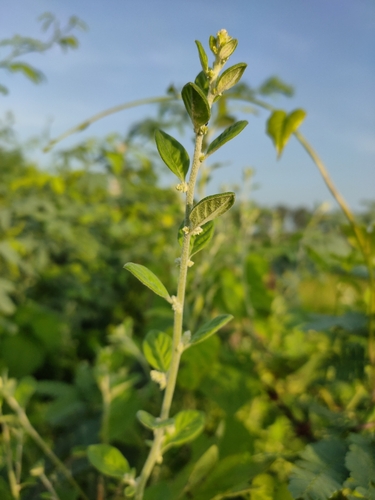
(c) SONU KUMAR, some rights reserved (CC BY-NC)
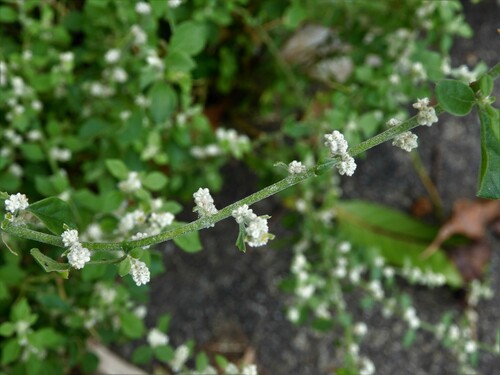
(c) Steven Chong, some rights reserved (CC BY-NC)
What to Eat
Edible parts: Leaves, Vegetable
The young leaves, stems, and seeds are cooked and eaten. The plant can be made into a drink when fresh or dried, and the leaves can be sun-dried and stored for later use.
Where to Find It
It is a tropical and subtropical plant. It is common in dry waste land at low and medium altitudes. It is more common in places with a long dry season. In India it is on the Deccan below 1,000 m. It can grow in arid places. In Tanzania it grows between sea level and 2,000 m above sea level.
Africa, Asia, Australia, Benin, Botswana, British Indian Ocean Terr., BIOT, Burkina Faso, Cameroon, Central Africa, Cote d'Ivoire, Congo DR, East Africa, Egypt, Ethiopia, Ghana, India, Indochina, Indonesia, Iran, Ivory Coast, Kenya, Liberia, Madagascar, Malawi, Malaysia, Maldives, Middle East, Mozambique, Nepal, Nigeria, North Africa, Pacific, Pakistan, Papua New Guinea, PNG, Philippines, Rwanda, Saudi Arabia, SE Asia, Sierra Leone, Somalia, South Africa, Southern Africa, South Sudan, Sri Lanka, Tanzania, Togo, Uganda, Vietnam, West Africa, Zambia, Zimbabwe,
How to Identify
A low lying grey and hairy herb. It can grow to 1 m tall. The stems are 20 to 80 cm long and sometimes branched. The leaves are alternate and with leaf stalks 1-5 mm long. The ends of the leaves are blunt. The leaves are 1 to 3.5 cm long. The flowers are green and white and about 2 mm across. The fruit is flattened and 1 mm across. The seed is black and shiny. It is about 0.7 mm long.
Nutrition Score: 30/100
| Part | Moisture | kJ | kcal | Protein | Vit A | Vit C | Iron | Zinc |
|---|---|---|---|---|---|---|---|---|
| Leaves | — | — | — | 21.7 | — | 0.6 | 0.7 | — |
How to Grow
Plants can be grown by seeds.
Medicinal Uses
This plant is used for food for people and animals. The whole plant, especially the leaves, is edible. The leaves are put into soup or eaten as a spinach or as a vegetable. The plant provides grazing for stock, game and chickens. The plant is used as a traditional medicine for snakebites. Traditionally, a snippet of the plant is placed in the centre of crude balls made of cow dung called "Gobbemmalu" made during Sankranti. The plant is also used as a talisman against evil spirits, a good-luck talisman for hunters, and a talisman for the well-being of widows. In the traditional medicine of India, the juice of crushed Ouret lanata root is used for jaundice therapy.
Production
Leaves are collected during the rainy season.
Other Information
It is a famine food. It is not known if it is used for food in Papua New Guinea.
Notes
There are about 10 Aerva species in warmer climates.
Names & Synonyms
Astmabayota, Bhui, Bilihindisoppu, Boorati, Chaya, Chepiskut, Chepkumot, Cherupula, Chivwa kuku, Daraara, Eleturot, Eleturot, Fod cadde, Food-cadde, Gadlak biro, Gorakha ganjo, Holly, Hudhufuffilaa, Kaganza ka mwana, Kapur-madhura, Karlakem, Kaudena jhangi, Kidelele, Kinonga, Kinongo, Kivuma nyuchi, Konda pindi, Ledra ara, Lendra arxa, Lopong arak, Lopong sag, Lopung, Lwelya, Mada, Maovi long, Muana nkasi, Paramoyo, Paunsia, Pichudi-sago, Pindiconda, Pol-kudu-pala, Polpala, Pompala, Shaza, Simetwo, Sirru, Sirupulai, Tabang ahas, Tebwa, Thelagapindi koora, Vhivwa kuku, Wario
References (55)
- Ambasta S.P. (Ed.), 2000, The Useful Plants of India. CSIR India. p 17
- Arora, R. K., 2014, Diversity in Underutilized Plant Species - An Asia-Pacific Perspective. Bioversity International. p 34
- Biocyclopedia Edible Plant Species. biocyclopedia.org
- Bircher, A. G. & Bircher, W. H., 2000, Encyclopedia of Fruit Trees and Edible Flowering Plants in Egypt and the Subtropics. AUC Press. p 11
- Bremness, L., 1994, Herbs. Collins Eyewitness Handbooks. Harper Collins. p 153
- Burkill, H. M., 1985, The useful plants of west tropical Africa, Vol. 3. Kew.
- Checklist of NT Vascular Plant Species. January 2003.
- Dangol, D. R. et al, 2017, Wild Edible Plants in Nepal. Proceedings of 2nd National Workshop on CUAOGR, 2017.
- Dansi, A., et al, 2008, Traditional leafy vegetables and their use in the Benin Republic. Genet Resour Crop Evol (2008) 55:1239–1256
- Dey, A. & Mukhererjee, A., 2015, Living and Survival Amidst Hunger: Wild Edible Botanicals as a Prime Forest Productivity in the Rural Purulia District, West Bengal, India from Colonial to Present. Research Journal of Forestry 9(3): 71-86
- Food Composition Tables for use in Africa FAO http://www.fao.org/infoods/directory No. 490
- Fowler, D. G., 2007, Zambian Plants: Their Vernacular Names and Uses. Kew. p 6
- Fox, F. W. & Young, M. E. N., 1982, Food from the Veld. Delta Books. p 70
- Global Plants JSTOR
- Grivetti, L. E., 1980, Agricultural development: present and potential role of edible wild plants. Part 2: Sub-Saharan Africa, Report to the Department of State Agency for International Development. p 44
- Grubben, G. J. H. and Denton, O. A. (eds), 2004, Plant Resources of Tropical Africa 2. Vegetables. PROTA, Wageningen, Netherlands. p 559
- Harkonen, M. & Vainio-Mattila, K., 1998, Some examples of Natural Products in the Eastern Arc Mountains. Journal of East African Natural History 87:265-278
- Hedrick, U.P., 1919, (Ed.), Sturtevant's edible plants of the world. p 27
- HOOPER Jardin, C., 1970, List of Foods Used In Africa, FAO Nutrition Information Document Series No 2.p 51
- Kanis, A in Womersley, J.S., (Ed), 1978, Handbooks of the Flora of Papua New Guinea. Melbourne University Press. Vol 1. p 16 (Line drawing)
- Latham, P. & Mbuta, A. K., 2014, Useful Plants of Bas-Congo Province, Democratic Republic of Congo. Volume 1. Salvation Army. p 21
- Latham, P. & Mbuta, A. K., 2017, Plants of Kongo Central Province, Democratic Republic of Congo. 3rd ed p 25
- Lugod, G.C. and de Padua L.S., 1979, Wild Food Plants in the Philippines. Vol. 1. Univ. of Philippines Los Banos. p 10
- Macmillan, H.F. (Revised Barlow, H.S., et al), 1991, Tropical Planting and Gardening. Sixth edition. Malayan Nature Society. Kuala Lumpur. p 356
- Marandi, R. R. & Britto, S. J., 2015, Medicinal Properties of Edible Weeds of Crop Fields and Wild plants Eaten by Oraon Tribals of Latehar District, Jharkhand. International Journal of Life Science and Pharma Research. Vo. 5. (2) April 2015
- Martin, F.W. & Ruberte, R.M., 1979, Edible Leaves of the Tropics. Antillian College Press, Mayaguez, Puerto Rico. p 173
- Maundu, P. et al, 1999, Traditional Food Plants of Kenya. National Museum of Kenya. p 55
- Misra, S., 2020, Survey of edible plants for human consumption in south Odisha, India. Journal of Emerging Technologies and Innovative Research (JETIR) Vol. 7, Issue 12 p 277
- Monsalud, M.R., Tongacan, A.L., Lopez, F.R., & Lagrimas, M.Q., 1966, Edible Wild Plants in Philippine Forests. Philippine Journal of Science. p 436
- Mpasiwakomu, R. A., 2017, The Diversity and Utilization of Wild Edible and Medicinal Plant Species found in Uvinza Miombo Woodlands, Tanzania. M. Sc. thesis University of Tanzania.
- Msuya, T. S., et al, 2010, Availability, Preference and Consumption of Indigenous Foods in the Eastern Arc Mountains, Tanzania, Ecology of Food and Nutrition, 49:3, 208-227
- Ngugi, G., 2000, Case Study from Kenya on Indigenous Wild Vegetables. Paper 4 Workshop in Kenya 1999.
- Peduruhewa, P. S., et al, 2021, Potential of Underutilized Wild Edible Plants as the Food for the Future – A Review. Journal of Food Security, Vol. 9, No. 4, 136-147
- Peters, C. R., O'Brien, E. M., and Drummond, R.B., 1992, Edible Wild plants of Sub-saharan Africa. Kew. p 47
- Pham-Hoang Ho, 1999, An Illustrated Flora of Vietnam. Nha Xuat Ban Tre. p 731
- Plowes, N. J. & Taylor, F. W., 1997, The Processing of Indigenous Fruits and other Wildfoods of Southern Africa. in Smartt, L. & Haq. (Eds) Domestication, Production and Utilization of New Crops. ICUC p 185 (As Amaranthus lanata)
- Rajapaksha, U., 1998, Traditional Food Plants in Sri Lanka. HARTI, Sri Lanka. p 24
- Rajkalkshmi, P. et al, 2001, Total carotenoid and beta-carotene contents of forest green leafy vegetables consumed by tribals of south India. Plant Foods for Human Nutrition 56:225-238
- Ray, A., et al, 2020, How many Wild Edible Plants do we Use. Frontiers in Sustainable Food Systems. 4:56 p 12
- Reddy, K. N., et al, 2006, Traditional knowledge on wild food plants in Andhra Pradesh. Indian Journal of Traditional Knowledge 6(1) pp 223-229
- Royal Botanic Gardens, Kew (1999). Survey of Economic Plants for Arid and Semi-Arid Lands (SEPASAL) database. Published on the Internet; http://www.rbgkew.org.uk/ceb/sepasal/internet [Accessed 24th March 2011]
- Ruffo, C. K., Birnie, A. & Tengnas, B., 2002, Edible Wild Plants of Tanzania. RELMA p 108
- Saidulu, P. et al, 2015, Ethnobotanical Knowledge Studied in Pocharam Wildlife Sanctuary, Telangana, India. Not Sci Biol, 2015, 7(2):164 -170
- Siemonsma, J. S. & Kasem Piluek, eds. 1993. Vegetables. In: Plant Resources of South-East Asia (PROSEA) 8:311
- Singh, H.B., Arora R.K.,1978, Wild edible Plants of India. Indian Council of Agricultural Research, New Delhi. p16
- Sinha, R. & Lakra, V., 2007, Edible weeds of tribals in Jharkhand, Orissa and West Bengal. Indian Journal of Traditional Knowledge 6(1) January 2007 pp 217-222
- Sujanapal, P., & Sankaran, K. V., 2016, Common Plants of Maldives. FAO & Kerala FRI, p 23
- Syst. veg. 5:565. 1819 (A.L. Juss., Ann. Mus. Natl. Hist. Nat. 2:131. 1803, nom. inval.)
- Topp, J. M. W., 1988, An Annotated Check List of the Flora of Diego Garcia, British Ocean Territory. Atoll Research Bulletin No. 313
- USDA, ARS, National Genetic Resources Program. Germplasm Resources Information Network - (GRIN). [Online Database] National Germplasm Resources Laboratory, Beltsville, Maryland. Available: www.ars-grin.gov/cgi-bin/npgs/html/econ.pl (10 April 2000)
- Vainio-Mattila, K., 2000, Wild vegetables used by the Sambaa in the Usumbara Mountains, NE Tanzania. Ann. Bot. Fennici 37:57-67
- Vartak, V.D. and Kulkarni, D.K., 1987, Monsoon wild leafy vegetables from hilly regions of Pune and neighbouring districts, Maharashtra state. J. Econ. Tax. Bot. Vol. 11 No. 2 pp 331-335
- Wiersema, J. H. & Leon, B., 2013, World Economic Plants. A Standard Reference CRC Press. 2nd Ed. p 20
- World Checklist of Useful Plant Species 2020. Royal Botanic Gardens, Kew
- Yimer, A., et al, 2021, Ethnobotanical study of wild edible plants used by Meinit Ethnic Community at Bench-Maji Zone, Southwest Ethiopia. Research Square. p 5