Deeringia polysperma
(Roxb.) Moq.
Bayambang
no rights reserved, uploaded by 葉子

(c) rain999777, some rights reserved (CC BY-NC)

(c) rain999777, some rights reserved (CC BY-NC)
What to Eat
Edible parts: Leaves
The young leaves are cooked and eaten as a vegetable.
Where to Find It
A tropical plant. It occurs in pasture land in the Philippines. In Papua New Guinea is occurs in moist places near water courses. It grows from sea level to 1,000 m altitude.
Asia, China, Indochina, Laos, Malaysia, Myanmar, Pacific, Papua New Guinea, PNG, Philippines, SE Asia, Taiwan, Thailand, Vietnam,
How to Identify
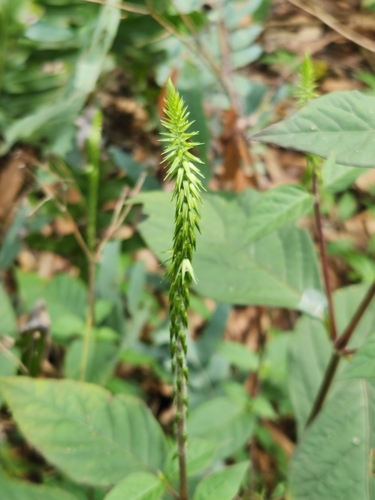
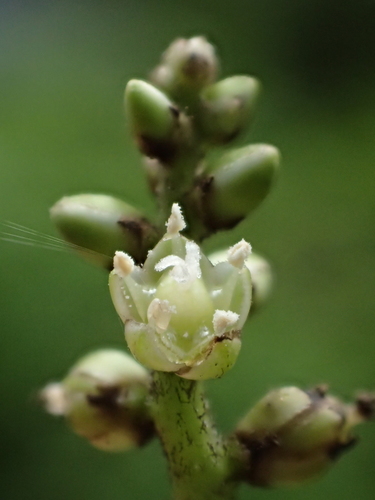
A slightly shrubby plant 1 to 2 metres long and green. It normally grows erect. The stems are hairy on young parts. The leaves are alternate along the stem. They are on 1-5 cm long leaf stalks. The leaf blade is 8-20 cm long by 3-7 cm wide. The leaves have a fine warty appearance. The flower cluster can have one branch. The flowers have both sexes. The fruit is a berry which is slightly flattened and 3-5 cm across. They can contain 20 or more seeds. The seeds can be 1 cm across and black and finely warty.
Notes
There are about 6-12 Deeringia species.
Names & Synonyms
Dialinh nhieu-hot
References (6)
- Bao Bojian; Steve Clemants, Thomas Borsch, 2003, Amaranthaceae, Flora of China. 5: 416
- Borrell, O.W., 1989, An Annotated Checklist of the Flora of Kairiru Island, New Guinea. Marcellin College, Victoria Australia. p 48
- A. L. P. P. de Candolle, Prodr. 13(2):236. 1849
- Kanis, A in Womersley, J.S., (Ed), 1978, Handbooks of the Flora of Papua New Guinea. Melbourne University Press. Vol 1. p 35
- Monsalud, M.R., Tongacan, A.L., Lopez, F.R., & Lagrimas, M.Q., 1966, Edible Wild Plants in Philippine Forests. Philippine Journal of Science. p 435
- Pham-Hoang Ho, 1999, An Illustrated Flora of Vietnam. Nha Xuat Ban Tre. p 727