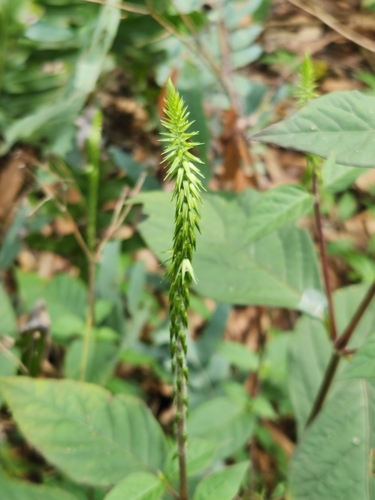
Aerva leucura
Moquin
Foam bush, White head
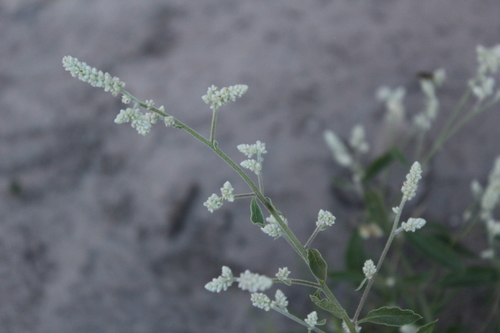
(c) Dewald du Plessis, some rights reserved (CC BY-NC)

(c) Dewald du Plessis, some rights reserved (CC BY-NC)
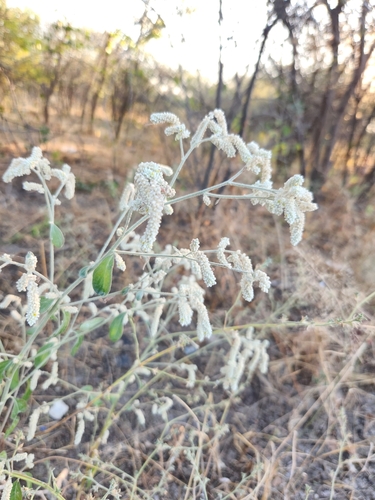
(c) Norbaya Durr, some rights reserved (CC BY-NC)
What to Eat
Edible parts: Leaves, Vegetable
The young leaves are cooked and eaten as a vegetable, often cooked together with peanuts, other leaves, and vegetables, or used as a relish. It is particularly valuable early in the growing season when other vegetables are not yet available.
Where to Find It
It is a tropical plant. It often grows on ant hills. It grows along roadsides. It can grow in arid places. In Tanzania it grows between 600-1,700 m above sea level.
Africa, Angola, Botswana, Central Africa, Congo, East Africa, Kenya, Malawi, Mozambique, Namibia, South Africa, Southern Africa, Swaziland, Tanzania, Uganda, Zambia, Zimbabwe,
How to Identify
A herb. It is 100-130 cm high. It often branches near the top. It is woolly and keeps growing from year to year. The leaves are alternate. The leaf blade is 5-8 cm long. It is egg shaped and tapers to both ends. They are dull green and covered with hairs. The flowers are small and white or yellow-white and in dense spikes. These are 2 cm long. The fruit is a small, dry capsule.
Nutrition Score: 25/100
| Part | Moisture | kJ | kcal | Protein | Vit A | Vit C | Iron | Zinc |
|---|---|---|---|---|---|---|---|---|
| Leaves | 83 | 233 | — | 2.4 | — | — | 10.3 | 0.9 |
How to Grow
Grows best in a sunny position. Prefers a well-drained, loamy soil.
Propagation: Seed - Cuttings of the new shoots as new growth commences. The cuttings root fast and are usually ready to plant out within 3 months.
Medicinal Uses
The plant is used in traditional medicine.
Other Uses
The dry flowers have been used to stuff pillows.
Other Information
It is used early in the season when other vegetables are not yet available.
Notes
There are about 10 Aerva species in warmer climates. It is used in medicine.
Names & Synonyms
Chidyonko, Fototo, Furanondo, Hoto, Kilindila, Kilindila, Kinonga, Lifweni, Mgungum mwenza, Mioma wa mbuya, Nyarotarota, Tlogotsweu
References (19)
- Fowler, D. G., 2007, Zambian Plants: Their Vernacular Names and Uses. Kew. p 6
- Fox, F. W. & Young, M. E. N., 1982, Food from the Veld. Delta Books. p 70
- Grubben, G. J. H. and Denton, O. A. (eds), 2004, Plant Resources of Tropical Africa 2. Vegetables. PROTA, Wageningen, Netherlands. p 559
- Herb., E. A., 1985,
- Long, C., 2005, Swaziland's Flora - siSwati names and Uses http://www.sntc.org.sz/flora/
- Maguire, 1978,
- Peters, C. R., O'Brien, E. M., and Drummond, R.B., 1992, Edible Wild plants of Sub-saharan Africa. Kew. p 47
- Pickering, H., & Roe, E., 2009, Wild Flowers of the Victoria Falls Area. Helen Pickering, London. p 20
- Roodt, V., 1998, Common Wild Flowers of the Okavango Delta. Medicinal Uses and Nutritional value. The Shell Field Guide Series: Part 2. Shell Botswana. p 17
- Ruiters-Welcome, A. K., 2019, Food plants of southern Africa. Ph.D. thesis. Univ. of Johannesburg p 9
- Royal Botanic Gardens, Kew (1999). Survey of Economic Plants for Arid and Semi-Arid Lands (SEPASAL) database. Published on the Internet; http://www.rbgkew.org.uk/ceb/sepasal/internet [Accessed 24th March 2011]
- Ruffo, C. K., Birnie, A. & Tengnas, B., 2002, Edible Wild Plants of Tanzania. RELMA p 110
- Swaziland's Flora Database http://www.sntc.org.sz/flora
- Thiselton-Dywer, W.T., (Ed.), 1913, Flora of Tropical Africa. Vol VI-section 1. Reeve, p 39
- Tredgold, M.H., 1986, Food Plants of Zimbabwe. Mambo Press. p 63
- Welcome, A. K. & Van Wyk, B.-E., 2019, An inventory and analysis of the food plants of southern Africa. South African Journal of Botany 122 (2019) 136–179
- Williamson, J., 2005, Useful Plants of Malawi. 3rd. Edition. Mdadzi Book Trust. p 15
- World Checklist of Useful Plant Species 2020. Royal Botanic Gardens, Kew
- www.zimbabweflora.co.zw 2011