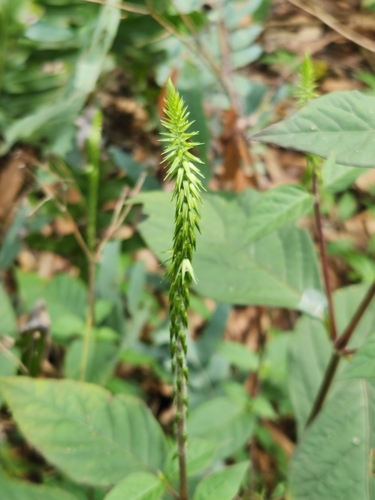
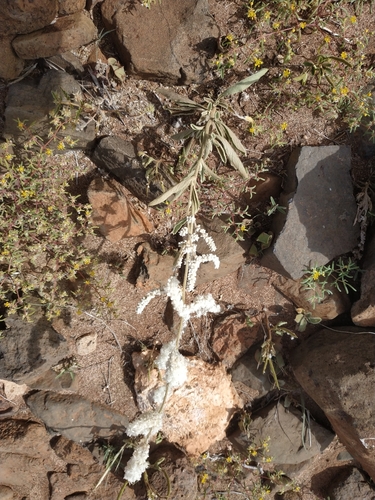
Aerva tomentosa
Forssk.
Bahema
(c) Paulo Vasconcelos, some rights reserved (CC BY-NC)

(c) Errol Véla, some rights reserved (CC BY-NC)

(c) Errol Véla, some rights reserved (CC BY-NC)
What to Eat
Edible parts: Leaves
The leaves are eaten as a vegetable.
Where to Find It
A tropical plant.
Africa, Asia, Australia, East Africa, Ethiopia, Gambia, Ghana, India, Senegal, Sudan, Tanzania, West Africa,
How to Identify
A herb. It grows 50-100 cm high. The leaves are alternate. The leaf blades are 10 cm long by 3 cm wide. They are woolly when young. The flower spike are 5 cm long.
Medicinal Uses
This herb is deep rooted, and is used as soil binder in desert reclamation. It is used for fuel and for fodder for goats. In traditional medicine the seeds are believed to cure headaches. A gargle is made from the plant to try to treat toothache. The plant has naturalised in northern regions of Australia, as an alien introduction, and is cultivated and utilised by the indigenous peoples of some countries. The thick, white inflorescences have traditionally been harvested in Arabia for stuffing cushions and saddle pads. Today, the soft fibres are still used as kapok for pillows. It is called Bilhangga in the languages of the Yindjibarndi and Ngarluma people, the English term is Kapok Bush.
Notes
There are about 10 Aerva species in warmer climates.
References (5)
- Abbiw, D.K., 1990, Useful Plants of Ghana. West African uses of wild and cultivated plants. Intermediate Technology Publications and the Royal Botanic Gardens, Kew. p 40
- Fl. aegypt.-arab. 122. 1775
- Hall, N. et al, 1972, The Use of Trees and Shrubs in the Dry Country of Australia, AGPS, Canberra. p 80, 163
- Martin, F.W. & Ruberte, R.M., 1979, Edible Leaves of the Tropics. Antillian College Press, Mayaguez, Puerto Rico. p 173
- Thiselton-Dywer, W.T., (Ed.), 1913, Flora of Tropical Africa. Vol VI-section 1. Reeve, p