Derris trifoliata
Lour.
Threeleaf derris
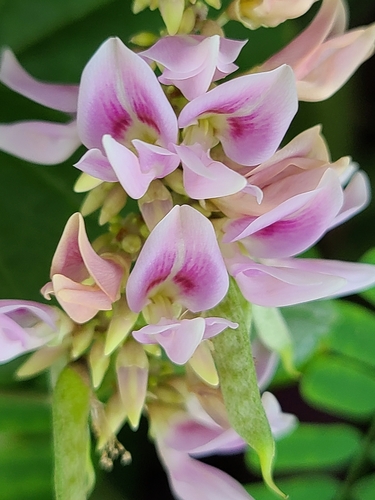
(c) Rujuta Vinod, some rights reserved (CC BY-NC), uploaded by Rujuta Vinod

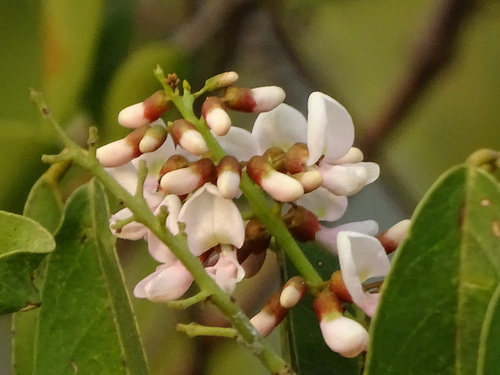
(c) Nina Peck, some rights reserved (CC BY-NC), uploaded by Nina Peck

(c) 靜禪郎, some rights reserved (CC BY-NC), uploaded by 靜禪郎
What to Eat
Edible parts: Leaves, Caution
The leaves are eaten, though caution is advised.
Known Hazards
Where to Find It
A tropical plant. It grows in brackish water near rivers. It occurs in the Western Ghats in India.
Africa, American Samoa, Asia, Australia, Cambodia, Caroline islands, Chuuk, Fiji, FSM, India, Indochina, Indonesia, Madagascar, Maldives, Mascarenes, Micronesia, Myanmar, Pacific, Palau, Rotuma, Samoa, SE Asia, Thailand, Tonga, Vietnam,
How to Identify
A climber. It is a woody vine. They can be 4 cm across. The leaves are compound and usually have 3-7 leaflets. The leaflets are narrowly oval and 6-15 cm long by 3-8 cm wide. The flowering shoots are 7-10 cm long. The flowers are white to pink. They are 13 mm across. The fruit are flat and 4-5 cm long by 2-3 cm wide. They usually only have one seed. The seed is kidney shaped and 25 mm long by 18 mm wide.
How to Grow
Plants can be grown from seeds or cuttings.
Medicinal Uses
The root is used in local medicine in India as a stimulant, antispasmodic and counter-irritant, and against rheumatism, chronic paralysis and dysmenorrhoea. A decoction of the roots is used externally against fever and internally against sores. Thai traditional doctors use roots or stems as a laxative, carminative and anti-arthritis treatment. The outer bark is soaked in water or the liquid in a green coconut, then squeezed. The juice is drunk in order to prevent infection, especially by mothers after chilbirth and by people who have been in contact with dead bodies or the body fluids of sick people. A decoction of the leaves is used in the treatment of malaria.
Other Uses
The stem fibres are used for making ropes and fish nets. The leaves contain the chemical compound rotenone (the active ingredient in the insecticide derris). Although this species is not a source of commercial derris dust, having only a weak insecticidal action, it has been used as an insecticide in South-East Asia. The bark contains up to 9.5% tannin.
Wikipedia
Source ↗Derris trifoliata is a species of flowering plant in the family Fabaceae. It is common in India; in various Indian languages, it is known as Angaar valli in Sanskrit; Karanjvel in Marathi; Firta in Konkani; Tigekranugu, Nauatige, and Chirathelathige in Telugu; Ketia and Swanlata in Oria; Kammattivalli and Ponumvalli in Malayalam; Kaliya lata/Kalilata and Panlata in Bengali; Panlata also in Hindi. It is also common in various parts of South East Asia; common names include Asiasimanan in Filipino Tagalog; Tuwa areuy in Indonesian Sundanese; Akar Ketuil, Ketui, Setui, Salang, Tuba bekut or Sea Tuba in Peninsular Malaysian; Phak thaep in central Thai; Cc Kn Nc/Cosc Kesn Nuwowsc in Vietnamese, etc. It is a large climber found commonly in coastal swamps of tropical coastal areas in South-East Asia. It is 3–5 meters long. Its leaves are alternate, pinnate, 12–20 cm; leaflets 5 and ovate, 6-10 cm, acuminate, rounded at base. Flowers are 1 cm in size, in axillary racemes 8–15 cm. Pods are 3–4 cm, flat, pale yellow in color. The rotenoid 6aα,12aα-12a-hydroxyelliptone can be found in the stems of D. trifoliata. In 1902 Kazuo Nagai, Japanese chemical engineer of the Government-General of Taiwan, isolated a pure crystalline compound from a closely related plant possibly Derris elliptica which he called rotenone, after the Taiwanese name of the plant 蘆藤 (Min Nan Chinese: lôo-tîn) translated into Japanese rōten (ローテン). The pod, root, and stem of the Derris trifoliata are rich in poisonous rotenoids and used commonly in insecticide, piscicide and pesticide activities and also have sometimes caused human morbidity or mortality due to suicide attempts or accidental ingestion. The larvae of Hasora hurama feed on D. trifoliata.
Notes
There are about 80 Derris species.
Names & Synonyms
Akar tuba biasa, Cocken, Cocken nuoc, Fue o'ona, Nwe-net, Vohonikorifotsy, Wunenipot, Wupenipot
References (5)
- Franklin, J., Keppel, G., & Whistler, W., 2008, The vegetation and flora of Lakeba, Nayau and Aiwa Islands, Central Lau Group, Fiji. Micronesica 40(1/2): 169–225, 2008
- Martin, F.W. & Ruberte, R.M., 1979, Edible Leaves of the Tropics. Antillian College Press, Mayaguez, Puerto Rico. p 199 (As Derris uliginosa)
- Stone, B.,
- Sujanapal, P., & Sankaran, K. V., 2016, Common Plants of Maldives. FAO & Kerala FRI, p 110
- Sukarya, D. G., (Ed.) 2013, 3,500 Plant Species of the Botanic Gardens of Indonesia. LIPI p 919