Desmodium repandum
(Vahl) DC.
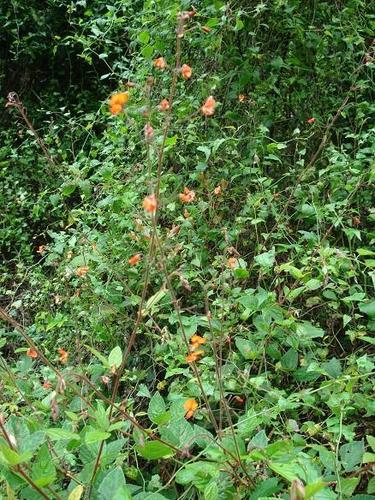
(c) juddkirkel, some rights reserved (CC BY-NC)
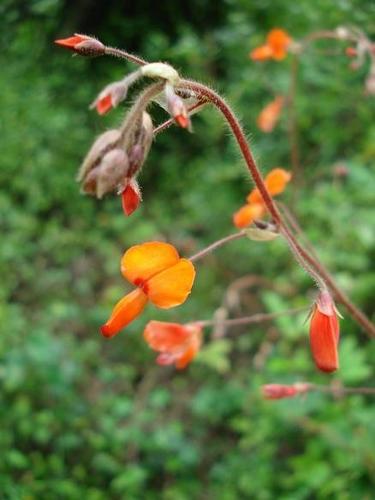
(c) juddkirkel, some rights reserved (CC BY-NC)

(c) juddkirkel, some rights reserved (CC BY-NC)
What to Eat
Edible parts: Leaves, Seeds
The young leaves are eaten as a minor vegetable, and the seeds are cooked and eaten.
Where to Find It
A tropical plant. It occurs between 1080 and 2350 m altitude in Papua New Guinea. It occurs in forests and gardens. In Swaziland it is in the high veld only. In Zimbabwe it grows between 900-1,850 m above sea level.
Africa, Asia, East Africa, Eswatini, Indochina, Indonesia, Laos, Mozambique, Nigeria, Pacific, Papua, Papua New Guinea, PNG, SE Asia, South Africa, Southern Africa, Swaziland, Vietnam, West Africa, West Papua, Zambia, Zimbabwe,
How to Identify
A low creeping legume with hairy stems. It can be up to 1 m tall. The stems can be simple or branched and are hairy. It has 3 leaflets the edges of which are slightly wavy. The leaves are densely hairy underneath. The leaflets are 2-11 cm long by 1.5-9.5 cm wide. They are rounded at the base and wedge shaped at the tip. The leaf stalks can be 1-10 cm long. The flowers are in unbranched groups at the ends of branches and these can be 7-30 cm long. It has red and yellow flowers. They are 0.8-1.2 cm long. The fruit are pods 1.5-4.5 cm long with 4-5 segments.
How to Grow
They are mostly self sown in grassland and old garden sites in the bush.
Other Information
Desmodium repandum is widespread as a self sown plant in the highlands of Papua New Guinea. The leaves and seeds are eaten in several areas as a minor vegetable.
Notes
There are about 350 Desmodium species. They are mostly in the tropics.
Names & Synonyms
Daguma korere, Nyambati, Torwatorwa
References (11)
- Bourke, R. M., Altitudinal limits of 230 economic crop species in Papua New Guinea. Terra australis 32.
- Fowler, D. G., 2007, Zambian Plants: Their Vernacular Names and Uses. Kew. p 36
- Hide, R., et al, 1979, A checklist of some plants in the territory of the Sinasina Nimai (Simbai Province, Papua New Guinea), with notes on their uses. Department Anthropology, University of Aukland
- Hide, R. L., (Ed.) 1984, Research Report of the Simbu Land Use Project. Vol.V1 South Simbu: Studies in Demography, Nutrition, and Subsistence. p 436
- Milliken, W., Ethnobotany of the Yali of West Papua. Royal Botanical Garden, Edinburgh. p 10 (near Baliem)
- Pham-Hoang Ho, 1999, An Illustrated Flora of Vietnam. Nha Xuat Ban Tre. p 922
- Powell, J.M., Ethnobotany. In Paijmans, K., 1976, New Guinea Vegetation. Australian National University Press. p 109
- Prodr. 2:334. 1825
- Sillitoe, P. 1995, An Ethnobotanical Account of the Plant Resources of the Wola Region, Southern Highlands Province, Papua New Guinea. J. Ethnobiol. 15(2): 201-235
- Swaziland's Flora Database http://www.sntc.org.sz/flora
- Verdcourt, B., 1979, Manual of New Guinea Legumes. Botany Bulletin No 11, Division of Botany, Lae, Papua New Guinea. p 404




