Desmodium triflorum
(L.) DC.
Three-flower beggarweed, Three-flower tick-trefoil

(c) E. Krapf, some rights reserved (CC BY-NC)
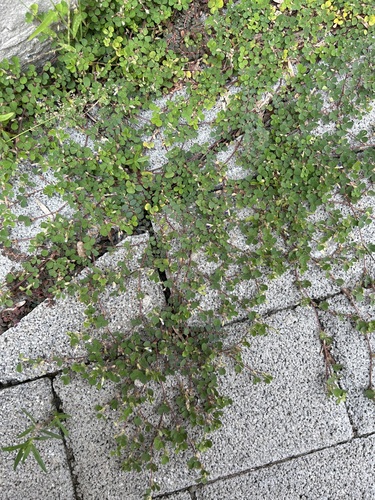
(c) ㄒㄓ, some rights reserved (CC BY-NC)
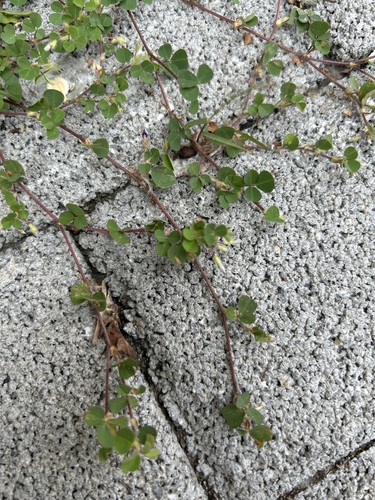
(c) ㄒㄓ, some rights reserved (CC BY-NC)
What to Eat
Edible parts: Leaves, Leaves - tea
None known.
Where to Find It
A tropical plant. It grows in drier areas. In Papua New Guinea it grows from sea level to 1110 m altitude.
Africa, American Samoa, Asia, Australia, Bangladesh, Belize, Cambodia, Central Africa, Central America, China, Colombia, Dominican Republic, East Africa, East Timor, Fiji, Gabon, Guinea, Guinée, Guinea-Bissau, Haiti, Himalayas, Honduras, India, Indochina, Indonesia, Laos, Malaysia, Marquesas, Myanmar, Nepal, New Caledonia, Northeastern India, Pacific, Pakistan, Papua New Guinea, PNG, Philippines, Rotuma, Samoa, Sao Tome and Principe, SE Asia, Sierra Leone, Solomon Islands, South America, Sri Lanka, Taiwan, Thailand, Timor-Leste, Vietnam, West Africa, West Indies, Zimbabwe,
How to Identify
A prostrate herb which forms mats. It can re-grow each year or continue growing from year to year. The plant can be 10-20 cm tall. The stems are 8-20 cm long. The stems are much branched and covered with yellow-brown hairs. The plant can form roots at the nodes of the stem. The leaves have 3 leaflets. These are oblong and 0.4-1.4 cm long by 0.4-1.2 cm wide. They can be hairy underneath. The leaf stalk is 0.4-1.1 cm long. There are normally 1-3 flowers in the axils of leaves. They are about 5 mm long. The petals are blue, purple or red. The fruit is a pod 1.2-1.8 cm long and with 2-5 segments. These are like a half circle in shape. One edge of the pod is indented.
How to Grow
Propagation: Best sown as soon as ripe. Stored seed develops a hard seedcoat and may benefit from scarification — pour a small amount of nearly boiling water over the seeds (taking care not to cook them) and soak for 12–24 hours in warm water. If seeds have not swollen by then, nick the seedcoat carefully without damaging the embryo and soak for a further 12 hours before sowing. Germination usually occurs within 1–4 months at 25°C. Prick seedlings into individual pots once large enough and grow on until ready to plant out. Cuttings of half-ripe wood with a heel can also be used. Divide larger clumps directly into permanent positions; pot up smaller clumps until well rooted. Root cuttings are also an option.
Medicinal Uses
The plant is antipyretic, antiseptic, and expectorant. A decoction is commonly used to treat diarrhoea, dysentery, and to quench thirst. It is also used as a mouthwash. The crushed plant or a poultice of the leaves is applied externally to wounds, ulcers, and skin problems. The whole plant is used medicinally to induce sweating and promote digestion.
Other Uses
Grown as a green manure and cover crop to suppress weeds and prevent soil erosion. The creeping mat of vegetation provides effective ground cover during the wet season, particularly in mown or closely cut settings such as under plantation crops and in lawns. Bird-attracting; Butterfly Food Plant; Carbon Farming.
Wikipedia
Desmodium triflorum is a compact annual or perennial reaching 0.2 m tall and wide, growing at a fast rate. Insect-pollinated flowers appear on nitrogen-fixing plants noted for wildlife attraction. Adapts to light sandy, medium loamy, and heavy clay soils with well-drained preference and mildly acidic to basic pH. Tolerates full shade through no shade and prefers moist soil. Hardy to UK zone 10.
Other Information
It is sold in local markets in China.
Notes
It is used as a green manure and cover plant. It is used for lawns. There are about 350 Desmodium species. They are mostly in the tropics. It is used in medicine.
Names & Synonyms
Janglimethi, Klet pla, Kudaliya, Kuddalia, Memang-mong-arabak, Muntamandu, Ranmethi, Rumput barek sisek puteh, San jiao hu, Sirupulladi, Trangqua ba-hoa, Ya tan hoi, Ya tan sai
References (19)
- Altschul, S.V.R., 1973, Drugs and Foods from Little-known Plants. Notes in Harvard University Herbaria. Harvard Univ. Press. Massachusetts. no. 1769
- Ambasta, S.P. (Ed.), 2000, The Useful Plants of India. CSIR India. p 168
- BARC, 2016, State of Biodiversity for Food and Agriculture in Bangladesh. Bangladesh Agricultural Research Council.
- Burkill, I.H., 1966, A Dictionary of the Economic Products of the Malay Peninsula. Ministry of Agriculture and Cooperatives, Kuala Lumpur, Malaysia. Vol 1 (A-H) p 807
- Cowie, I, 2006, A Survey of Flora and vegetation of the proposed Jaco-Tutuala-Lore National Park. Timor-Lests (East Timor) www.territorystories.nt/gov.au p 47
- Ekman Herbarium records Haiti
- Flora of Pakistan. www.eFloras.org
- Franklin, J., Keppel, G., & Whistler, W., 2008, The vegetation and flora of Lakeba, Nayau and Aiwa Islands, Central Lau Group, Fiji. Micronesica 40(1/2): 169–225, 2008
- Kumar, R. & Saikia, P., 2020, Wild edible plants of Jharkhand and their utilitarian perspectives. Indian Journal of Traditional Knowledge Vol 19 (2), April 2020, pp 237-250
- Li, D. et al, 2017, Ethnobotanical survey of herbal tea plants from the traditional markets in Chaoshan, China. Journal of Ethnopharmacology. 205 (2017) 195-206
- Paczkowska, G . & Chapman, A.R., 2000, The Western Australian Flora. A Descriptive Calatogue. Western Australian Herbarium. p 428
- Peekel, P.G., 1984, (Translation E.E.Henty), Flora of the Bismarck Archipelago for Naturalists, Division of Botany, Lae, PNG. p 237, 236
- Pham-Hoang Ho, 1999, An Illustrated Flora of Vietnam. Nha Xuat Ban Tre. p 927
- Prodr. 2:334. 1825
- Sawian, J. T., et al, 2007, Wild edible plants of Meghalaya, North-east India. Natural Product Radiance Vol. 6(5): p 415 (As trifolium but probably triflorum)
- Smith, A.C., 1985, Flora Vitiensis Nova, Lawaii, Kuai, Hawaii, Volume 3 p 193
- USDA, ARS, National Genetic Resources Program. Germplasm Resources Information Network - (GRIN). [Online Database] National Germplasm Resources Laboratory, Beltsville, Maryland. Available: www.ars-grin.gov/cgi-bin/npgs/html/econ.pl (10 April 2000)
- Verdcourt, B., 1979, Manual of New Guinea Legumes. Botany Bulletin No 11, Division of Botany, Lae, Papua New Guinea. p 409
- Wiersema, J. H. & Leon, B., 2013, World Economic Plants. A Standard Reference CRC Press. 2nd Ed. p 241




