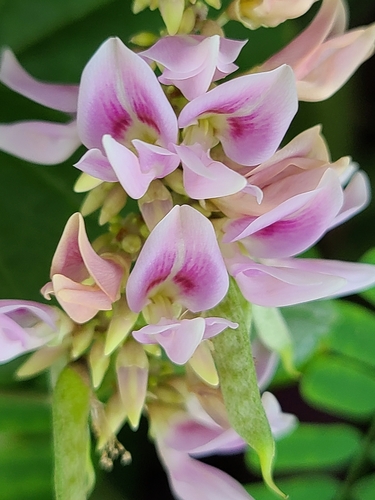
Desmodium velutinum
(Willd.) DC.
no rights reserved
no rights reserved
no rights reserved
What to Eat
Edible parts: Leaves
The leaves are eaten.
Where to Find It
A tropical plant. It tends to grow in grassland and drier areas. In Papua New Guinea is occurs from 2 m to 600 m altitude. In Zimbabwe it grows between 100-1,320 m above sea level.
Africa, Asia, Australia, Benin, Burkina Faso, Cambodia, Central Africa, China, Congo DR, East Africa, Guiana, Guinea, Guinée, Guinea-Bissau, Himalayas, India, Indochina, Indonesia, Laos, Madagascar, Malaysia, Mozambique, Myanmar, Nepal, Nigeria, Pacific, Papua New Guinea, PNG, Philippines, Sao Tome and Principe, SE Asia, Sierra Leone, South America, Sri Lanka, Thailand, Vietnam, West Africa, Zimbabwe,
How to Identify
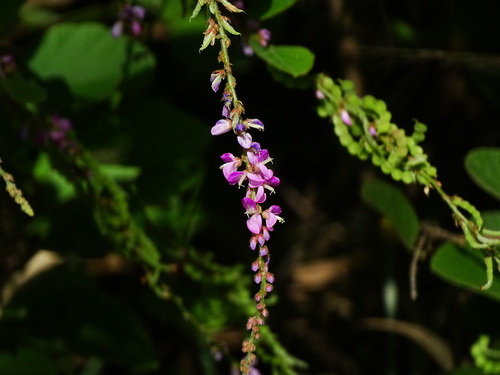
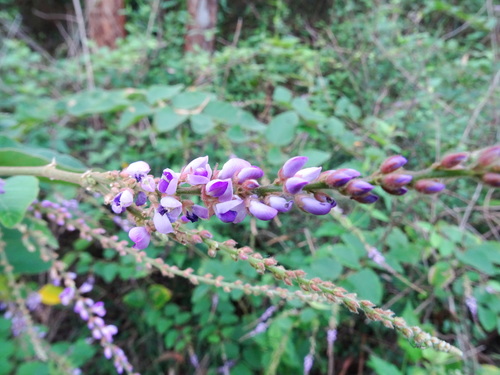
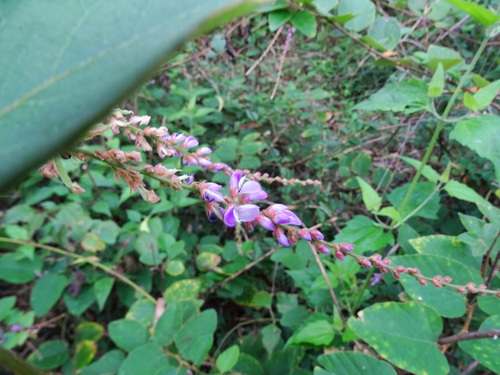
A woody shrub. It grows from 0.5-2 m high. The stems are densely covered with pale hairs when young. The leaves normally have one leaflet but occasionally 3. The leaflet is 2.5-19 cm long by 1.1-13 cm wide. It is bluntly rounded at the tip. There a hairs which are more rough on top and velvety underneath. The flowers are 5 mm long in clusters either at the ends of branches or in the axils of leaves. These flower clusters are 2-30 cm long. They are covered with hooked hairs. The flowers are mauve, red or blue. The fruit are pods 1.2-2.4 cm long and with 2-7 segments.
Notes
There are about 350 Desmodium species. They are mostly in the tropics.
Names & Synonyms
'Danka ' dafi, Damgere, Kulenhimaba, Macabreu, Nhacanama, Nangata-tchenche, Rap-rap, Tamron, Tam, Thoclep, Trangqua long
References (10)
- Bonou, A., et al, 2013, Valeur economique des Produits Forestiers Non Ligneux (PFNL) au Benin. Editions Universitaires Europeennes p 96
- East African Herbarium records, 1981,
- Latham, P., 2004, Useful Plants of Bas-Congo province. Salvation Army & DFID p 108
- MORTIMORE,
- Peekel, P.G., 1984, (Translation E.E.Henty), Flora of the Bismarck Archipelago for Naturalists, Division of Botany, Lae, PNG. p 235, 234
- Peters, C. R., O'Brien, E. M., and Drummond, R.B., 1992, Edible Wild plants of Sub-saharan Africa. Kew. p 133
- Pham-Hoang Ho, 1999, An Illustrated Flora of Vietnam. Nha Xuat Ban Tre. p 928
- Prodr. 2:328. 1825
- Verdcourt, B., 1979, Manual of New Guinea Legumes. Botany Bulletin No 11, Division of Botany, Lae, Papua New Guinea. p 411
- World Checklist of Useful Plant Species 2020. Royal Botanic Gardens, Kew