Dialium guineense
Willd.
Sierra Leone tamarind, Black velvet tree
(c) Sunday Berlioz KAKPO, some rights reserved (CC BY), uploaded by Sunday Berlioz KAKPO

(c) Marco Schmidt, some rights reserved (CC BY-NC-SA)
(c) Sylvain Piry, some rights reserved (CC BY-NC), uploaded by Sylvain Piry
What to Eat
Edible parts: Nuts, Fruit, Aril, Leaves, Seeds
The bark and leaves have medicinal properties and are used against several diseases. For example, it is a component of the Nigerian mixture Aju Mbaise, and it helps soothe coughs and toothaches.
Where to Find It
A tropical plant. It is native to tropical West Africa. It grows in lowland, evergreen humid or semi-dry forests. It grows in savannah. It can grow in arid places. It grows up to 1,200 m above sea level. It grows in areas with a rainfall between 1,000-1,600 mm per year. In Brisbane Botanical Gardens.
Africa, Asia, Australia, Benin, Burkina Faso, Cameroon, Caribbean, Central Africa, Central African Republic, CAR, Central America, Chad, Congo, Côte d'Ivoire, Cuba, Equatorial Guinea, Gambia, Ghana, Guinea, Guinée, Guinea-Bissau, Indonesia, Ivory Coast, Liberia, Mali, Niger, Nigeria, Sahel, Sao Tome and Principe, SE Asia, Senegal, Sierra Leone, St. Vincent and Grenadines, Sudan, Togo, West Africa*, West Indies,
How to Identify
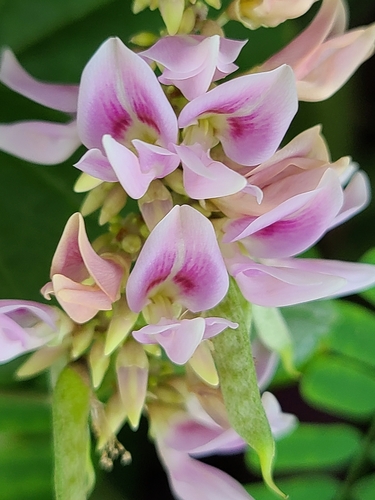
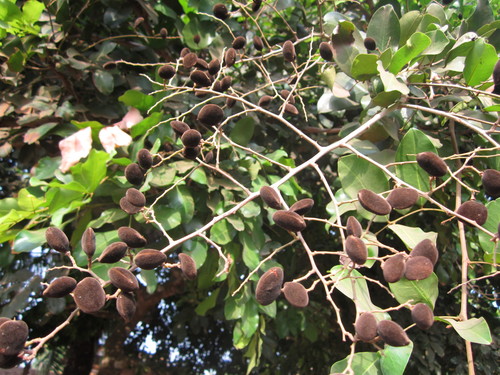
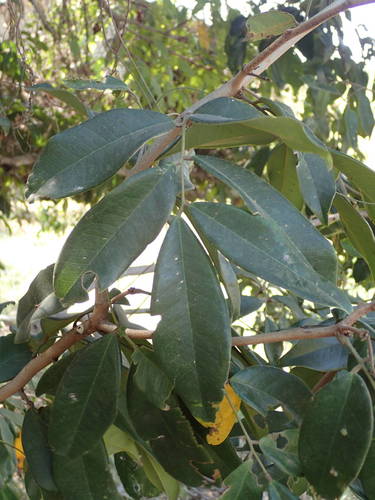
An evergreen shrub or tree. It grows up to 20 m high. The trunk has slight buttresses. The crown is large and round. The leaves have leaflets along the stalk. There are 3-7 leaflets. They are 13 cm long. The flowers are yellowish white and in branched erect panicles. They have rusty hairs. The fruit are pods 2 cm long by 2.5 cm wide. They are flat and oval. The pods are velvety black with an acid pulp. The pulp is edible. The pods are held above the leaves on wide spreading branched panicles.
Nutrition Score: 48/100
| Part | Moisture | kJ | kcal | Protein | Vit A | Vit C | Iron | Zinc |
|---|---|---|---|---|---|---|---|---|
| Fruit | 17.1 | 1229 | 294 | 3.4 | — | — | 3.7 | — |
How to Grow
Plants are grown from seed. Plants can be budded. Plants can be grown from stem cuttings.
Medicinal Uses
The bark and leaves are used as a treatment against several diseases. The root-bark is used for the treatment of coughs. Bark for treating stomatitis and also toothache.
Other Uses
The heartwood is reddish-brown with pink streaks; the sapwood is whitish with distinct ripple marks. The texture is fine, the grain even. The wood is hard, heavy, durable. Because of the high silicate content of the timber, axes and saws quickly get blunt. A handsome wood, it is used for vehicles, houses and flooring. Note: This plant is most commonly used to provide the wood for the fufu pestle. Y oung trees are cut down and destroyed for this purpose. The wood is said to make a good fuel and charcoal. The tree is used as natural fallow species for fertility restoration.
Wikipedia
Source ↗Dialium guineense, the velvet tamarind, is a tall, tropical, fruit-bearing tree in the family Fabaceae. It has small, typically grape-sized, edible fruits with brown, hard, inedible shells.
Production
Fruit mature in 90-150 days.
Other Information
It is a commonly used food in West Africa. It is sold in local markets.
Notes
There are about 40 Dialium species. They grow in tropical SE Asia. They probably all have edible fruit. Also as Caesalpinaceae.
Names & Synonyms
Aigele, Airan, Anwin, Atenguengelere, Awin, Bebui, Beludo, Black tamarind, Boie-maio, Bragamboy, Bu fotodi, Bubei, Bufaro, Bu foyitay, Bu fulan, Butara, Cito, Cossirae, Cossito, Epadum, Era, Iwin, Jaabe wadou, Kosito, M'bim, M'bimbe, M'boie, Mako, Mboy, Meco, Moque, N'boi, Nchichi, Nkwaa, Ora, Pau-veludo, Po-de-ve-ludo, Pohon asam halus, Solomsolom, Ukak, Umboi, Uparan, Veludo, Velvet tamarind, White tamarind
References (45)
- Agbahoungba, S., et al, 2016, Ecological diversity and conservation of wild edible fruit trees species in the Lama Forest Reserve in Benin. Bois et Forets des Tropiques 2016, No. 329(3)
- Ambe, G., 2001, Les fruits sauvages comestibles des savanes guinéennes de Côte-d’Ivoire : état de la connaissance par une population locale, les Malinké. Biotechnol. Agron. Soc. Environ. 5(1), 43-48
- Aniama, S. O., et al, 2016, Ethnobotanical documentaton of some plants among Igala people of Kogi State (Nigeria). The International Journal Of Engineering And Science (IJES). 5(4) pp 33-42
- Arch. Bot. (Leipzig) 1:31, t. 6. 1796
- Assogbadjo, A. E. et al, 2013, Specific Richness and Cultural Importance of Wild Edible Trees in Benin. Acta Hort. 979, ISHS 2013
- Atato, A., et al, 2010, Diversity of Edible Wild Fruit Tree Species of Togo. Global Science Books.
- Awodoyin, R.O., Olubode, O.S., Ogbu, J.U., Balogun, R.B., Nwawuisi, J.U. and Orji, K.O., 2015, Indigenous Fruit Trees of Tropical Africa: Status, Opportunity for Development and Biodiversity Management. Agricultural Sciences, 6, 31-41
- Barwick, M., 2004, Tropical and Subtropical Trees. A Worldwide Encyclopedic Guide. Thames and Hudson p 143
- Bernholt, H. et al, 2009, Plant species richness and diversity in urban and peri-urban gardens of Niamey, Niger. Agroforestry Systems 77:159-179
- Boedecker, J., et al, 2014, Dietary contribution of Wild Edible Plants to women’s diets in the buffer zone around the Lama forest, Benin – an underutilized potential. Food Sec. 6:833–849
- Bojang, L., 1999, Non-wood Forest Products in The Gambia. EC-FAO Partnership Programme.
- Burkill, H. M., 1985, The useful plants of west tropical Africa, Vol. 3. Kew.
- Catarino, L., et al, 2016, Ecological data in support of an analysis of Guinea-Bissau's medicinal flora. Data in Brief 7 (2016):1078-1097
- Chapman, J. D. & Chapman, H. M., 2001, The Forest Flora of Taraba and Andamawa States, Nigeria. WWF & University of Canterbury. p 182
- Codjia, J. T. C., et al, 2003, Diversity and local valorisation of vegetal edible products in Benin. Cahiers Agricultures 12:1-12
- Dansi, A., et al, 2008, Traditional leafy vegetables and their use in the Benin Republic. Genet Resour Crop Evol (2008) 55:1239–1256
- Djihounouck, Y., et al, 2018, Diversité Et Importance Socio-Economique Des Espèces Fruitières Sauvages Comestibles En Zone Kasa (Sud-Ouest Du Sénégal). European Scientific Journal December 2018 edition Vol.14, No.36 ISSN: 1857 – 7881
- Djihounouck, Y., et al, 2021, Ethnobotanical Uses of Non-cultivated Edible Fruit Species in the Department of Oussouye (South Senegal). Journal of Food Research; Vol. 10, No. 4 p 20
- Facciola, S., 1998, Cornucopia 2: a Source Book of Edible Plants. Kampong Publications, p 68
- FAO Corporate Document Repository. The Major Significance of 'Minor' Forest Products. Appendix 3
- Food Composition Tables for use in Africa FAO http://www.fao.org/infoods/directory No. 1052
- Gallagher, D. E., 2010, Farming beyond the escarpment: Society, Environment, and Mobility in Precolonial Southeastern Burkina Faso. PhD University of Michigan.
- Gilbert, T., et al, 2017, Diversity and local transformation of indigenous edible fruits in sahelian domain of Cameroon. Journal of Animal & Plant Sciences Vol. 26 (2): 5289-5300
- Hedrick, U.P., 1919, (Ed.), Sturtevant's edible plants of the world. p 270
- Herzog, F. et al, 1994, Composition and consumption of gathered wild fruits in the V-Baoule, Cote D'Ivoire. Ecology of Food and Nutrition Vol. 32, pp. 181-196
- ILDIS Legumes of the World http:www:ildis.org/Legume/Web
- INFOODS:FAO/INFOODS Databases
- Jardin, C., 1970, List of Foods Used In Africa, FAO Nutrition Information Document Series No 2.p 33
- Jusu, A. & Cuni-Sanchez, A., 2017, Priority indigenous fruit trees in the African rainforest zone: insights from Sierra Leone. Genet Resour Crop Evol (2017) 64:745–760
- Kiple, K.F. & Ornelas, K.C., (eds), 2000, The Cambridge World History of Food. CUP p 1875
- Macmillan, H.F. (Revised Barlow, H.S., et al) 1991, Tropical Planting and Gardening. Sixth edition. Malayan Nature Society. Kuala Lumpur. p 298
- Martin, F. W., et al, 1987, Perennial Edible Fruits of the Tropics. USDA Handbook 642 p 34
- Meregini, O. A., 2005, Some endangered plants producing edible fruits and seeds in Southeastern Nigeria. Fruits, Vol. 60 pp 211-220
- N'Diaye, M., et al.,2003, Principle fruits of gathering consumed and marketed in Guinea. Fruits, Vol. 58: 99-116
- Ndiaye, C., 2014, Nutritional potential of wild fruit Dialium guineense. Journal of Food Composition and Analysis.
- Nyadanu, D., et al, 2015, Agro-biodiversity and challenges of on-farm conservation: the case of plant genetic resources of neglected and underutilized crop species in Ghana. Genet. Resourc. Crop Evol. 62(7):
- Ogungbenle H. N. & Ebadan P., 2014, Nutritional Qualities and Amino Acid Profile of Velvet Tamarind (Dalium guineense) Pulp. British Biomedical Bulletin 2][1][2014]006-016
- Royal Botanic Gardens, Kew (1999). Survey of Economic Plants for Arid and Semi-Arid Lands (SEPASAL) database. Published on the Internet; http://www.rbgkew.org.uk/ceb/sepasal/internet [Accessed 21st April 2011]
- Savill, P. S. & Fox, J. E. D., Trees of Sierra Leone. p 86
- Segnon, A. C. & Achigan-Dako, E. G., 2014, Comparative analysis of diversity and utilization of edible plants in arid and semi-arid areas in Benin. Journal of Ethnobiology and Ethnomedicine 2014, 10:80
- Sukarya, D. G., (Ed.) 2013, 3,500 Plant Species of the Botanic Gardens of Indonesia. LIPI p 227
- Ubom, R. M., 2010, Ethnobotany and Diversity Conservatioon in the Niger Delta, Nigeria. International Journal of Botany. 6(3): 310-322
- USDA, ARS, National Genetic Resources Program. Germplasm Resources Information Network - (GRIN). [Online Database] National Germplasm Resources Laboratory, Beltsville, Maryland. Available: www.ars-grin.gov/cgi-bin/npgs/html/econ.pl (10 April 2000)
- Wiersema, J. H. & Leon, B., 2013, World Economic Plants. A Standard Reference CRC Press. 2nd Ed. p 241
- www.worldagroforestrycentre.org/treedb/