Dialium indum
L.
Honey tamarind plum

(c) mirisgala.net, some rights reserved (CC BY-SA)
(c) xsugu, some rights reserved (CC BY-NC)
(c) xsugu, some rights reserved (CC BY-NC)
What to Eat
Edible parts: Fruit
Fruit - raw. The small dull velvety-black fruits have a delicious subacid flavour somewhat reminiscent of tamarind but not so acid. Considered a delicacy in some areas. The fruits have thin brittle shells which preserve the desiccative pulp for several months. The fruit is about 25mm long.
Where to Find It
It is a tropical plant. It suits a hot, wet tropical lowland climate. It grows in evergreen forest in southern Thailand. It occurs in moist places in valleys. It grows in swamp forest. In Borneo it grows up to 1,200 m above sea level.
Asia, Central America*, India, Indochina, Indonesia, Malaysia*, Myanmar, Philippines, Sarawak, SE Asia, Singapore, Thailand*,
How to Identify
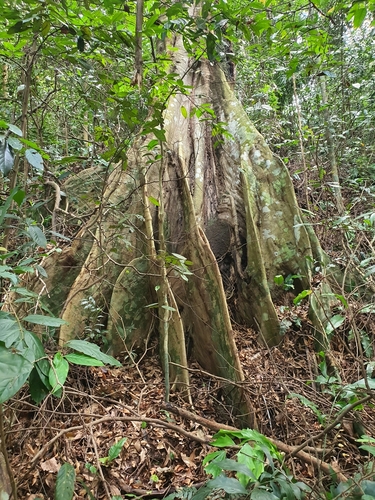
A large tree. It grows 20-25 m high. It can be 40 m tall with a trunk 80 cm across. The leaves are compound. The leaf is 10-20 cm long and hairy. The 5-9 leaflets occur alternately. They are oval and 7-10 cm long by 2.5-3 cm wide. The flower panicles can be at the ends of branches or in the axils of leaves. They are hairy and 10 cm long. The flowers do not have petals. The buds are 4-5 mm long. The fruit is a fleshy pod with black velvety rind. It is 2-3 cm long by 1.5-2 cm wide. There is one seed inside. The seed is oval and has marks along it. It is 1-1.5 cm long. The pod has edible sweet pulp.
Nutrition Score: 42/100
| Part | Moisture | kJ | kcal | Protein | Vit A | Vit C | Iron | Zinc |
|---|---|---|---|---|---|---|---|---|
| Fruit | 63.8 | — | 126 | 1.2 | — | 1.2 | 11 | 9.1 |
How to Grow
Plants are grown from seed.
Other Uses
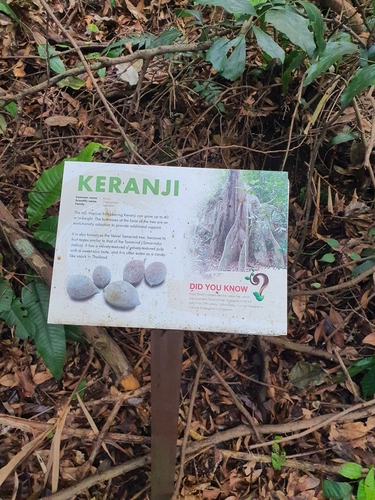
The dark yellow-brown to chestnut-brown wood is very hard and compact, very heavy, and strong. It is highly valued for house construction and making boats. It is also often used to make rulers. This tree is one of several species yielding a timber known as 'Keranji'. The general description of this wood is as follows:- The heartwood is golden-brown or red-brown; clearly demarcated from the white to yellowish sapwood. The texture is fine to moderately coarse and even; the grain interlocked or wavy. The wood is heavy; moderately durable but the sapwood is susceptible to insect and fungal attack. It can be easy to very difficult to resaw and cross-cut depending on the species; planing is easy to slightly difficult, and the planed surface is moderately smooth; nailing property is good. The wood is suitable for heavy construction, flooring, handles for striking tools and batons.
Wikipedia
Source ↗Dialium indum, the tamarind-plum or velvet tamarind, is a tall, tropical, fruit-bearing tree. It belongs to the family Fabaceae, and has small, typically grape-sized edible fruits with brown hard inedible shells. No reports of cultivation exist, information on propagation is limited.
Other Information
It is sold in markets.
Notes
There are about 40 Dialium species. They grow in tropical SE Asia. They probably all have edible fruit. Also as Caesalpinaceae.
Names & Synonyms
Asam belanda, Asam keranji, Asam kranji, Asam londo, Asam tjina, Asem china, Black tamarind, Damortis, Guayamochil, Kaa yee khao, Kamanchilis, Kamtsile, Kayi khow, Keran-keran, Keranji burong, Keranji padi, Keranji, Keranji papan, Ki ranji, Kranji, Kuran, Kuranji, Kway-tanyeng, Makham-khong, Makham-thet, Manila tamarind, Merbau kera, Pohon asam keranji madu, Pranji, Sepau, Samak penanggok, Taung-kaye
References (27)
- Argent, G et al, nd, Manual of the Larger and More important non Dipterocarp Trees of Central Kalimantan Indonesia. Volume 2 Forest Research Institute, Samarinda, Indonesia. p 355
- Barwick, M., 2004, Tropical and Subtropical Trees. A Worldwide Encyclopedic Guide. Thames and Hudson p 143
- Burkill, I.H., 1966, A Dictionary of the Economic Products of the Malay Peninsula. Ministry of Agriculture and Cooperatives, Kuala Lumpur, Malaysia. Vol 1 (A-H) p 812 (Also as Dialium laurinum)
- Chai, P. P. K. (Ed), et al, 2000, A checklist of Flora, Fauna, Food and Medicinal Plants. Lanjak Entimau Wildlife Sanctuary, Sarawak. Forestry Malaysia & ITTO. p 168 (Also as Dialium laurinum)
- Facciola, S., 1998, Cornucopia 2: a Source Book of Edible Plants. Kampong Publications, p 68 (As Dialium indum)
- GRIN
- Hedrick, U.P., 1919, (Ed.), Sturtevant's edible plants of the world. p 270 (As Dialium indum)
- J. D. Hooker, Fl. Brit. India 2:269. 1878 (As Dialium laurinum)
- http://sarawakfacts.sarawak.gov.my (As Dialium laurinum)
- Jacquat, C., 1990, Plants from the Markets of Thailand. D.K. Book House p 46
- Kebler, P. J. A., & Kidiyasa, 1994, Trees of the Balikpapan-Samarinda area of East Kalimantan, Indonesia. The Tropenbos Foundation, Wageningen, The Netherlands. p 71
- Kiple, K.F. & Ornelas, K.C., (eds), 2000, The Cambridge World History of Food. CUP p 1875
- Macmillan, H.F. (Revised Barlow, H.S., et al) 1991, Tropical Planting and Gardening. Sixth edition. Malayan Nature Society. Kuala Lumpur. p 298
- Martin, F. W., et al, 1987, Perennial Edible Fruits of the Tropics. USDA Handbook 642 p 34
- Milow, P., et al, 2013, Malaysian species of plants with edible fruits or seeds and their evaluation. International Journal of Fruit Science. 14:1, 1-27
- Priyadi, H., et al, Five hundred plant species in Gunung Halimun Salak National Park, West Java. A checklist including Sundanese names, distribution and use. CIFOR, FFPRI, SLU p 9
- PROSEA 2 p 375
- Shaffiq, A. M., A., et al, 2013, Marketable wild fruits of Sarawak, Borneo: Their mode of consumption, uses and sugar profiles. Indian Journal of Traditional Knowledge. Vol 12(2): 195-201
- Siong, K. H., 2003, Indigenous Fruits of Sarawak. ITTO & Sarawak Forest Department. p 72
- Slik, F., www.asianplant.net
- Soerianegara, I. & Lemmens, R. H. M. L., (Eds.) 1993, Timber trees: Major commercial timbers. Plant Resources of South-East Asia. Wageningen. No. 5(1). p 164
- Sukarya, D. G., (Ed.) 2013, 3,500 Plant Species of the Botanic Gardens of Indonesia. LIPI p 227
- Tankard, G., 1990, Tropical fruit. An Australian Guide to Growing and using exotic fruit. Viking p 126
- USDA, ARS, National Genetic Resources Program. Germplasm Resources Information Network - (GRIN). [Online Database] National Germplasm Resources Laboratory, Beltsville, Maryland. Available: www.ars-grin.gov/cgi-bin/npgs/html/econ.pl (10 April 2000)
- Wiersema, J. H. & Leon, B., 2013, World Economic Plants. A Standard Reference CRC Press. 2nd Ed. p 242
- World Checklist of Useful Plant Species 2020. Royal Botanic Gardens, Kew
- Zawiah, N. & Othaman, H., 2012, 99 Spesies Buah di FRIM. Institut Penyelidikan Perhutanan Malaysia. p 92




